
Entry
Reader's guide
Entries A-Z
Subject index
Stonyfield Farm
Stonyfield Farm, the world's largest organic yogurt producer, is widely recognized for being a sustainable, mission-driven business model. The company has received national awards for energy efficiency, waste minimization, recycling, corporate environmental leadership, and efforts to address climate change. Stonyfield Farm aims to be ecologically conscious and profitable. The president and “CE-Yo” of Stonyfield Farm, Gary Hirshberg, has described himself as an “ecoentrepreneur” who wanted to change the American diet and save the Earth at the same time. Hirshberg advocates corporate environmental responsibility, maintaining that Earth-friendly practices are also economically sound.
Hirshberg and his partner, Samuel Kaymen, embarked on their venture at a minuscule New Hampshire dairy farm affiliated with a rural homesteading school. Using Kaymen's recipe, they began making quarts of plain organic yogurt from seven cows in 1983. Failed experiments and mounting debt marked the cottage industry's early years. Hirshberg recalled that, at the time, many people dismissed organic food as a “fringy fad.” The key challenge to winning acceptance for organic products was taste, and Hirshberg knew that their yogurt would have to be delicious to gain customers. As the business expanded, it began purchasing Jersey milk from local farmers. New filling and capping machines allowed Stonyfield to start offering individual-serving containers in strawberry, cappuccino, peach, and various other flavors.
Stonyfield Farm eschewed producers who used antibiotics, artificial growth hormones, and toxic pesticides. Hirshberg chose to use organic sugar instead of high-fructose corn syrup, agar instead of modified food starch, and organic milk solids instead of gelatin. Stonyfield's slogan became “You just can't fake this stuff.” Despite paying for expensive organic ingredients and absorbing higher production costs, the business earned better net profit margins than its competitors. Hirshberg found that investing in pure, top-quality, organic ingredients was worthwhile because his loyal customers gladly shelled out more for superior yogurt. At the same time, Hirshberg knew that organic food could not be priced at elitist levels if he wanted to “save the world, one yogurt at a time.” Stonyfield first sold only to local health food stores. While committed to both the food and politics of the organic movement, Hirshberg also believed that organics would have to accommodate supermarkets and pursue commercial opportunities in order to gain footing. After he commenced handing out free samples at the local Stop & Shop, the chain agreed to carry Stonyfield yogurt at its several hundred supermarkets across New England. In his eagerness to reach mainstream consumers, Hirshberg was integral in turning the organic movement into a potent industry.
Stonyfield Farm, in Londonderry, New Hampshire, makes organic dairy products such as yogurt and milk
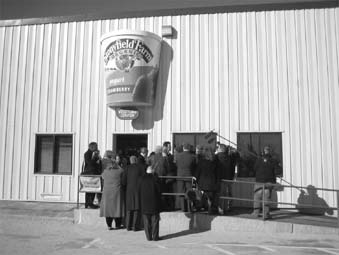
For Stonyfield's first eight years, Hirshberg raised money from individual investors and never broke even, despite growing demand for the yogurt. In 1988, the business built a large, modern plant in Londonderry, New Hampshire. Revenues reached $10.2 million in 1992, which was the first profitable year. Stonyfield Farm eventually flourished as the third-largest yogurt operation in the United States, with $330 million in annual sales. By 2003, Hirshberg had sold 80 percent of Stonyfield Farm to the French food-products conglomerate Groupe Danone. Stonyfield remained independent, and Hirshberg retained voting control of the board of directors. Despite criticism that he had “sold out,” he asserted that the deal was a “win-win” situation for organic producers and consumers. Buyouts and acquisitions of small, pioneering companies by giant corporations have occurred regularly in the organic industry. While some high-profile undertakings that capitalized on organic food's boom have been the target of harsh critiques, Stonyfield Farm has worked at convincing the public that “Big Organics” can still be sustainable and socially responsible.
...
- Business Organizations, Movements, and Planning
- Balanced Scorecard
- Best Available Control Technology
- Best Management Practices
- Ceres Principles
- Certification
- Closed-Loop Supply Chain
- Compliance
- Core Competencies
- Corporate Social Responsibility
- Cost-Benefit Analysis
- Demand-Side Management
- Discounting
- Dow Jones Sustainability Index
- Ecoeffectiveness
- Ecoefficiency
- Ecoindustrial Park
- Ecological Economics
- Economic Value Added
- Emissions Trading
- Energy Performance Contracting
- Energy Service Company
- Environmental Accounting
- Environmental Assessment
- Environmental Audit
- Environmental Economics
- Environmental Impact Statement
- Environmental Indicators
- Environmental Management System
- Environmental Marketing
- Environmental Risk Assessment
- Environmental Services
- Environmentally Preferable Purchasing
- Equator Principles
- Extended Producer Responsibility
- Extended Product Responsibility
- Externalities
- Factor Four and Factor Ten
- Fair Trade
- Genuine Progress Indicator
- Global Reporting Initiative
- Global Sullivan Principles
- Industrial Ecology
- Industrial Metabolism
- Industrial Nutrients
- Informational Regulation
- Integrated Bottom Line
- International Organization for Standardization
- ISO 14000
- ISO 19011
- Leadership in Green Business
- Life Cycle Analysis
- Material Input per Service Unit (MIPS)
- Maximum Achievable Control Technology
- National Priorities List
- Natural Capital
- New Source Review
- Quantitative Risk Assessment
- Recycling, Business of
- Reverse Logistics
- Service Design
- Social Return on Investment
- Steady State Economy
- Stewardship
- Supply Chain Management
- Value Chain
- Business Profiles
- Green Business Challenges
- Green Business Solutions
- Abatement
- Appropriate Technology
- Bio-Based Material
- Biofuels
- Biological Resource Management
- Biomimicry
- Bioremediation
- Biotechnology
- Blended Value
- Brownfield Redevelopment
- Carbon Neutral
- Carbon Sequestration
- Carbon Trading
- Cause-Related Marketing
- Clean Fuels
- Clean Production
- Clean Technology
- Cogeneration
- Conservation
- Coopetition
- Cradle-to-Cradle
- Deposit Systems
- Distributed Energy
- Ecolabels
- Ecosystem Services
- Ecotourism
- Environmental Justice
- Green Building
- Green Chemistry
- Green Design
- Green Retailing
- Green Technology
- Green-Collar Jobs
- Gross National Happiness
- Integrated Pest Management
- Organic
- Pollution Offsets
- Pollution Prevention
- Precautionary Principle
- Remanufacturing
- Resource Management
- Responsible Sourcing
- Restoration
- Right to Know
- Seventh Generation
- Six Sigma
- Smart Energy
- Social Entrepreneurship
- Social Marketing
- Socially Responsible Investing
- Superfund
- Sustainability
- Sustainable Design
- Sustainable Development
- Systems Thinking
- Take Back
- Upcycle
- Voluntary Standards
- Waste Reduction
- Loading...
Get a 30 day FREE TRIAL
-
 Watch videos from a variety of sources bringing classroom topics to life
 -
Read modern, diverse business cases
-
Explore hundreds of books and reference titles

Read next

More like this
Sage Recommends
We found other relevant content for you on other Sage platforms.
Have you created a personal profile? Login or create a profile so that you can save clips, playlists and searches