
Entry
Reader's guide
Entries A-Z
Subject index
Restoration
Restoration involves actively working to bring something back to a previous condition, often because it has suffered injury or its integrity has degraded over time. Many things—artwork, architectural structures, or political institutions—can be the subject of restoration efforts.
Ecosystem Restoration
Ecosystem restoration entails returning an ecosystem to its previous healthy state. Humankind has historically disrupted ecosystems by logging, clearing land for agricultural purposes, and altering water levels and flows by draining swamps and constructing dams and dikes. There has been a recent increased appreciation for the “free services” that ecosystems provide, with a resulting increase in laws facilitating restoration. An early realization involved lost diversity through native prairie destruction. The first major prairie restoration was in 1934 at University of Wisconsin–Madison's arboretum.
Site of a Staten Island Salt Marsh Restoration project. In 1990, nearly 600,000 gallons of fuel oil discharged from a ruptured Exxon pipeline on the bottom of the Arthur Kill waterway, killing much of the marsh vegetation and a variety of intertidal organisms
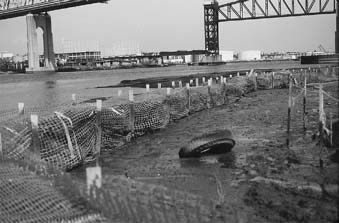
Federal aid to states was provided as early as 1937 by the Federal Aid in Wildlife Restoration Act. However, it and other laws were aimed at restoring wildlife, sometimes actually leading to habitat modification rather than ecosystem restoration. The Estuary Protection Act of 1968 provided means for restoration, but also required balancing restoration with development for economic purposes—an underlying theme of several other acts. The policy goal of “no overall net loss” of wetlands, established by the Water Resources Development Act of 1990, served to dramatically expand implementation of restoration activities mitigating the destruction of wetlands through development and highway construction.
The Coastal Wetlands Planning Protection and Restoration Act from the same year provided for federal grant funding. Finally, The Estuaries and Clean Water Act of 2000 established an Estuary Habitat and Restoration Council, charged with producing a national restoration strategy.
Not all restoration has been based on good scientific knowledge, and outcomes are difficult to predict. Consequently, there have been increasing calls for ecologically grounded ecosystem restoration. Proponents suggest that successful ecosystem restoration should entail clearly stated goals and a design stemming from ecological principles. Restorationists should gather and utilize quantitative data about the way the ecosystem functions and its reaction to change, and an analysis of results must guide future actions.
An ecosystem might need to be restored because of radical alteration due to either intentional or unintentional introduction of nonnative species. For example, saltcedar—an invasive deciduous small tree—was introduced to the United States in the 1800s as an ornamental species. As early as 1850, it rapidly spread through riparian habitat and replaced native plant life. The plant has a long natural life (50–100 years), absorbs an excess of water (a larger tree is capable of absorbing 200 gallons of water per day), can withstand cutting, burning, cold temperatures, droughts, and floods, and changes the salinity of the surrounding soil by excreting salt from its leaves. Thus, restoration efforts could aim for the eradication of the saltcedar. However, questions are raised when considering species eradication from an ecosystem: is it right to eliminate a species once it has settled into an ecosystem? What constitutes an invasive species and after how long, if ever, would it be considered native? In relation to wildlife, these ethical questions are often more poignant. Another question, more difficult to answer, is what a specific ecosystem should be like. In a warming world, should attempts be made to restore an area to its historical condition? Or should the character of the ecosystem be changed to one that is sustainable in a warmer climate regime? How and to what state we restore ecosystems is largely a reflection of our communal values.
...
- Business Organizations, Movements, and Planning
- Balanced Scorecard
- Best Available Control Technology
- Best Management Practices
- Ceres Principles
- Certification
- Closed-Loop Supply Chain
- Compliance
- Core Competencies
- Corporate Social Responsibility
- Cost-Benefit Analysis
- Demand-Side Management
- Discounting
- Dow Jones Sustainability Index
- Ecoeffectiveness
- Ecoefficiency
- Ecoindustrial Park
- Ecological Economics
- Economic Value Added
- Emissions Trading
- Energy Performance Contracting
- Energy Service Company
- Environmental Accounting
- Environmental Assessment
- Environmental Audit
- Environmental Economics
- Environmental Impact Statement
- Environmental Indicators
- Environmental Management System
- Environmental Marketing
- Environmental Risk Assessment
- Environmental Services
- Environmentally Preferable Purchasing
- Equator Principles
- Extended Producer Responsibility
- Extended Product Responsibility
- Externalities
- Factor Four and Factor Ten
- Fair Trade
- Genuine Progress Indicator
- Global Reporting Initiative
- Global Sullivan Principles
- Industrial Ecology
- Industrial Metabolism
- Industrial Nutrients
- Informational Regulation
- Integrated Bottom Line
- International Organization for Standardization
- ISO 14000
- ISO 19011
- Leadership in Green Business
- Life Cycle Analysis
- Material Input per Service Unit (MIPS)
- Maximum Achievable Control Technology
- National Priorities List
- Natural Capital
- New Source Review
- Quantitative Risk Assessment
- Recycling, Business of
- Reverse Logistics
- Service Design
- Social Return on Investment
- Steady State Economy
- Stewardship
- Supply Chain Management
- Value Chain
- Business Profiles
- Green Business Challenges
- Green Business Solutions
- Abatement
- Appropriate Technology
- Bio-Based Material
- Biofuels
- Biological Resource Management
- Biomimicry
- Bioremediation
- Biotechnology
- Blended Value
- Brownfield Redevelopment
- Carbon Neutral
- Carbon Sequestration
- Carbon Trading
- Cause-Related Marketing
- Clean Fuels
- Clean Production
- Clean Technology
- Cogeneration
- Conservation
- Coopetition
- Cradle-to-Cradle
- Deposit Systems
- Distributed Energy
- Ecolabels
- Ecosystem Services
- Ecotourism
- Environmental Justice
- Green Building
- Green Chemistry
- Green Design
- Green Retailing
- Green Technology
- Green-Collar Jobs
- Gross National Happiness
- Integrated Pest Management
- Organic
- Pollution Offsets
- Pollution Prevention
- Precautionary Principle
- Remanufacturing
- Resource Management
- Responsible Sourcing
- Restoration
- Right to Know
- Seventh Generation
- Six Sigma
- Smart Energy
- Social Entrepreneurship
- Social Marketing
- Socially Responsible Investing
- Superfund
- Sustainability
- Sustainable Design
- Sustainable Development
- Systems Thinking
- Take Back
- Upcycle
- Voluntary Standards
- Waste Reduction
- Loading...
Get a 30 day FREE TRIAL
-
 Watch videos from a variety of sources bringing classroom topics to life
 -
Read modern, diverse business cases
-
Explore hundreds of books and reference titles

Read next

More like this
Sage Recommends
We found other relevant content for you on other Sage platforms.
Have you created a personal profile? Login or create a profile so that you can save clips, playlists and searches