
Entry
Reader's guide
Entries A-Z
Subject index
Remanufacturing
Remanufacturing is a process whereby used items are disassembled, and their components are inspected, cleaned, and then used in the manufacture of new products. A product is considered remanufactured if its primary components come from a used product, although it should not be inferior to, or less durable than, comparable new products that solely use virgin materials, which are materials that haven't been used, consumed, or subject to processing before. Remanufacturing can reduce both production costs and demand for increasingly scarce virgin natural resources, although other options such as reuse or recycling may be preferable depending on product type and the value of the materials. Remanufacturing differs from recycling in that recycling takes a material (newspapers, plastic bottles, cans) that often feeds into the production of different goods, unrelated to the original raw material.
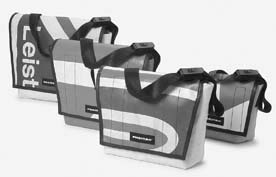
The Freitag company makes bags from old truck tarpaulins, used seat belts, and cycle inner tubes, which could be considered an example of remanufacturing
In their report “Remanufacturing and Product Design: Designing for the 7th Generation,” Casper Gray and Martin Charter have tried to clarify the meaning of remanufacturing and note that it can be easily confused with similar terms beginning with “re,” such as repair, refurbishment, and reconditioning. The only way to distinguish its correct definition is to consider the process adopted. There are different types of remanufacturing, and they offer the following synonyms that also represent remanufacturing across different industries: rebuilt (remanufacturing in motor vehicles and systems), recharged (remanufactured imaging products, such as toner cartridges), retread or remolded (for the tire industry), rewound (remanufacturing certain electrical equipment), overhaul (most notably in the aerospace industry).
The feasibility of remanufacturing is often dependent upon design for environment, or more specifically, design for remanufacture (DFR); so that the original product design ensures that core remanufacturable components are easily accessible for cleaning and reinserting into new products. DFR is, at the time of writing, yet to be adopted widely. In fact, due to concerns over intellectual property, some manufacturers may design their products in such a way that third-party remanufacturers cannot recover core components at all. Alternatively, products may also be designed with obsolescence or disposal in mind, so as to increase revenue for the manufacturer as consumers have to buy new products at the end of a product's useful life.
Most manufactured products could be remanufactured, although the decreasing costs of brand-new products coupled with low consumer demand for remanufactured goods will impact the economic incentives for investing widely in business-to-consumer (B2C) remanufacturing capacity. Research has revealed some unfavorable consumer attitudes toward remanufactured goods when they are perceived to be of lesser quality, perhaps inferred by a cheaper price. For example, an often-cited example is retreaded tires and the belief that that these are inferior in performance and safety to new tires, even though nowadays there are equivalent safety assurance standards for both to pass. There is a marketing challenge here in overcoming and redressing these consumer preconceptions.
A growing number of original equipment manufacturers (OEMs) are engaging in remanufacturing, in particular in a business-to-business (B2B) environment, in light of heightened awareness of sustainable development, with Xerox seen to be one of the pioneers in this field. Xerox has adapted its Product Service System (PSS) so that its products can only be rented instead of purchased, meaning that every three years, it can recover and remanufacture the core components. Such activities divert waste that would otherwise be sent to landfill, and Xerox reaps both economic and environmental benefits.
...
- Business Organizations, Movements, and Planning
- Balanced Scorecard
- Best Available Control Technology
- Best Management Practices
- Ceres Principles
- Certification
- Closed-Loop Supply Chain
- Compliance
- Core Competencies
- Corporate Social Responsibility
- Cost-Benefit Analysis
- Demand-Side Management
- Discounting
- Dow Jones Sustainability Index
- Ecoeffectiveness
- Ecoefficiency
- Ecoindustrial Park
- Ecological Economics
- Economic Value Added
- Emissions Trading
- Energy Performance Contracting
- Energy Service Company
- Environmental Accounting
- Environmental Assessment
- Environmental Audit
- Environmental Economics
- Environmental Impact Statement
- Environmental Indicators
- Environmental Management System
- Environmental Marketing
- Environmental Risk Assessment
- Environmental Services
- Environmentally Preferable Purchasing
- Equator Principles
- Extended Producer Responsibility
- Extended Product Responsibility
- Externalities
- Factor Four and Factor Ten
- Fair Trade
- Genuine Progress Indicator
- Global Reporting Initiative
- Global Sullivan Principles
- Industrial Ecology
- Industrial Metabolism
- Industrial Nutrients
- Informational Regulation
- Integrated Bottom Line
- International Organization for Standardization
- ISO 14000
- ISO 19011
- Leadership in Green Business
- Life Cycle Analysis
- Material Input per Service Unit (MIPS)
- Maximum Achievable Control Technology
- National Priorities List
- Natural Capital
- New Source Review
- Quantitative Risk Assessment
- Recycling, Business of
- Reverse Logistics
- Service Design
- Social Return on Investment
- Steady State Economy
- Stewardship
- Supply Chain Management
- Value Chain
- Business Profiles
- Green Business Challenges
- Green Business Solutions
- Abatement
- Appropriate Technology
- Bio-Based Material
- Biofuels
- Biological Resource Management
- Biomimicry
- Bioremediation
- Biotechnology
- Blended Value
- Brownfield Redevelopment
- Carbon Neutral
- Carbon Sequestration
- Carbon Trading
- Cause-Related Marketing
- Clean Fuels
- Clean Production
- Clean Technology
- Cogeneration
- Conservation
- Coopetition
- Cradle-to-Cradle
- Deposit Systems
- Distributed Energy
- Ecolabels
- Ecosystem Services
- Ecotourism
- Environmental Justice
- Green Building
- Green Chemistry
- Green Design
- Green Retailing
- Green Technology
- Green-Collar Jobs
- Gross National Happiness
- Integrated Pest Management
- Organic
- Pollution Offsets
- Pollution Prevention
- Precautionary Principle
- Remanufacturing
- Resource Management
- Responsible Sourcing
- Restoration
- Right to Know
- Seventh Generation
- Six Sigma
- Smart Energy
- Social Entrepreneurship
- Social Marketing
- Socially Responsible Investing
- Superfund
- Sustainability
- Sustainable Design
- Sustainable Development
- Systems Thinking
- Take Back
- Upcycle
- Voluntary Standards
- Waste Reduction
- Loading...
Get a 30 day FREE TRIAL
-
 Watch videos from a variety of sources bringing classroom topics to life
 -
Read modern, diverse business cases
-
Explore hundreds of books and reference titles

Read next

More like this
Sage Recommends
We found other relevant content for you on other Sage platforms.
Have you created a personal profile? Login or create a profile so that you can save clips, playlists and searches