
Entry
Reader's guide
Entries A-Z
Subject index
Recycling, Business of
Numerous products support our professional and private lifestyles. Absent intervention, they will all end up in the garbage at the end of their useful lives. Compounding the situation is society's growing consumptive appetite both for more products, and for different varieties of the same product. A global population that has quadrupled in the last 50 years, possessing increasing material needs and desires, further increases the pressures that will be exerted on Earth's natural resources. Recycling of materials is one piece—along with reduction (of consumption) and reuse (including refurbishment) of products—of the overall approach needed to effectively utilize these resources in a sustainable manner. Because of the greater energy requirements of recycling, it is somewhat less desirable than either reduction or reuse.
Recycling can be defined as the entire chain of activities involved in the collection and utilization of all or part of old products in the manufacture of new products. Therefore, the business of recycling involves all concerns along the recycling value chain, including product design, recycling processes, reliability of secondary raw material supplies, markets for recycled goods, regulatory mandates/legislation, and the overall economics of recycling.
The recycling of materials has long been practiced by individuals out of economic necessity, since the cost of using secondary raw material (scrap) was typically less than the cost of using virgin material. As economies industrialized and manufacturers pursued technological innovation and ever-increasing economies of scale, this relationship frequently reversed. As collection and sale of scrap materials became less profitable, fewer scrap collectors existed. The economic incentive for individuals to recycle therefore declined, rendering it more convenient to simply dispose of end-of-life products, further reducing the viability of the recycling business. Although recycling had been part of the framework of daily life, the habit thus diminished. Recycling received a significant boost during World War II for patriotic reasons—as a means of providing materials for the war effort—but again declined in the postwar period. Interest revived with the growth of the environmental movement in the 1970s. Concerns about declining availability of landfill space, water and air pollution from landfills and incinerators, and resource depletion led to the initiation of municipal recycling efforts. These in turn increased the supply of postconsumer materials, necessitating the need for more use of such materials in products, thereby “closing the loop.” Increased material complexity of products has complicated recycling and affected its economics, however.
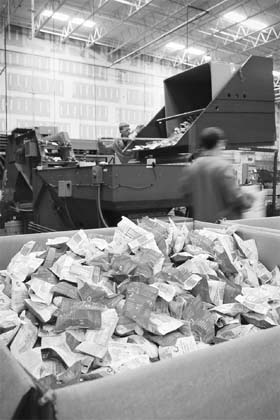
Approximately 120 million kilograms of Hewlett-Packard products are recycled annually. Here can be seen a bin full of green envelopes that contain used printer cartridges
Customer Requirements
In any business, satisfying the requirements of the customer is paramount. The size, appearance, and functionality of products made from recycled materials need to be as competitive as their traditional counterparts. A product, green or otherwise, must be designed to meet the preferences of consumers if it is to perform well in the marketplace.
When the customer is a manufacturing company, it is imperative that the supplier employs rigorous quality assurance practices to ensure homogeneously high quality of its secondary raw material supply. When these secondary raw materials are obtained from end-of-life products originating in areas with diverse environmental regulations, this poses greater challenges.
...
- Business Organizations, Movements, and Planning
- Balanced Scorecard
- Best Available Control Technology
- Best Management Practices
- Ceres Principles
- Certification
- Closed-Loop Supply Chain
- Compliance
- Core Competencies
- Corporate Social Responsibility
- Cost-Benefit Analysis
- Demand-Side Management
- Discounting
- Dow Jones Sustainability Index
- Ecoeffectiveness
- Ecoefficiency
- Ecoindustrial Park
- Ecological Economics
- Economic Value Added
- Emissions Trading
- Energy Performance Contracting
- Energy Service Company
- Environmental Accounting
- Environmental Assessment
- Environmental Audit
- Environmental Economics
- Environmental Impact Statement
- Environmental Indicators
- Environmental Management System
- Environmental Marketing
- Environmental Risk Assessment
- Environmental Services
- Environmentally Preferable Purchasing
- Equator Principles
- Extended Producer Responsibility
- Extended Product Responsibility
- Externalities
- Factor Four and Factor Ten
- Fair Trade
- Genuine Progress Indicator
- Global Reporting Initiative
- Global Sullivan Principles
- Industrial Ecology
- Industrial Metabolism
- Industrial Nutrients
- Informational Regulation
- Integrated Bottom Line
- International Organization for Standardization
- ISO 14000
- ISO 19011
- Leadership in Green Business
- Life Cycle Analysis
- Material Input per Service Unit (MIPS)
- Maximum Achievable Control Technology
- National Priorities List
- Natural Capital
- New Source Review
- Quantitative Risk Assessment
- Recycling, Business of
- Reverse Logistics
- Service Design
- Social Return on Investment
- Steady State Economy
- Stewardship
- Supply Chain Management
- Value Chain
- Business Profiles
- Green Business Challenges
- Green Business Solutions
- Abatement
- Appropriate Technology
- Bio-Based Material
- Biofuels
- Biological Resource Management
- Biomimicry
- Bioremediation
- Biotechnology
- Blended Value
- Brownfield Redevelopment
- Carbon Neutral
- Carbon Sequestration
- Carbon Trading
- Cause-Related Marketing
- Clean Fuels
- Clean Production
- Clean Technology
- Cogeneration
- Conservation
- Coopetition
- Cradle-to-Cradle
- Deposit Systems
- Distributed Energy
- Ecolabels
- Ecosystem Services
- Ecotourism
- Environmental Justice
- Green Building
- Green Chemistry
- Green Design
- Green Retailing
- Green Technology
- Green-Collar Jobs
- Gross National Happiness
- Integrated Pest Management
- Organic
- Pollution Offsets
- Pollution Prevention
- Precautionary Principle
- Remanufacturing
- Resource Management
- Responsible Sourcing
- Restoration
- Right to Know
- Seventh Generation
- Six Sigma
- Smart Energy
- Social Entrepreneurship
- Social Marketing
- Socially Responsible Investing
- Superfund
- Sustainability
- Sustainable Design
- Sustainable Development
- Systems Thinking
- Take Back
- Upcycle
- Voluntary Standards
- Waste Reduction
- Loading...
Get a 30 day FREE TRIAL
-
 Watch videos from a variety of sources bringing classroom topics to life
 -
Read modern, diverse business cases
-
Explore hundreds of books and reference titles

Read next

More like this
Sage Recommends
We found other relevant content for you on other Sage platforms.
Have you created a personal profile? Login or create a profile so that you can save clips, playlists and searches