
Entry
Reader's guide
Entries A-Z
Subject index
Greenwashing
Greenwashing is a term used to describe businesses, organizations, and individuals who exaggerate or make false claims about the environmental benefits of their products and services. In short, greenwashing is an unjustified claim of environmental virtue. While such accusations are now widespread, qualifying to what degree communications have intentionally distorted environmental harm or benefit can be difficult, especially when judgments are often subject to interpretation. This can include accusations of greenwashing against those who have taken action to improve environmental performance, but are perceived to have not done enough. These difficulties may have delayed legislation on greenwashing issues, although both public and private governance is now emerging.
There are several different forms of greenwashing, including providing false information about environmental attributes, exaggerated claims of sustainability, taking credit for environmental improvements mandated by outside influences, and deceptive claims based on inappropriate comparisons to outdated technologies.
According to some, greenwashing has been confined to instances where environmental claims have not actually been false, but have failed to present the entire environmental picture. However, recent research has uncovered a category of greenwashing where claims of environmental credibility were adjudged to be false and deceitful. These examples vary from claims that certain products have certification from recognized independent bodies when they did not (for example, shampoos that claimed to be “certified organic”), to those where marketing overrepresented the environmental advantages of a given characteristic. A number of these cases have been highlighted in the car industry in the United Kingdom (UK). Suzuki GB released direct mail marketing stating that cars have “great green credentials” and are “guilt-free,” featuring graphics of butterflies, blue skies, flowers, and a rainbow. The UK government's Advertising Standards Agency felt that although the advertising implied that the car caused little or no harm to the environment, this fact was not substantively justifiable. In a similar case, the Norwegian government has banned companies from claiming that any vehicle is “green,” “clean,” or “environmentally friendly.”
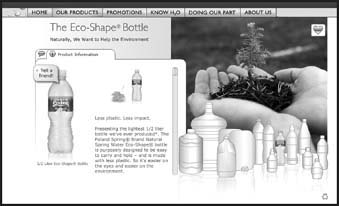
Some would argue that this Poland Spring company web page is an example of greenwashing. The company touts an improved “ecoshaped” bottle with a smaller paper label to contribute less volume to the waste stream. Nevertheless, an estimated 80 percent of all bottled-water containers still end up in landfills
The growing realization that being “green” can be profitable for a business leads to a second form of greenwashing: exaggerating a product or service's sustain-ability or green features. Many companies have started to identify, after the fact, features of current products as being environmentally sound while no fundamental or physical change has been made. A sub-category of this type of greenwashing occurs when a company touts that changes to a product or process were environmentally motivated, when they were in fact motivated by financial gain. For example, in what many believe to be the first use of the term greenwashing, Jay Westerveld noted that hoteliers’ requests for customers to reuse their towels and linens were not motivated out of concern for the environment as they claimed, but out of the desire to cut costs and increase profits. Indeed, this type of activity has been noticeably widespread, as companies have rolled out new “green” programs for energy and material inputs, packaging, and logistics that in fact save them money.
...
- Business Organizations, Movements, and Planning
- Balanced Scorecard
- Best Available Control Technology
- Best Management Practices
- Ceres Principles
- Certification
- Closed-Loop Supply Chain
- Compliance
- Core Competencies
- Corporate Social Responsibility
- Cost-Benefit Analysis
- Demand-Side Management
- Discounting
- Dow Jones Sustainability Index
- Ecoeffectiveness
- Ecoefficiency
- Ecoindustrial Park
- Ecological Economics
- Economic Value Added
- Emissions Trading
- Energy Performance Contracting
- Energy Service Company
- Environmental Accounting
- Environmental Assessment
- Environmental Audit
- Environmental Economics
- Environmental Impact Statement
- Environmental Indicators
- Environmental Management System
- Environmental Marketing
- Environmental Risk Assessment
- Environmental Services
- Environmentally Preferable Purchasing
- Equator Principles
- Extended Producer Responsibility
- Extended Product Responsibility
- Externalities
- Factor Four and Factor Ten
- Fair Trade
- Genuine Progress Indicator
- Global Reporting Initiative
- Global Sullivan Principles
- Industrial Ecology
- Industrial Metabolism
- Industrial Nutrients
- Informational Regulation
- Integrated Bottom Line
- International Organization for Standardization
- ISO 14000
- ISO 19011
- Leadership in Green Business
- Life Cycle Analysis
- Material Input per Service Unit (MIPS)
- Maximum Achievable Control Technology
- National Priorities List
- Natural Capital
- New Source Review
- Quantitative Risk Assessment
- Recycling, Business of
- Reverse Logistics
- Service Design
- Social Return on Investment
- Steady State Economy
- Stewardship
- Supply Chain Management
- Value Chain
- Business Profiles
- Green Business Challenges
- Green Business Solutions
- Abatement
- Appropriate Technology
- Bio-Based Material
- Biofuels
- Biological Resource Management
- Biomimicry
- Bioremediation
- Biotechnology
- Blended Value
- Brownfield Redevelopment
- Carbon Neutral
- Carbon Sequestration
- Carbon Trading
- Cause-Related Marketing
- Clean Fuels
- Clean Production
- Clean Technology
- Cogeneration
- Conservation
- Coopetition
- Cradle-to-Cradle
- Deposit Systems
- Distributed Energy
- Ecolabels
- Ecosystem Services
- Ecotourism
- Environmental Justice
- Green Building
- Green Chemistry
- Green Design
- Green Retailing
- Green Technology
- Green-Collar Jobs
- Gross National Happiness
- Integrated Pest Management
- Organic
- Pollution Offsets
- Pollution Prevention
- Precautionary Principle
- Remanufacturing
- Resource Management
- Responsible Sourcing
- Restoration
- Right to Know
- Seventh Generation
- Six Sigma
- Smart Energy
- Social Entrepreneurship
- Social Marketing
- Socially Responsible Investing
- Superfund
- Sustainability
- Sustainable Design
- Sustainable Development
- Systems Thinking
- Take Back
- Upcycle
- Voluntary Standards
- Waste Reduction
- Loading...
Get a 30 day FREE TRIAL
-
 Watch videos from a variety of sources bringing classroom topics to life
 -
Read modern, diverse business cases
-
Explore hundreds of books and reference titles

Read next

More like this
Sage Recommends
We found other relevant content for you on other Sage platforms.
Have you created a personal profile? Login or create a profile so that you can save clips, playlists and searches