
Entry
Reader's guide
Entries A-Z
Subject index
Green-Collar Jobs
As business, government, and the community have sought to address a growing list of environmental issues, their efforts have created a new kind of work. Employment has traditionally been divided between the categories of “blue collar” (i.e., laboring) and “white collar” (i.e., administration). “Green collar” is a new category that has been created to describe laboring, semi-skilled, and trade jobs that contribute to improvements in environmental quality. These can be found in many sectors of the economy, for example, laborers reforesting a degraded landscape, farmers growing organic food, waste sorters in a recycling facility, builders of ecoefficient homes, pollution-reduction technicians, and many others.
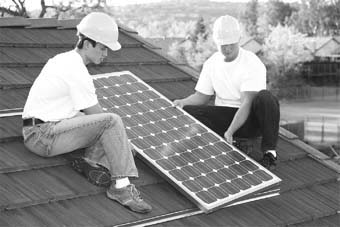
Green collar jobs include labor, semiskilled, and trade jobs that contribute to improvements in environmental quality, such as these two builders installing rooftop solar panels
Green-collar jobs generate three kinds of benefits: environmental, economic, and social. On the environmental side, they reduce the harmful side effects of economic development, help to repair damaged ecosystems, and improve the quality of the environment. In terms of the economy, they offer a new growth area for employment, income, and government revenue. They also provide the labor and skills that enable employers to make more efficient use of resources and develop environmentally friendly products or services. In social terms, they offer an opportunity to lift people out of poverty by providing employment opportunities, they offer good wages and working conditions, they provide a career path, they reduce the public health impacts of production, and they improve public amenity. Green-collar jobs may involve new kinds of work in emerging green industries or they may develop from older occupations as established employers make the transition to more environmentally sustainable practices.
Historically, there have been many jobs that have had a positive impact on the environment. In pre-industrial Europe, for example, gamekeepers maintained natural habitats to support healthy populations of animals and birds. Since the industrial revolution and the rapid growth of cities, more specialized jobs have been created to improve local environments. Workers who began the construction of urban sewerage systems during the late 19th century are a case in point. The rapid spread of industrialization around the world in the second half of the 20th century accelerated the expansion in this kind of work. Increasingly strict environmental laws in the 1960s and 1970s, for example, led to a growing number of technicians being employed by industry to reduce pollution. In the 1980s, links were drawn between environmental, social, and economic problems, and sustainable development was proposed as a systematic solution. The idea was that if industrial development were undertaken with more care, it could still generate economic growth and social benefits (such as employment) as well as conserve a healthy environment for present and future generations. By the 1990s, it was becoming evident that actions to protect the environment could create new jobs and shift employment from older damaging industries into cleaner production. In 1999, Alan Durning coined the term green-collar jobs in a study of employment changes in the northwest of the United States. The concept has since been expanded by researchers, such as Raquel Pinderhughes, and community organizations, such as the Apollo Alliance, to cover other types of work and develop the social dimension in more detail.
...
- Business Organizations, Movements, and Planning
- Balanced Scorecard
- Best Available Control Technology
- Best Management Practices
- Ceres Principles
- Certification
- Closed-Loop Supply Chain
- Compliance
- Core Competencies
- Corporate Social Responsibility
- Cost-Benefit Analysis
- Demand-Side Management
- Discounting
- Dow Jones Sustainability Index
- Ecoeffectiveness
- Ecoefficiency
- Ecoindustrial Park
- Ecological Economics
- Economic Value Added
- Emissions Trading
- Energy Performance Contracting
- Energy Service Company
- Environmental Accounting
- Environmental Assessment
- Environmental Audit
- Environmental Economics
- Environmental Impact Statement
- Environmental Indicators
- Environmental Management System
- Environmental Marketing
- Environmental Risk Assessment
- Environmental Services
- Environmentally Preferable Purchasing
- Equator Principles
- Extended Producer Responsibility
- Extended Product Responsibility
- Externalities
- Factor Four and Factor Ten
- Fair Trade
- Genuine Progress Indicator
- Global Reporting Initiative
- Global Sullivan Principles
- Industrial Ecology
- Industrial Metabolism
- Industrial Nutrients
- Informational Regulation
- Integrated Bottom Line
- International Organization for Standardization
- ISO 14000
- ISO 19011
- Leadership in Green Business
- Life Cycle Analysis
- Material Input per Service Unit (MIPS)
- Maximum Achievable Control Technology
- National Priorities List
- Natural Capital
- New Source Review
- Quantitative Risk Assessment
- Recycling, Business of
- Reverse Logistics
- Service Design
- Social Return on Investment
- Steady State Economy
- Stewardship
- Supply Chain Management
- Value Chain
- Business Profiles
- Green Business Challenges
- Green Business Solutions
- Abatement
- Appropriate Technology
- Bio-Based Material
- Biofuels
- Biological Resource Management
- Biomimicry
- Bioremediation
- Biotechnology
- Blended Value
- Brownfield Redevelopment
- Carbon Neutral
- Carbon Sequestration
- Carbon Trading
- Cause-Related Marketing
- Clean Fuels
- Clean Production
- Clean Technology
- Cogeneration
- Conservation
- Coopetition
- Cradle-to-Cradle
- Deposit Systems
- Distributed Energy
- Ecolabels
- Ecosystem Services
- Ecotourism
- Environmental Justice
- Green Building
- Green Chemistry
- Green Design
- Green Retailing
- Green Technology
- Green-Collar Jobs
- Gross National Happiness
- Integrated Pest Management
- Organic
- Pollution Offsets
- Pollution Prevention
- Precautionary Principle
- Remanufacturing
- Resource Management
- Responsible Sourcing
- Restoration
- Right to Know
- Seventh Generation
- Six Sigma
- Smart Energy
- Social Entrepreneurship
- Social Marketing
- Socially Responsible Investing
- Superfund
- Sustainability
- Sustainable Design
- Sustainable Development
- Systems Thinking
- Take Back
- Upcycle
- Voluntary Standards
- Waste Reduction
- Loading...
Get a 30 day FREE TRIAL
-
 Watch videos from a variety of sources bringing classroom topics to life
 -
Read modern, diverse business cases
-
Explore hundreds of books and reference titles

Read next

More like this
Sage Recommends
We found other relevant content for you on other Sage platforms.
Have you created a personal profile? Login or create a profile so that you can save clips, playlists and searches