
Entry
Reader's guide
Entries A-Z
Subject index
Green Design
Green design is design that is environmentally conscious and has the goal of sustainability. It can refer to the design of consumer goods and products, technologies, the built environment, or even systems and methods of doing things. Other terms used include ecodesign and sustainable design. Green design embraces the economic, social, and environmental impacts of producing and consuming a product with a view to minimizing its environmental impacts and nonrenewable resource use, and helping people live in harmony with nature.
In architecture, the goal of green design is to construct buildings with a reduced environmental impact, through careful selection of materials and a switch to natural and recycled building materials. The energy demands of the building may be reduced by adopting passive processes for heating and cooling, using solar-driven processes to heat interior spaces, using effective shading to prevent the building from overheating, while devices such as Trombe walls may be used to create cool drafts when the building is too hot.
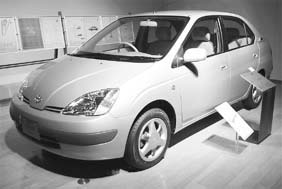
The Toyota Prius is a full hybrid electric car, introduced in Japan in 1997 and worldwide in 2001. Pictured here is an early model of the car in the Toyota Museum in Japan
The environmental benefits of green design should be self-evident. These impacts are visible on a local level (i.e., the product doesn't pollute at the point of use, or the factory that produces the product doesn't have a negative impact on its local environment) and on a larger global scale. Well-designed green products help the human race as a whole transition into a more sustainable future, and do not exacerbate global-scale problems, such as climate change and ozone depletion.
In addition to the environmental improvements gained as a result of employing green design, businesses can also benefit economically by reducing costs as a result of more efficient processes. They can improve their efficiency, and reach out to the rapidly growing segment of the market that purchases environmentally responsible products. According to the Hartman Group, 75 percent of U.S. consumers prefer greener alternative products. In this way, it is often possible to achieve many synergistic “win-wins” through green design.
Many traditional products and technologies achieved a much better integration with the natural world than modern technologies do. Tools, transportation, and buildings evolved to fit the local conditions. For example, mud huts in the French Cameroon had a hemispherical shape that was the most efficient shape for keeping the insides cool. The vertical ribs holding the huts up also guided rainwater away, and could be used as scaffolding during construction, as well as for later repairs.
Design methods changed with the changing requirements of industrializing nations. The traditional evolution of forms was no longer developing quickly enough to keep up with the constant demand for new products in rapidly expanding economies. The design process was removed from the site of manufacture to the drawing board, where scale drawings were made. The designer now had a few hours on a drawing board to achieve what had once taken centuries of adaptation.
At the same time, economic considerations became all important. In some cases, economic considerations also serve environmental goals. For example, the minimization of materials used means resources are saved. However, they may be saved at the expense of the length of the operating life of a product.
...
- Business Organizations, Movements, and Planning
- Balanced Scorecard
- Best Available Control Technology
- Best Management Practices
- Ceres Principles
- Certification
- Closed-Loop Supply Chain
- Compliance
- Core Competencies
- Corporate Social Responsibility
- Cost-Benefit Analysis
- Demand-Side Management
- Discounting
- Dow Jones Sustainability Index
- Ecoeffectiveness
- Ecoefficiency
- Ecoindustrial Park
- Ecological Economics
- Economic Value Added
- Emissions Trading
- Energy Performance Contracting
- Energy Service Company
- Environmental Accounting
- Environmental Assessment
- Environmental Audit
- Environmental Economics
- Environmental Impact Statement
- Environmental Indicators
- Environmental Management System
- Environmental Marketing
- Environmental Risk Assessment
- Environmental Services
- Environmentally Preferable Purchasing
- Equator Principles
- Extended Producer Responsibility
- Extended Product Responsibility
- Externalities
- Factor Four and Factor Ten
- Fair Trade
- Genuine Progress Indicator
- Global Reporting Initiative
- Global Sullivan Principles
- Industrial Ecology
- Industrial Metabolism
- Industrial Nutrients
- Informational Regulation
- Integrated Bottom Line
- International Organization for Standardization
- ISO 14000
- ISO 19011
- Leadership in Green Business
- Life Cycle Analysis
- Material Input per Service Unit (MIPS)
- Maximum Achievable Control Technology
- National Priorities List
- Natural Capital
- New Source Review
- Quantitative Risk Assessment
- Recycling, Business of
- Reverse Logistics
- Service Design
- Social Return on Investment
- Steady State Economy
- Stewardship
- Supply Chain Management
- Value Chain
- Business Profiles
- Green Business Challenges
- Green Business Solutions
- Abatement
- Appropriate Technology
- Bio-Based Material
- Biofuels
- Biological Resource Management
- Biomimicry
- Bioremediation
- Biotechnology
- Blended Value
- Brownfield Redevelopment
- Carbon Neutral
- Carbon Sequestration
- Carbon Trading
- Cause-Related Marketing
- Clean Fuels
- Clean Production
- Clean Technology
- Cogeneration
- Conservation
- Coopetition
- Cradle-to-Cradle
- Deposit Systems
- Distributed Energy
- Ecolabels
- Ecosystem Services
- Ecotourism
- Environmental Justice
- Green Building
- Green Chemistry
- Green Design
- Green Retailing
- Green Technology
- Green-Collar Jobs
- Gross National Happiness
- Integrated Pest Management
- Organic
- Pollution Offsets
- Pollution Prevention
- Precautionary Principle
- Remanufacturing
- Resource Management
- Responsible Sourcing
- Restoration
- Right to Know
- Seventh Generation
- Six Sigma
- Smart Energy
- Social Entrepreneurship
- Social Marketing
- Socially Responsible Investing
- Superfund
- Sustainability
- Sustainable Design
- Sustainable Development
- Systems Thinking
- Take Back
- Upcycle
- Voluntary Standards
- Waste Reduction
- Loading...
Get a 30 day FREE TRIAL
-
 Watch videos from a variety of sources bringing classroom topics to life
 -
Read modern, diverse business cases
-
Explore hundreds of books and reference titles

Read next

More like this
Sage Recommends
We found other relevant content for you on other Sage platforms.
Have you created a personal profile? Login or create a profile so that you can save clips, playlists and searches