
Entry
Reader's guide
Entries A-Z
Subject index
Green Building
A green building is a structure designed to reduce its environmental impact as compared to a standard building of its type, based on the construction and operations of the building. This impact includes the use of resources such as energy, water, and materials, as well as the reduction of outputs such as storm water runoff, construction waste, and indoor emissions. Because of the holistic nature of this approach, green building projects generally require closer collaboration between designers and builders than traditional projects. Green buildings have grown rapidly since 2000 as a result of voluntary certification systems such as Leadership in Energy and Environmental Design (LEED) and Green Star. Because of their technological rather than social focus, these structures are also sometimes called high-performance buildings. Cutting-edge architecture is now focusing on producing carbon-neutral buildings, where a structure produces zero net carbon emissions.
According to the nonprofit U.S. Green Building Council (USGBC), buildings within the United States produce nearly 40 percent of all carbon dioxide emissions and 30 percent of waste output while consuming 72 percent of electricity and 40 percent of raw materials and 14 percent of potable water. In most cases, there is relatively little that building inhabitants can do to reduce these figures once the structure is in place. The responsibility for producing more environmentally friendly buildings is therefore placed on the shoulders of those who design and construct them. At the same time, there is tremendous potential for reducing resource consumption and waste production by better designing buildings and construction practices.
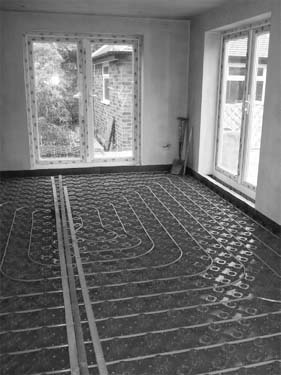
Buildings in the United States are the source of nearly 40 percent of U.S. carbon dioxide emissions and use 72 percent of the country's electricity. Efficient underfloor heating, as shown here, is one aspect of green building
There is no single definition of what makes a building green. The LEED standards of the USGBC use six categories in their definition: sustainable sites, water efficiency, energy and atmosphere, materials and resources, indoor environmental quality, and design innovation. Similarly, the U.S. Environmental Protection Agency (EPA) includes energy efficiency, water efficiency, environmentally preferable materials, waste reduction, toxics reduction, indoor air quality, and smart growth in its explanation of what makes a building green. The idea is to go beyond simply using less water or energy, but to consider how multiple components of a building's design work together in a mini-ecosystem: the site and its relationship to surrounding networks of transportation, wildlife habitat, and urban space; the indoor environment, including emissions from paint and carpet; and the sources and sinks for the materials that go into the building and the waste that comes out. The complexity of a green building means that architects, engineers, and construction managers have to work closely together to achieve the goals of the project.
Globally, programs such as the Building Research Establishment Environmental Assessment Method (BREEAM) in the United Kingdom, Comprehensive Assessment System for Building Environmental Efficiency (CASBEE) in Japan, Green Star in New Zealand and Australia, and the Green Globes in North America serve a similar function as the USGBC's LEED. The LEED standards themselves have been adapted by over 40 countries, including Brazil, China, and India, while BREEAM International has been employed across Europe and Asia. The major differences between the systems are in how certification is approved (on-site inspection for BREEAM, documentation for LEED) and in percentage reductions from a baseline (LEED) as compared to quantitative targets (BREEAM). The World Green Building Council acts as a clearinghouse for these different systems, sharing information about building techniques, policies, and certification schemes.
...
- Business Organizations, Movements, and Planning
- Balanced Scorecard
- Best Available Control Technology
- Best Management Practices
- Ceres Principles
- Certification
- Closed-Loop Supply Chain
- Compliance
- Core Competencies
- Corporate Social Responsibility
- Cost-Benefit Analysis
- Demand-Side Management
- Discounting
- Dow Jones Sustainability Index
- Ecoeffectiveness
- Ecoefficiency
- Ecoindustrial Park
- Ecological Economics
- Economic Value Added
- Emissions Trading
- Energy Performance Contracting
- Energy Service Company
- Environmental Accounting
- Environmental Assessment
- Environmental Audit
- Environmental Economics
- Environmental Impact Statement
- Environmental Indicators
- Environmental Management System
- Environmental Marketing
- Environmental Risk Assessment
- Environmental Services
- Environmentally Preferable Purchasing
- Equator Principles
- Extended Producer Responsibility
- Extended Product Responsibility
- Externalities
- Factor Four and Factor Ten
- Fair Trade
- Genuine Progress Indicator
- Global Reporting Initiative
- Global Sullivan Principles
- Industrial Ecology
- Industrial Metabolism
- Industrial Nutrients
- Informational Regulation
- Integrated Bottom Line
- International Organization for Standardization
- ISO 14000
- ISO 19011
- Leadership in Green Business
- Life Cycle Analysis
- Material Input per Service Unit (MIPS)
- Maximum Achievable Control Technology
- National Priorities List
- Natural Capital
- New Source Review
- Quantitative Risk Assessment
- Recycling, Business of
- Reverse Logistics
- Service Design
- Social Return on Investment
- Steady State Economy
- Stewardship
- Supply Chain Management
- Value Chain
- Business Profiles
- Green Business Challenges
- Green Business Solutions
- Abatement
- Appropriate Technology
- Bio-Based Material
- Biofuels
- Biological Resource Management
- Biomimicry
- Bioremediation
- Biotechnology
- Blended Value
- Brownfield Redevelopment
- Carbon Neutral
- Carbon Sequestration
- Carbon Trading
- Cause-Related Marketing
- Clean Fuels
- Clean Production
- Clean Technology
- Cogeneration
- Conservation
- Coopetition
- Cradle-to-Cradle
- Deposit Systems
- Distributed Energy
- Ecolabels
- Ecosystem Services
- Ecotourism
- Environmental Justice
- Green Building
- Green Chemistry
- Green Design
- Green Retailing
- Green Technology
- Green-Collar Jobs
- Gross National Happiness
- Integrated Pest Management
- Organic
- Pollution Offsets
- Pollution Prevention
- Precautionary Principle
- Remanufacturing
- Resource Management
- Responsible Sourcing
- Restoration
- Right to Know
- Seventh Generation
- Six Sigma
- Smart Energy
- Social Entrepreneurship
- Social Marketing
- Socially Responsible Investing
- Superfund
- Sustainability
- Sustainable Design
- Sustainable Development
- Systems Thinking
- Take Back
- Upcycle
- Voluntary Standards
- Waste Reduction
- Loading...
Get a 30 day FREE TRIAL
-
 Watch videos from a variety of sources bringing classroom topics to life
 -
Read modern, diverse business cases
-
Explore hundreds of books and reference titles

Read next

More like this
Sage Recommends
We found other relevant content for you on other Sage platforms.
Have you created a personal profile? Login or create a profile so that you can save clips, playlists and searches