
Entry
Reader's guide
Entries A-Z
Subject index
E-Waste Management
Due to the increase of global production of and demand for consumer electronics, the question of what to do with e-waste has become an important and complex issue of international environmental policy. E-waste consists of used or broken electronic or electrical devices, like computers, televisions, cell phones, spare wires, and circuit boards. Careful consideration must be given to these devices, as they are a significant source of toxic pollution into national and international waste streams. In 2007, consumer electronics comprised approximately 2 percent of the United States’ solid waste stream, totaling approximately 2.5 million tons, according to the U.S. Environmental Protection Agency (EPA).
E-waste management encompasses personal, business, and governmental strategies that can be used to responsibly handle decommissioned electronic components and devices. Depending on the goals of the user and the condition of the Waste Electrical and Electronic Equipment (WEEE), material can be donated for reuse, refurbished for donation or resale, sourced for parts, recycled into component materials, or deposited into a landfill. Successful e-waste management strives to avoid landfill disposal and to reduce environmental pollution at all stages of a product's life.
Effective e-waste management plans consider the functionality of the used electronic or electrical device and provide for several alternatives for these used products, along with e-cycling or landfill disposal. These options include donation plans, where still-functioning devices, like cell phones with expired service contracts, can be donated to other potential users. Donation plans can help to build an initial bridge across the digital divide, while simultaneously reducing e-waste. Another viable e-waste management option for working devices is a cash or incentive trade-in system, via either a physical site or an Internet forum.
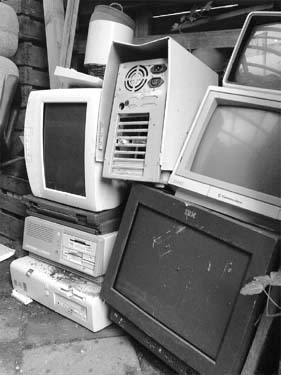
Consumers upgrade electronic devices often, because companies release new models every few years. Electronic waste, or e-waste, contains many harmful elements, such as battery components
For nonfunctional WEEE, there are a variety of options for recycling, or e-cycling. Municipalities and nonprofit organizations often host collection days for these materials. Typically, these events are intended for individual consumers, limiting the number of items that can be processed to discourage companies from using the opportunity to discard large amounts of e-waste at little or no cost. E-cycling programs are not limited to governmental and nonprofit efforts. Growing numbers of electronics producers and retailers are allowing consumers to return items at the end of their life cycles as a demonstration of corporate social responsibility. For example, Staples collects a wide variety of used WEEE at its stores; Dell recycles Dell products for free and will recycle other brands for free with the purchase of a new Dell, and Apple Inc. will accept any brand of computer, display, MP3 player, or mobile phone for recycling when the item is mailed to their recycling program address.
In developed countries, there are two general methods of e-cycling. First, devices can be dismantled by hand into their various component parts. This allows workers to sort the materials to find working parts that can be reused before the remaining parts are recycled in bulk. The second method requires the entire commingled WEEE collection to be fed into a large, industrial separator. The goods are shredded into small pieces, and separated by a complex system of magnets, screens, and currents. The entire process takes place within an enclosed system with dust collectors and scrubbers to minimize the exposure of workers and the environment to pollutants.
...
- Business Organizations, Movements, and Planning
- Balanced Scorecard
- Best Available Control Technology
- Best Management Practices
- Ceres Principles
- Certification
- Closed-Loop Supply Chain
- Compliance
- Core Competencies
- Corporate Social Responsibility
- Cost-Benefit Analysis
- Demand-Side Management
- Discounting
- Dow Jones Sustainability Index
- Ecoeffectiveness
- Ecoefficiency
- Ecoindustrial Park
- Ecological Economics
- Economic Value Added
- Emissions Trading
- Energy Performance Contracting
- Energy Service Company
- Environmental Accounting
- Environmental Assessment
- Environmental Audit
- Environmental Economics
- Environmental Impact Statement
- Environmental Indicators
- Environmental Management System
- Environmental Marketing
- Environmental Risk Assessment
- Environmental Services
- Environmentally Preferable Purchasing
- Equator Principles
- Extended Producer Responsibility
- Extended Product Responsibility
- Externalities
- Factor Four and Factor Ten
- Fair Trade
- Genuine Progress Indicator
- Global Reporting Initiative
- Global Sullivan Principles
- Industrial Ecology
- Industrial Metabolism
- Industrial Nutrients
- Informational Regulation
- Integrated Bottom Line
- International Organization for Standardization
- ISO 14000
- ISO 19011
- Leadership in Green Business
- Life Cycle Analysis
- Material Input per Service Unit (MIPS)
- Maximum Achievable Control Technology
- National Priorities List
- Natural Capital
- New Source Review
- Quantitative Risk Assessment
- Recycling, Business of
- Reverse Logistics
- Service Design
- Social Return on Investment
- Steady State Economy
- Stewardship
- Supply Chain Management
- Value Chain
- Business Profiles
- Green Business Challenges
- Green Business Solutions
- Abatement
- Appropriate Technology
- Bio-Based Material
- Biofuels
- Biological Resource Management
- Biomimicry
- Bioremediation
- Biotechnology
- Blended Value
- Brownfield Redevelopment
- Carbon Neutral
- Carbon Sequestration
- Carbon Trading
- Cause-Related Marketing
- Clean Fuels
- Clean Production
- Clean Technology
- Cogeneration
- Conservation
- Coopetition
- Cradle-to-Cradle
- Deposit Systems
- Distributed Energy
- Ecolabels
- Ecosystem Services
- Ecotourism
- Environmental Justice
- Green Building
- Green Chemistry
- Green Design
- Green Retailing
- Green Technology
- Green-Collar Jobs
- Gross National Happiness
- Integrated Pest Management
- Organic
- Pollution Offsets
- Pollution Prevention
- Precautionary Principle
- Remanufacturing
- Resource Management
- Responsible Sourcing
- Restoration
- Right to Know
- Seventh Generation
- Six Sigma
- Smart Energy
- Social Entrepreneurship
- Social Marketing
- Socially Responsible Investing
- Superfund
- Sustainability
- Sustainable Design
- Sustainable Development
- Systems Thinking
- Take Back
- Upcycle
- Voluntary Standards
- Waste Reduction
- Loading...
Get a 30 day FREE TRIAL
-
 Watch videos from a variety of sources bringing classroom topics to life
 -
Read modern, diverse business cases
-
Explore hundreds of books and reference titles

Read next

More like this
Sage Recommends
We found other relevant content for you on other Sage platforms.
Have you created a personal profile? Login or create a profile so that you can save clips, playlists and searches