
Entry
Reader's guide
Entries A-Z
Subject index
Environmental Marketing
With increased global warming, the swift growth of the world population, and the depletion of natural resources, corporations and governments have been forced to give some consideration to environmental issues that they may have chosen to ignore only a few decades ago. As it becomes increasingly clear to consumers that the policy of “business as usual” is not sustainable for our planet, businesses are responding to pressure from consumers to become more sustainable: advertising one's environmental concerns and sustainable practices has become one among many marketing tools available to businesses. This article begins by addressing the historical perspective on environmental management, followed by a discussion of greening the internal environment (e.g., by harnessing human resources and organizational culture of the firm) and the external environment (e.g., encouraging green consumer behavior as well as reaching out to consumers via green advertising). Operational activities, including greening the supply chain, are used to connect the two environments as well as to determine specific strategic orientations of the organization, such as the role of innovation management and sustainability as a source of competitive advantage. The variability of greening attitudes by industry and markets and other related issues are also discussed.
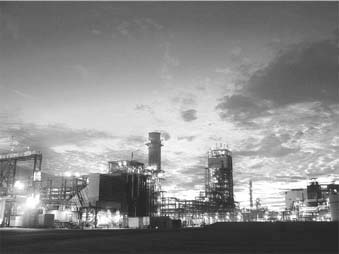
Several companies, including General Electric, have implemented environmental marketing programs to improve their business offerings. GE is researching greener technologies, such as this Integrated Gasification Combined Cycle, the end result of which is lower emission of greenhouse gases
What is Environmental Marketing?
Environmental marketing refers to a broad range of activities designed to emphasize to the consumer and to other businesses that a company's activities and products are sustainable or environmentally friendly. Several companies have proactively implemented environmental marketing programs to improve their business offerings in several different ways. Some recent notable examples are as follows:
- British Petroleum (BP) has committed to spending $350 million on energy efficient products over several years and is aggressively promoting its environmental awareness programs.
- General Electric (GE) is spending $1.5 billion on its Ecoimagination campaign, which aims to research and implement less-polluting technologies and to promote them as emblems of GE's environmental concern.
- Starbuck's announced the donation of $10 million over five years for clean drinking water around the world through the sale of its Ethos bottled water. The company already offers coffees that offer fair pay for growers and environmentally sound cultivation.
- 3M encourages employees to participate in its “Pollution Prevention Pays” program, which seeks to reduce pollution through means such as product redesign and modification, and recycling. Since 1974, the program has offset over 2 billion pounds of air, water, and solid waste pollutants from the environment.
- The largest home and garden center chain, Home Depot, discontinued the sale of wood products from endangered forests in 2002.
In addition to firms, major global bodies, such as the United Nations, have promoted green practices for municipal governments, and even buildings, for example, the William J. Clinton Presidential Library in Little Rock, Arkansas, advertise that they were built using environmentally friendly construction. Several industry-based associations actively encourage green marketing programs. For instance, the U.S. Green Building Council is responsible for certifying and promoting environmentally responsible and high-performance buildings, while the Green Seal organization awards green seals to products that meet rigorous environmental standards, which in turn helps consumers identify products that are environmentally safe.
...
- Business Organizations, Movements, and Planning
- Balanced Scorecard
- Best Available Control Technology
- Best Management Practices
- Ceres Principles
- Certification
- Closed-Loop Supply Chain
- Compliance
- Core Competencies
- Corporate Social Responsibility
- Cost-Benefit Analysis
- Demand-Side Management
- Discounting
- Dow Jones Sustainability Index
- Ecoeffectiveness
- Ecoefficiency
- Ecoindustrial Park
- Ecological Economics
- Economic Value Added
- Emissions Trading
- Energy Performance Contracting
- Energy Service Company
- Environmental Accounting
- Environmental Assessment
- Environmental Audit
- Environmental Economics
- Environmental Impact Statement
- Environmental Indicators
- Environmental Management System
- Environmental Marketing
- Environmental Risk Assessment
- Environmental Services
- Environmentally Preferable Purchasing
- Equator Principles
- Extended Producer Responsibility
- Extended Product Responsibility
- Externalities
- Factor Four and Factor Ten
- Fair Trade
- Genuine Progress Indicator
- Global Reporting Initiative
- Global Sullivan Principles
- Industrial Ecology
- Industrial Metabolism
- Industrial Nutrients
- Informational Regulation
- Integrated Bottom Line
- International Organization for Standardization
- ISO 14000
- ISO 19011
- Leadership in Green Business
- Life Cycle Analysis
- Material Input per Service Unit (MIPS)
- Maximum Achievable Control Technology
- National Priorities List
- Natural Capital
- New Source Review
- Quantitative Risk Assessment
- Recycling, Business of
- Reverse Logistics
- Service Design
- Social Return on Investment
- Steady State Economy
- Stewardship
- Supply Chain Management
- Value Chain
- Business Profiles
- Green Business Challenges
- Green Business Solutions
- Abatement
- Appropriate Technology
- Bio-Based Material
- Biofuels
- Biological Resource Management
- Biomimicry
- Bioremediation
- Biotechnology
- Blended Value
- Brownfield Redevelopment
- Carbon Neutral
- Carbon Sequestration
- Carbon Trading
- Cause-Related Marketing
- Clean Fuels
- Clean Production
- Clean Technology
- Cogeneration
- Conservation
- Coopetition
- Cradle-to-Cradle
- Deposit Systems
- Distributed Energy
- Ecolabels
- Ecosystem Services
- Ecotourism
- Environmental Justice
- Green Building
- Green Chemistry
- Green Design
- Green Retailing
- Green Technology
- Green-Collar Jobs
- Gross National Happiness
- Integrated Pest Management
- Organic
- Pollution Offsets
- Pollution Prevention
- Precautionary Principle
- Remanufacturing
- Resource Management
- Responsible Sourcing
- Restoration
- Right to Know
- Seventh Generation
- Six Sigma
- Smart Energy
- Social Entrepreneurship
- Social Marketing
- Socially Responsible Investing
- Superfund
- Sustainability
- Sustainable Design
- Sustainable Development
- Systems Thinking
- Take Back
- Upcycle
- Voluntary Standards
- Waste Reduction
- Loading...
Get a 30 day FREE TRIAL
-
 Watch videos from a variety of sources bringing classroom topics to life
 -
Read modern, diverse business cases
-
Explore hundreds of books and reference titles

Read next

More like this
Sage Recommends
We found other relevant content for you on other Sage platforms.
Have you created a personal profile? Login or create a profile so that you can save clips, playlists and searches