
Entry
Reader's guide
Entries A-Z
Subject index
Emissions Trading
Emissions trading is a policy measure aimed at reducing pollution. Originally referred to as tradable pollution rights, it enables firms to trade the right to emit or discharge specified amounts of particular pollutants. It has been used to control sulfur dioxide (SO2) that contributes to acid rain, nitrous oxides and volatile organic compounds that contribute to smog, greenhouse gases, and nutrient discharges into waterways.
In cap-and-trade emissions trading, a limit is set for total amount of a specific pollutant, or set of pollutants, that are allowed to be emitted over a particular period—usually a year—by specific industries in a particular region. The limit or cap chosen is supposed to be within the estimated capacity of the environment to assimilate the pollutant (or at least a step toward achieving that goal), but in reality is often more an indication of what is considered economically feasible. This cap is then divided into allowances (or permits) that are allocated to firms.
Emissions trading schemes are normally limited to large firms in a particular industry sector with significant emissions. A participating firm can sell any allowances that are surplus to its requirements to another firm that needs extra allowances, or it can save them up for the future when they might be needed.
The two main ways of initially allocating allowances are usually referred to as “grand-fathering” and “auctioning.” Grandfathering involves allocating allowances to firms on the basis of their past emissions. Alternatively, allowances can be auctioned off to polluters.
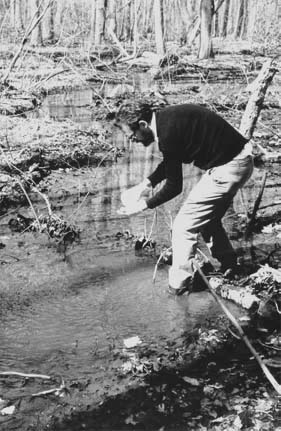
In the United States, the Acid Rain Cap and Trade scheme is cited as a success. Part of the process involves collecting water samples for acid rain analysis, such as here in a Chesapeake wetland tributary
Open market emissions trading allows companies to earn emission reduction credits for voluntary reductions in a particular time period of specified pollutants discharged from their plants. These can be either reductions from the usual emission rates for a particular facility or reductions below the regulated standards that the facility is required to meet, whichever is less.
Firms that reduce their rate of emissions from a particular facility can then sell the credits they earn to other firms for whom buying credits is cheaper than reducing their emissions to comply with those regulations. Trading is usually open to all firms. The money that can be earned from selling credits is supposed to provide an incentive for firms to come up with innovative ways to reduce their emission rates.
Some open market emission trading schemes allow firms to gain credits from reducing pollution from a variety of small mobile sources such as old cars, leaf blowers, and lawn mowers. Credits can be exchanged between different types of sources and industries. Sometimes different types of pollutants are covered in one trading scheme so that reductions in emissions of one pollutant can be used as credits for increased emissions of a different pollutant.
Emissions trading is based on the idea that it is cheaper for some firms to reduce their emissions than others and therefore more cost effective to allow the market to decide where emission reductions will be made than for governments to require uniform reductions across an industry. Firms that find it expensive to reduce emissions are able to buy up emission permits instead. Those that can reduce emissions cheaply can in turn profitably sell their unneeded permits.
...
- Business Organizations, Movements, and Planning
- Balanced Scorecard
- Best Available Control Technology
- Best Management Practices
- Ceres Principles
- Certification
- Closed-Loop Supply Chain
- Compliance
- Core Competencies
- Corporate Social Responsibility
- Cost-Benefit Analysis
- Demand-Side Management
- Discounting
- Dow Jones Sustainability Index
- Ecoeffectiveness
- Ecoefficiency
- Ecoindustrial Park
- Ecological Economics
- Economic Value Added
- Emissions Trading
- Energy Performance Contracting
- Energy Service Company
- Environmental Accounting
- Environmental Assessment
- Environmental Audit
- Environmental Economics
- Environmental Impact Statement
- Environmental Indicators
- Environmental Management System
- Environmental Marketing
- Environmental Risk Assessment
- Environmental Services
- Environmentally Preferable Purchasing
- Equator Principles
- Extended Producer Responsibility
- Extended Product Responsibility
- Externalities
- Factor Four and Factor Ten
- Fair Trade
- Genuine Progress Indicator
- Global Reporting Initiative
- Global Sullivan Principles
- Industrial Ecology
- Industrial Metabolism
- Industrial Nutrients
- Informational Regulation
- Integrated Bottom Line
- International Organization for Standardization
- ISO 14000
- ISO 19011
- Leadership in Green Business
- Life Cycle Analysis
- Material Input per Service Unit (MIPS)
- Maximum Achievable Control Technology
- National Priorities List
- Natural Capital
- New Source Review
- Quantitative Risk Assessment
- Recycling, Business of
- Reverse Logistics
- Service Design
- Social Return on Investment
- Steady State Economy
- Stewardship
- Supply Chain Management
- Value Chain
- Business Profiles
- Green Business Challenges
- Green Business Solutions
- Abatement
- Appropriate Technology
- Bio-Based Material
- Biofuels
- Biological Resource Management
- Biomimicry
- Bioremediation
- Biotechnology
- Blended Value
- Brownfield Redevelopment
- Carbon Neutral
- Carbon Sequestration
- Carbon Trading
- Cause-Related Marketing
- Clean Fuels
- Clean Production
- Clean Technology
- Cogeneration
- Conservation
- Coopetition
- Cradle-to-Cradle
- Deposit Systems
- Distributed Energy
- Ecolabels
- Ecosystem Services
- Ecotourism
- Environmental Justice
- Green Building
- Green Chemistry
- Green Design
- Green Retailing
- Green Technology
- Green-Collar Jobs
- Gross National Happiness
- Integrated Pest Management
- Organic
- Pollution Offsets
- Pollution Prevention
- Precautionary Principle
- Remanufacturing
- Resource Management
- Responsible Sourcing
- Restoration
- Right to Know
- Seventh Generation
- Six Sigma
- Smart Energy
- Social Entrepreneurship
- Social Marketing
- Socially Responsible Investing
- Superfund
- Sustainability
- Sustainable Design
- Sustainable Development
- Systems Thinking
- Take Back
- Upcycle
- Voluntary Standards
- Waste Reduction
- Loading...
Get a 30 day FREE TRIAL
-
 Watch videos from a variety of sources bringing classroom topics to life
 -
Read modern, diverse business cases
-
Explore hundreds of books and reference titles

Read next

More like this
Sage Recommends
We found other relevant content for you on other Sage platforms.
Have you created a personal profile? Login or create a profile so that you can save clips, playlists and searches