
Entry
Reader's guide
Entries A-Z
Subject index
Ecoindustrial Park
An ecoindustrial park (EIP) is a cluster of businesses networking and cooperating with each other as well as with other stakeholders, such as the local community, in an attempt to efficiently share resources to reduce overall waste and pollution. The goal is to achieve sustainable development and improve environmental quality, while also increasing economic gains. Members work together in what is often a contiguous location where coinvestors seek superior environmental, economic, and social performance through symbiotic collaboration in resource management and the supply of ecoefficient services, such electricity, transportation, and waste removal. EIP designs usually include individually managed buildings as well as shared support facilities.
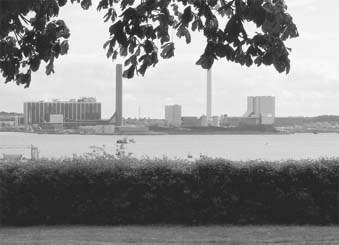
In Kalundborg, Denmark, a symbiosis network allows DONG Energy's Asnaes Power Plant to heat 3,500 local homes. Steam from the power plant is also sold to a pharmaceutical and enzyme manufacturer, and fly ash and clinker from the plant are used for road building and cement production
The ecoindustrial park concept is a culmination of several fields of research and practice including industrial ecology, clean production, urban planning, and architecture. At a basic level, the model builds from a business concept known as economies of scale, or reductions in unit cost and increases in efficiency gained from large-scale or aggregate production. For example, it can be costly for one firm to build transportation infrastructure, but spread across a dozen firms the expense per firm is reduced. Furthermore, options such as public transportation routes or carpooling are increasingly feasible when business partners cooperate. By augmenting savings through cost sharing, the park may be able to host support services such as a training center, a cafeteria, a daycare center, or research and development (R&D) facilities that may otherwise be unaffordable.
The EIP concept has evolved along with innovation in patterns of intercompany relationships and organization design, but the unique contribution of the EIP is the goal to advance ecologically friendly development. This objective is particularly notable because industrial clusters or corridors have historically been linked to pollution and degradation of the local environment. In contrast to many industrial parks, an EIP should fit into its natural setting and take a proactive role in rehabilitating or at least maintaining the surrounding ecological systems. A number of EIPs have adjacent forest, wetland, or coastal areas under sustainable management plans. In some instances, attunement to the local environment can contribute to reductions in operating costs, such as when firms collect and utilize rainwater in drought-prone environments. Other advantages come from efficiencies in lighting and heat. Some parks develop on-site renewable energy sources, such as wind and solar. An EIP goal may be to become totally energy independent of fossil fuels or outside electricity, and the EIP may be created adjacent to existing or expanding power plants for this reason. The park can also include an efficient material flow system by anchoring development around resource recovery companies that are set up for this purpose. For example, a water flow system can be designed such that processed water from one plant may be reused by another.
...
- Business Organizations, Movements, and Planning
- Balanced Scorecard
- Best Available Control Technology
- Best Management Practices
- Ceres Principles
- Certification
- Closed-Loop Supply Chain
- Compliance
- Core Competencies
- Corporate Social Responsibility
- Cost-Benefit Analysis
- Demand-Side Management
- Discounting
- Dow Jones Sustainability Index
- Ecoeffectiveness
- Ecoefficiency
- Ecoindustrial Park
- Ecological Economics
- Economic Value Added
- Emissions Trading
- Energy Performance Contracting
- Energy Service Company
- Environmental Accounting
- Environmental Assessment
- Environmental Audit
- Environmental Economics
- Environmental Impact Statement
- Environmental Indicators
- Environmental Management System
- Environmental Marketing
- Environmental Risk Assessment
- Environmental Services
- Environmentally Preferable Purchasing
- Equator Principles
- Extended Producer Responsibility
- Extended Product Responsibility
- Externalities
- Factor Four and Factor Ten
- Fair Trade
- Genuine Progress Indicator
- Global Reporting Initiative
- Global Sullivan Principles
- Industrial Ecology
- Industrial Metabolism
- Industrial Nutrients
- Informational Regulation
- Integrated Bottom Line
- International Organization for Standardization
- ISO 14000
- ISO 19011
- Leadership in Green Business
- Life Cycle Analysis
- Material Input per Service Unit (MIPS)
- Maximum Achievable Control Technology
- National Priorities List
- Natural Capital
- New Source Review
- Quantitative Risk Assessment
- Recycling, Business of
- Reverse Logistics
- Service Design
- Social Return on Investment
- Steady State Economy
- Stewardship
- Supply Chain Management
- Value Chain
- Business Profiles
- Green Business Challenges
- Green Business Solutions
- Abatement
- Appropriate Technology
- Bio-Based Material
- Biofuels
- Biological Resource Management
- Biomimicry
- Bioremediation
- Biotechnology
- Blended Value
- Brownfield Redevelopment
- Carbon Neutral
- Carbon Sequestration
- Carbon Trading
- Cause-Related Marketing
- Clean Fuels
- Clean Production
- Clean Technology
- Cogeneration
- Conservation
- Coopetition
- Cradle-to-Cradle
- Deposit Systems
- Distributed Energy
- Ecolabels
- Ecosystem Services
- Ecotourism
- Environmental Justice
- Green Building
- Green Chemistry
- Green Design
- Green Retailing
- Green Technology
- Green-Collar Jobs
- Gross National Happiness
- Integrated Pest Management
- Organic
- Pollution Offsets
- Pollution Prevention
- Precautionary Principle
- Remanufacturing
- Resource Management
- Responsible Sourcing
- Restoration
- Right to Know
- Seventh Generation
- Six Sigma
- Smart Energy
- Social Entrepreneurship
- Social Marketing
- Socially Responsible Investing
- Superfund
- Sustainability
- Sustainable Design
- Sustainable Development
- Systems Thinking
- Take Back
- Upcycle
- Voluntary Standards
- Waste Reduction
- Loading...
Get a 30 day FREE TRIAL
-
 Watch videos from a variety of sources bringing classroom topics to life
 -
Read modern, diverse business cases
-
Explore hundreds of books and reference titles

Read next

More like this
Sage Recommends
We found other relevant content for you on other Sage platforms.
Have you created a personal profile? Login or create a profile so that you can save clips, playlists and searches