
Entry
Reader's guide
Entries A-Z
Subject index
Distributed Energy
Distributed energy is both complementary and alternative to “centralized power generation,” addressing many of the shortcomings of centralized systems. Key qualities of distributed energy are that it is decentralized, diverse, and close to the end user. As such, distributed energy resources (DERs) are increasingly used to address common problems of centralized power systems such as peak power, backup power during power outages, increased power quality, as well as lower cost and lower energy consumption for electrical, heating, and cooling needs. Distributed energy systems commonly used today include diesel and fuel generators, solar power, fuel cells, wind turbines, biomass, microturbines, load reduction technologies, and battery storage systems. Though very basic distributed energy systems, such as diesel-operated backup generators, represent a significant exception, more and more distributed energy technologies provide cleaner, faster, and more efficient energy than centralized power systems. All distributed energy systems have the built-in advantage of generating power nearer to the point of consumption, thus reducing losses inherent in the transmission and distribution system of centralized power stations.
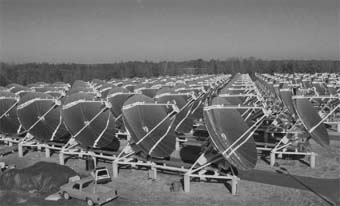
In one type of distributed energy, the concentrating solar plant, the sun's energy is focused onto a point using mirrors or lenses, generating intense heat. This solar-energy dish-collector field is in Shenandoah, Georgia
The nation's overall energy portfolio is increasingly reliant on distributed energy technologies, for they have, as many reports clearly indicate, the important potential “to mitigate congestion in transmission lines, reduce the impact of electricity price fluctuations, strengthen energy security, and provide greater stability to the electricity grid.” Along the same lines, industry observers have likened distributed energy systems to the historical evolution of computer systems: once highly centralized and expensive, they have become, in short order, more efficient, more decentralized, cheaper, and more user friendly. And, of course, primarily as a result of these developments, both distributed energy systems and computer systems find an ever-widening range of uses.
The basic idea behind distributed energy systems, of course, is not at all new. Indeed, it was not until the advent of the industrial revolution, the creation of urban centers, and the building of the first large-scale power plants that energy production became centralized. During the early years of the American republic, people had their own furnaces and their own wind or water-generated mills—very much a decentralized or distributed energy system. Despite the fact that there is still no clearly agreed-upon definition for distributed energy, however, it is different from such historical examples of decentralized systems in that it is part of a larger system, or network. Indeed, many European countries now pay costumers for feeding energy back into the grid from their own energy generators, assuming they are zero carbon emissions. In some cases, more per kilowatt is fed into the grid from these homes than what is taken out of the grid.
DERs have become particularly significant in the information technology industry, which is dependent on a steady and reliable supply of electricity, without any tolerance to variations in energy quality, much less complete power outages. And since a large and growing part of U.S. business transactions are based on information technology, DERs are increasingly viewed as vital to the overall well-being of the economy.
...
- Business Organizations, Movements, and Planning
- Balanced Scorecard
- Best Available Control Technology
- Best Management Practices
- Ceres Principles
- Certification
- Closed-Loop Supply Chain
- Compliance
- Core Competencies
- Corporate Social Responsibility
- Cost-Benefit Analysis
- Demand-Side Management
- Discounting
- Dow Jones Sustainability Index
- Ecoeffectiveness
- Ecoefficiency
- Ecoindustrial Park
- Ecological Economics
- Economic Value Added
- Emissions Trading
- Energy Performance Contracting
- Energy Service Company
- Environmental Accounting
- Environmental Assessment
- Environmental Audit
- Environmental Economics
- Environmental Impact Statement
- Environmental Indicators
- Environmental Management System
- Environmental Marketing
- Environmental Risk Assessment
- Environmental Services
- Environmentally Preferable Purchasing
- Equator Principles
- Extended Producer Responsibility
- Extended Product Responsibility
- Externalities
- Factor Four and Factor Ten
- Fair Trade
- Genuine Progress Indicator
- Global Reporting Initiative
- Global Sullivan Principles
- Industrial Ecology
- Industrial Metabolism
- Industrial Nutrients
- Informational Regulation
- Integrated Bottom Line
- International Organization for Standardization
- ISO 14000
- ISO 19011
- Leadership in Green Business
- Life Cycle Analysis
- Material Input per Service Unit (MIPS)
- Maximum Achievable Control Technology
- National Priorities List
- Natural Capital
- New Source Review
- Quantitative Risk Assessment
- Recycling, Business of
- Reverse Logistics
- Service Design
- Social Return on Investment
- Steady State Economy
- Stewardship
- Supply Chain Management
- Value Chain
- Business Profiles
- Green Business Challenges
- Green Business Solutions
- Abatement
- Appropriate Technology
- Bio-Based Material
- Biofuels
- Biological Resource Management
- Biomimicry
- Bioremediation
- Biotechnology
- Blended Value
- Brownfield Redevelopment
- Carbon Neutral
- Carbon Sequestration
- Carbon Trading
- Cause-Related Marketing
- Clean Fuels
- Clean Production
- Clean Technology
- Cogeneration
- Conservation
- Coopetition
- Cradle-to-Cradle
- Deposit Systems
- Distributed Energy
- Ecolabels
- Ecosystem Services
- Ecotourism
- Environmental Justice
- Green Building
- Green Chemistry
- Green Design
- Green Retailing
- Green Technology
- Green-Collar Jobs
- Gross National Happiness
- Integrated Pest Management
- Organic
- Pollution Offsets
- Pollution Prevention
- Precautionary Principle
- Remanufacturing
- Resource Management
- Responsible Sourcing
- Restoration
- Right to Know
- Seventh Generation
- Six Sigma
- Smart Energy
- Social Entrepreneurship
- Social Marketing
- Socially Responsible Investing
- Superfund
- Sustainability
- Sustainable Design
- Sustainable Development
- Systems Thinking
- Take Back
- Upcycle
- Voluntary Standards
- Waste Reduction
- Loading...
Get a 30 day FREE TRIAL
-
 Watch videos from a variety of sources bringing classroom topics to life
 -
Read modern, diverse business cases
-
Explore hundreds of books and reference titles

Read next

More like this
Sage Recommends
We found other relevant content for you on other Sage platforms.
Have you created a personal profile? Login or create a profile so that you can save clips, playlists and searches