
Entry
Reader's guide
Entries A-Z
Subject index
Cradle-to-Cradle
Cradle-to-cradle (C2C) is based on the principle that the whole life cycle of products and services needs to be redesigned so that every waste is a raw material for another round of production, service, or use. It aims to create systems that are both ecoefficient and waste-free, and can be been applied to industrial designs and manufacturing as well as urban environments, buildings, economics, and social systems.
Any production process will produce some waste, and traditionally most of this waste has ended up in landfills. “Cradle-to-grave” is a process by which companies take responsibility for the disposal of the goods they produce (usually as a waste product of the production process), but the waste is not necessarily reused or recycled. Not much thought is given to whether the waste can be used by another industry or company, where it could be an ingredient or material for production of their goods. In the terms of a life cycle analysis, cradle-to-grave describes the entire life of a material until the time it is disposed of. Consequently, the environmental problems associated with disposal, particularly in regards to landfills and waste incineration, are not dealt with by the cradle-to-grave process.
It is therefore essential to view the life cycle in terms of cradle-to-cradle, and to consider the best way to dispose of the end product when no longer required. The term cradle-to-cradle was invented by Walter R. Stahel in the 1970s, but it did not become popular until the book Cradle to Cradle: Remaking the Way We Make Things, by William McDonough and Michael Braungart, was published in 2002. Stahel stressed the importance of using the holistic approach, as well as the economic, ecological, and social advantages of a closed-loop economy.
McDonough and Braungart argued that the cradle-to-cradle practice requires a complete turnaround in thinking in some cases—just as when we are driving to a certain destination and we realize that we are going on a wrong path, slowing down does not correct the path. We need to return to a certain point to continue our journey. Similarly, we need a completely different model for dealing with waste.
Cradle-to-cradle design often involves referring to nature for inspiration, where one organism's waste is food for another, and nutrients flow indefinitely in cycles of birth, decay, and rebirth. The biological metabolism in ecosystems can be mirrored in the technological systems they design, so that there is a closed loop in which valuable resources move in cycles of production, use, recovery, and remanufacture.
In the cradle-to-cradle model, all materials used in industrial/manufacturing processes (such as creating metals, fibers, and dyes) fall into two main categories: technical or biological nutrients. Technical nutrients are restricted to nontoxic, nonharmful synthetic materials that do not have a negative impact on the environment and can be used in continuous cycles as the same product without losing their integrity or quality. Biological nutrients consist mainly of organic materials that can be easily disposed of in any natural environment to decompose into the soil.
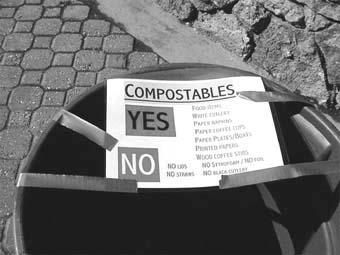
Zero-waste plans focus on reducing waste and reusing products, followed by recycling and composting through methods such as this waste bin in Nevada
...
- Business Organizations, Movements, and Planning
- Balanced Scorecard
- Best Available Control Technology
- Best Management Practices
- Ceres Principles
- Certification
- Closed-Loop Supply Chain
- Compliance
- Core Competencies
- Corporate Social Responsibility
- Cost-Benefit Analysis
- Demand-Side Management
- Discounting
- Dow Jones Sustainability Index
- Ecoeffectiveness
- Ecoefficiency
- Ecoindustrial Park
- Ecological Economics
- Economic Value Added
- Emissions Trading
- Energy Performance Contracting
- Energy Service Company
- Environmental Accounting
- Environmental Assessment
- Environmental Audit
- Environmental Economics
- Environmental Impact Statement
- Environmental Indicators
- Environmental Management System
- Environmental Marketing
- Environmental Risk Assessment
- Environmental Services
- Environmentally Preferable Purchasing
- Equator Principles
- Extended Producer Responsibility
- Extended Product Responsibility
- Externalities
- Factor Four and Factor Ten
- Fair Trade
- Genuine Progress Indicator
- Global Reporting Initiative
- Global Sullivan Principles
- Industrial Ecology
- Industrial Metabolism
- Industrial Nutrients
- Informational Regulation
- Integrated Bottom Line
- International Organization for Standardization
- ISO 14000
- ISO 19011
- Leadership in Green Business
- Life Cycle Analysis
- Material Input per Service Unit (MIPS)
- Maximum Achievable Control Technology
- National Priorities List
- Natural Capital
- New Source Review
- Quantitative Risk Assessment
- Recycling, Business of
- Reverse Logistics
- Service Design
- Social Return on Investment
- Steady State Economy
- Stewardship
- Supply Chain Management
- Value Chain
- Business Profiles
- Green Business Challenges
- Green Business Solutions
- Abatement
- Appropriate Technology
- Bio-Based Material
- Biofuels
- Biological Resource Management
- Biomimicry
- Bioremediation
- Biotechnology
- Blended Value
- Brownfield Redevelopment
- Carbon Neutral
- Carbon Sequestration
- Carbon Trading
- Cause-Related Marketing
- Clean Fuels
- Clean Production
- Clean Technology
- Cogeneration
- Conservation
- Coopetition
- Cradle-to-Cradle
- Deposit Systems
- Distributed Energy
- Ecolabels
- Ecosystem Services
- Ecotourism
- Environmental Justice
- Green Building
- Green Chemistry
- Green Design
- Green Retailing
- Green Technology
- Green-Collar Jobs
- Gross National Happiness
- Integrated Pest Management
- Organic
- Pollution Offsets
- Pollution Prevention
- Precautionary Principle
- Remanufacturing
- Resource Management
- Responsible Sourcing
- Restoration
- Right to Know
- Seventh Generation
- Six Sigma
- Smart Energy
- Social Entrepreneurship
- Social Marketing
- Socially Responsible Investing
- Superfund
- Sustainability
- Sustainable Design
- Sustainable Development
- Systems Thinking
- Take Back
- Upcycle
- Voluntary Standards
- Waste Reduction
- Loading...
Get a 30 day FREE TRIAL
-
 Watch videos from a variety of sources bringing classroom topics to life
 -
Read modern, diverse business cases
-
Explore hundreds of books and reference titles

Read next

More like this
Sage Recommends
We found other relevant content for you on other Sage platforms.
Have you created a personal profile? Login or create a profile so that you can save clips, playlists and searches