
Entry
Reader's guide
Entries A-Z
Subject index
Corporate Social Responsibility
“Social responsibility [is the] responsibility of an organization for the impacts of its decisions and activities on society and the environment through transparent and ethical behavior that is consistent with sustainable development and the welfare of society; takes into account the expectations of stakeholders; is in compliance with applicable law and consistent with international norms of behavior; and is integrated through out the organization.”—Working definition, ISO 26000 Working Group on Social Responsibility, Sydney, February 2007.
Corporate social responsibility (CSR) is an evolving concept that does not currently have a universally accepted definition. It frequently overlaps with similar terms, such as corporate sustainability, corporate sustainable development, and corporate citizenship. Whether or not or to what extent businesses must implement CSR has been a heated topic of discussion through the years, but was particularly vociferous during the debate about conducting business in South Africa during the apartheid era. At the time, many corporate executives maintained that their responsibility extended only to their shareholders.
Milton Friedman argued their case in his 1970 New York Times Magazine article, “The Social Responsibility of Business Is to Increase Its Profits.” In Friedman's Libertarian point of view, a business, since it was not a person, had no responsibility other than to fulfill the purpose for which it was created, that is, to maximize the return on shareholder investment. He said that executives and employees owed allegiance to the firms for which they worked and must keep the profit-maximization goal firmly in mind. He equated efforts to improve society through the conduct of business with “pure and unadulterated socialism.”
Although there are still those who hold Friedman's view, most business executives, including many who self-identify as Libertarians, now acknowledge that companies do indeed have a social responsibility.
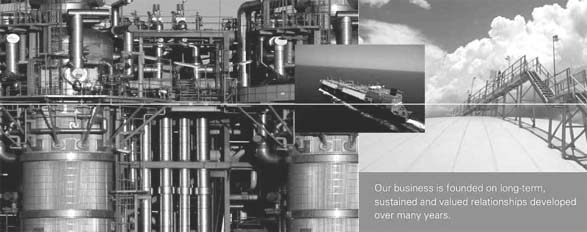
This page from an October 2006 British Petroleum brochure touts its commitment to “sustained and valued relationships” during its exploration and extraction of liquid natural gas
Forty Years in the Making
In the 40 years since the publication of Friedman's article, much has happened to change businesses’ stance on CSR from defiant opposition to acceptance, and in some cases advocacy, but two factors were key in this transformation. The most important was the advent of the information age, in particular the development of and open access to the Internet and social media (e.g., mobile phones, smart phones, text messaging, and Twitter). The second was the advanced understanding of global climate change, which altered the way most people think about natural resources and social responsibility. There is a growing public backlash against accepting the destruction of commonly held resources to meet the selfish ends of a few.
At the time when Friedman made his case that business was not a person and therefore not a moral entity subject to social responsibility, the flow of information was tightly controlled by corporations. The general public only had access to news and events through traditional media (e.g., radio, television, and print). Even stockholders had limited access to information about the corporations in which they were invested, having to rely on annual reports. In such an environment, corporate actions were held up to very little public scrutiny and coordinated consumer actions were rare. As the flow of information loosened, following the introduction of home computers in the 1980s and the expansion of the Internet in the 1990s, it not only became harder for corporations to keep their operations private, but it allowed consumers across vast distances to exchange information and act upon it.
...
- Business Organizations, Movements, and Planning
- Balanced Scorecard
- Best Available Control Technology
- Best Management Practices
- Ceres Principles
- Certification
- Closed-Loop Supply Chain
- Compliance
- Core Competencies
- Corporate Social Responsibility
- Cost-Benefit Analysis
- Demand-Side Management
- Discounting
- Dow Jones Sustainability Index
- Ecoeffectiveness
- Ecoefficiency
- Ecoindustrial Park
- Ecological Economics
- Economic Value Added
- Emissions Trading
- Energy Performance Contracting
- Energy Service Company
- Environmental Accounting
- Environmental Assessment
- Environmental Audit
- Environmental Economics
- Environmental Impact Statement
- Environmental Indicators
- Environmental Management System
- Environmental Marketing
- Environmental Risk Assessment
- Environmental Services
- Environmentally Preferable Purchasing
- Equator Principles
- Extended Producer Responsibility
- Extended Product Responsibility
- Externalities
- Factor Four and Factor Ten
- Fair Trade
- Genuine Progress Indicator
- Global Reporting Initiative
- Global Sullivan Principles
- Industrial Ecology
- Industrial Metabolism
- Industrial Nutrients
- Informational Regulation
- Integrated Bottom Line
- International Organization for Standardization
- ISO 14000
- ISO 19011
- Leadership in Green Business
- Life Cycle Analysis
- Material Input per Service Unit (MIPS)
- Maximum Achievable Control Technology
- National Priorities List
- Natural Capital
- New Source Review
- Quantitative Risk Assessment
- Recycling, Business of
- Reverse Logistics
- Service Design
- Social Return on Investment
- Steady State Economy
- Stewardship
- Supply Chain Management
- Value Chain
- Business Profiles
- Green Business Challenges
- Green Business Solutions
- Abatement
- Appropriate Technology
- Bio-Based Material
- Biofuels
- Biological Resource Management
- Biomimicry
- Bioremediation
- Biotechnology
- Blended Value
- Brownfield Redevelopment
- Carbon Neutral
- Carbon Sequestration
- Carbon Trading
- Cause-Related Marketing
- Clean Fuels
- Clean Production
- Clean Technology
- Cogeneration
- Conservation
- Coopetition
- Cradle-to-Cradle
- Deposit Systems
- Distributed Energy
- Ecolabels
- Ecosystem Services
- Ecotourism
- Environmental Justice
- Green Building
- Green Chemistry
- Green Design
- Green Retailing
- Green Technology
- Green-Collar Jobs
- Gross National Happiness
- Integrated Pest Management
- Organic
- Pollution Offsets
- Pollution Prevention
- Precautionary Principle
- Remanufacturing
- Resource Management
- Responsible Sourcing
- Restoration
- Right to Know
- Seventh Generation
- Six Sigma
- Smart Energy
- Social Entrepreneurship
- Social Marketing
- Socially Responsible Investing
- Superfund
- Sustainability
- Sustainable Design
- Sustainable Development
- Systems Thinking
- Take Back
- Upcycle
- Voluntary Standards
- Waste Reduction
- Loading...
Get a 30 day FREE TRIAL
-
 Watch videos from a variety of sources bringing classroom topics to life
 -
Read modern, diverse business cases
-
Explore hundreds of books and reference titles

Read next

More like this
Sage Recommends
We found other relevant content for you on other Sage platforms.
Have you created a personal profile? Login or create a profile so that you can save clips, playlists and searches