
Entry
Reader's guide
Entries A-Z
Subject index
Conservation
Conservation can broadly be defined as the protection of biological diversity and natural resources from human-induced change. The concept of conservation has a range of meanings to different people. Over the course of history, conservation ideals have not only been used to save animals and plants from extinction, but also to promote ideas about land and agriculture, to colonize peoples, to promote nation building, to fight against social and political injustices and, most importantly, to provide sustainable resources for green business.
Conservation is a process; it attempts to regulate and protect biodiversity and natural resources for the longer term. Usually, it is a response to anthropogenic threats—originating from humans—of one kind or another, including industrial, urban, or agricultural developments, human encroachment, or general unsustainable human practices. Its object is mostly nonhuman, although it is now commonly accepted that “cultural heritage” should be considered equally worthy of conservation. Nonetheless, much of contemporary conservation efforts focus on the natural environment, especially biological diversity, in terms of plant and animal species and natural resources, such as water, forests, soil, air (quality), mountains, wetlands, but also landscapes, ecosystems, and so forth.
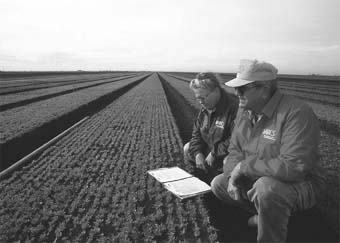
One branch of conservation aims to regulate and preserve biodiversity and natural resources from agricultural development. Here, conservationists Bobbi McDermott and Neal Hoy review a conservation plan in a field of leaf lettuce in Arizona
Conservation is not only about “nature.” It is as much—if not more—about people and the interaction between people and nature. It is often assumed that humans have a dominant and therefore responsible role; dominant because humans are “allowed” to use biodiversity and natural resources, but they must do so in a responsible manner. This usually entails limiting the impact of humans on nature and ensuring that nature has a place to exist without too much negative human interference.
Human Reliance on Ecosystems
The human reliance on ecosystems is one of the major arguments underlying the conservation imperative. Humans benefit from a vast number of natural processes that are provided by natural ecosystems. These benefits are collectively known as ecosystem services, and include basic necessities like clean drinking water and natural processes such as the decomposition of wastes. Conservation of specific ecosystems may maintain a vast range of ecosystem services for a locality, including moderation of weather extremes; dispersal of seeds; mitigation of drought and floods; cycling of nutrients; protection of streams, rivers channels, and coastal shores from erosion; control of agricultural pests; purification of air and water; and pollination of crops.
The concept of use is crucial in differentiating between conservation and preservation. Conservation usually allows some use of natural resources or biodiversity, while preservation generally allows no use at all. This use can be consumptive and extractive, or nonconsumptive and nonextractive. Examples of the former include harvesting plants for medicinal use or selective logging as a part of sustainable forest management. Examples of the latter include taking photos of animals in their natural habitat.
The idea of use in conservation is evidently important when thinking about “green business.” After all, natural resources—such as oil, gas, water, minerals, and trees—continue to form the basis on which contemporary capitalist society rests. As such, nature indeed provides the “resources” that lead to all types of benefits that humans enjoy, and—so the argument goes—in order to guarantee these benefits and the economic system behind it, humans need to conserve these “resources.” Talking about “natural resources” is therefore another indication that we are not talking about preservation, which connotes more with the term wilderness. Yet, the boundaries between conservation and preservation are not firm, neither in theory nor in practice.
...
- Business Organizations, Movements, and Planning
- Balanced Scorecard
- Best Available Control Technology
- Best Management Practices
- Ceres Principles
- Certification
- Closed-Loop Supply Chain
- Compliance
- Core Competencies
- Corporate Social Responsibility
- Cost-Benefit Analysis
- Demand-Side Management
- Discounting
- Dow Jones Sustainability Index
- Ecoeffectiveness
- Ecoefficiency
- Ecoindustrial Park
- Ecological Economics
- Economic Value Added
- Emissions Trading
- Energy Performance Contracting
- Energy Service Company
- Environmental Accounting
- Environmental Assessment
- Environmental Audit
- Environmental Economics
- Environmental Impact Statement
- Environmental Indicators
- Environmental Management System
- Environmental Marketing
- Environmental Risk Assessment
- Environmental Services
- Environmentally Preferable Purchasing
- Equator Principles
- Extended Producer Responsibility
- Extended Product Responsibility
- Externalities
- Factor Four and Factor Ten
- Fair Trade
- Genuine Progress Indicator
- Global Reporting Initiative
- Global Sullivan Principles
- Industrial Ecology
- Industrial Metabolism
- Industrial Nutrients
- Informational Regulation
- Integrated Bottom Line
- International Organization for Standardization
- ISO 14000
- ISO 19011
- Leadership in Green Business
- Life Cycle Analysis
- Material Input per Service Unit (MIPS)
- Maximum Achievable Control Technology
- National Priorities List
- Natural Capital
- New Source Review
- Quantitative Risk Assessment
- Recycling, Business of
- Reverse Logistics
- Service Design
- Social Return on Investment
- Steady State Economy
- Stewardship
- Supply Chain Management
- Value Chain
- Business Profiles
- Green Business Challenges
- Green Business Solutions
- Abatement
- Appropriate Technology
- Bio-Based Material
- Biofuels
- Biological Resource Management
- Biomimicry
- Bioremediation
- Biotechnology
- Blended Value
- Brownfield Redevelopment
- Carbon Neutral
- Carbon Sequestration
- Carbon Trading
- Cause-Related Marketing
- Clean Fuels
- Clean Production
- Clean Technology
- Cogeneration
- Conservation
- Coopetition
- Cradle-to-Cradle
- Deposit Systems
- Distributed Energy
- Ecolabels
- Ecosystem Services
- Ecotourism
- Environmental Justice
- Green Building
- Green Chemistry
- Green Design
- Green Retailing
- Green Technology
- Green-Collar Jobs
- Gross National Happiness
- Integrated Pest Management
- Organic
- Pollution Offsets
- Pollution Prevention
- Precautionary Principle
- Remanufacturing
- Resource Management
- Responsible Sourcing
- Restoration
- Right to Know
- Seventh Generation
- Six Sigma
- Smart Energy
- Social Entrepreneurship
- Social Marketing
- Socially Responsible Investing
- Superfund
- Sustainability
- Sustainable Design
- Sustainable Development
- Systems Thinking
- Take Back
- Upcycle
- Voluntary Standards
- Waste Reduction
- Loading...
Get a 30 day FREE TRIAL
-
 Watch videos from a variety of sources bringing classroom topics to life
 -
Read modern, diverse business cases
-
Explore hundreds of books and reference titles

Read next

More like this
Sage Recommends
We found other relevant content for you on other Sage platforms.
Have you created a personal profile? Login or create a profile so that you can save clips, playlists and searches