
Entry
Reader's guide
Entries A-Z
Subject index
Cause-Related Marketing
Cause-related marketing (CRM) is defined as the public association of a for-profit company with a nonprofit organization, intended to raise mutual awareness and benefit. This may involve donating a percentage of revenues to a specific cause based on the revenue from a specific time period. McDonald's earmarking $1 for the Muscular Dystrophy Association from the sale of every large order of fries is a good example of this practice. Companies use CRM in order to enhance their corporate reputation, raise brand awareness, increase customer loyalty, build sales, and overall improve their brand image. CRM is considered to be distinct from corporate philanthropy, since the former term is a marketing relationship and not a donation—the money is not an outright gift to the not-for-profit organization and is not tax deductible.
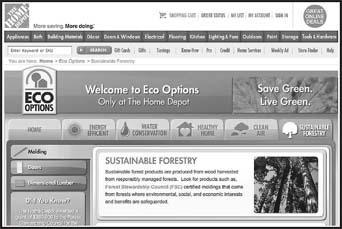
Cause-related marketing pairs a for-profit company with a nonprofit organization and intends to raise awareness for mutual benefit. Here, a screen grab from Home Depot's corporate site touts the company's ecological efforts and support of the Forest Stewardship Council's work toward sustainable forestry
History
The term was first used by American Express in 1983 to describe its campaign to raise money for the restoration of the Statue of Liberty. The company donated 1 cent to the Statue of Liberty every time someone used their credit card, and $1 for every new card issued. Over $2 million was raised during the first four months, and, very soon, the number of new cardholders grew by 45 percent and card usage increased by 28 percent. CRM has continued to grow rapidly in the past decade. In recent years, the term has encompassed other cooperative activities involving business and charitable causes, harnessing the power of “doing well by doing good.”
In the United States, the birth of CRM can be traced back to one of the founding fathers, Benjamin Franklin, who in 1747 publicized a “scheme of the Philadelphia Lottery” to raise money for the defense of Philadelphia. Over 30,000 tickets were printed, and the money raised was used mostly for the creation of a militia and the construction of a fort, called the battery, on the Pennsylvania side of the Delaware River, just south of Philadelphia. Later, in an effort to raise money for the first public hospital in the United States, The Pennsylvania Hospital, in 1751, he came up with the new idea of combining public money with private donations, thus creating the first matching grant.
Moving ahead to the late 20th century, another notable CRM campaign occurred in 1976 through a partnership between the Marriott Corporation and the March of Dimes. Marriott's goal was to create a cost-effective media coverage and public relations campaign for its 200-acre family entertainment center, Marriott's Great America, in Santa Clara, California. The objective of March of Dimes, on the other hand, was to increase fund-raising by increasing the collection of pledges. The promotion was conducted in 67 cities throughout the western United States and was deemed to be a huge success for both organizations.
Another example of a CRM campaign was created by Rosica, Mulhern and Associates on behalf of Famous Amos cookies in 1979. The chairman and founder of the company, Wally Amos, spoke on behalf of the Literacy Volunteers of America, and gave back a percentage of the sales of his products to this cause. This cause-marketing tie-in was a “win–win” situation for both Famous Amos cookies and for maintaining visibility of the literacy programs.
...
- Business Organizations, Movements, and Planning
- Balanced Scorecard
- Best Available Control Technology
- Best Management Practices
- Ceres Principles
- Certification
- Closed-Loop Supply Chain
- Compliance
- Core Competencies
- Corporate Social Responsibility
- Cost-Benefit Analysis
- Demand-Side Management
- Discounting
- Dow Jones Sustainability Index
- Ecoeffectiveness
- Ecoefficiency
- Ecoindustrial Park
- Ecological Economics
- Economic Value Added
- Emissions Trading
- Energy Performance Contracting
- Energy Service Company
- Environmental Accounting
- Environmental Assessment
- Environmental Audit
- Environmental Economics
- Environmental Impact Statement
- Environmental Indicators
- Environmental Management System
- Environmental Marketing
- Environmental Risk Assessment
- Environmental Services
- Environmentally Preferable Purchasing
- Equator Principles
- Extended Producer Responsibility
- Extended Product Responsibility
- Externalities
- Factor Four and Factor Ten
- Fair Trade
- Genuine Progress Indicator
- Global Reporting Initiative
- Global Sullivan Principles
- Industrial Ecology
- Industrial Metabolism
- Industrial Nutrients
- Informational Regulation
- Integrated Bottom Line
- International Organization for Standardization
- ISO 14000
- ISO 19011
- Leadership in Green Business
- Life Cycle Analysis
- Material Input per Service Unit (MIPS)
- Maximum Achievable Control Technology
- National Priorities List
- Natural Capital
- New Source Review
- Quantitative Risk Assessment
- Recycling, Business of
- Reverse Logistics
- Service Design
- Social Return on Investment
- Steady State Economy
- Stewardship
- Supply Chain Management
- Value Chain
- Business Profiles
- Green Business Challenges
- Green Business Solutions
- Abatement
- Appropriate Technology
- Bio-Based Material
- Biofuels
- Biological Resource Management
- Biomimicry
- Bioremediation
- Biotechnology
- Blended Value
- Brownfield Redevelopment
- Carbon Neutral
- Carbon Sequestration
- Carbon Trading
- Cause-Related Marketing
- Clean Fuels
- Clean Production
- Clean Technology
- Cogeneration
- Conservation
- Coopetition
- Cradle-to-Cradle
- Deposit Systems
- Distributed Energy
- Ecolabels
- Ecosystem Services
- Ecotourism
- Environmental Justice
- Green Building
- Green Chemistry
- Green Design
- Green Retailing
- Green Technology
- Green-Collar Jobs
- Gross National Happiness
- Integrated Pest Management
- Organic
- Pollution Offsets
- Pollution Prevention
- Precautionary Principle
- Remanufacturing
- Resource Management
- Responsible Sourcing
- Restoration
- Right to Know
- Seventh Generation
- Six Sigma
- Smart Energy
- Social Entrepreneurship
- Social Marketing
- Socially Responsible Investing
- Superfund
- Sustainability
- Sustainable Design
- Sustainable Development
- Systems Thinking
- Take Back
- Upcycle
- Voluntary Standards
- Waste Reduction
- Loading...
Get a 30 day FREE TRIAL
-
 Watch videos from a variety of sources bringing classroom topics to life
 -
Read modern, diverse business cases
-
Explore hundreds of books and reference titles

Read next

More like this
Sage Recommends
We found other relevant content for you on other Sage platforms.
Have you created a personal profile? Login or create a profile so that you can save clips, playlists and searches