
Entry
Reader's guide
Entries A-Z
Subject index
Carbon Neutral
Becoming carbon neutral, sometimes known as CO2 neutral, most commonly refers to achieving net zero greenhouse gas (GHG) emissions (including all greenhouse gases weighted according to their CO2-equivalent impact). Carbon neutrality can be achieved by reducing and avoiding GHG emissions at the point of origin/production, or by balancing greenhouse gas emissions through the purchase of an equivalent amount of carbon offsets. This combination of activities allows companies, charities, governments, nongovernmental organizations (NGOs), and individuals to reduce their net climate change impact to nil. To emphasize reduction of GHG emissions is generally recognized as a “best practice,” and to offset, if necessary, residual emissions.
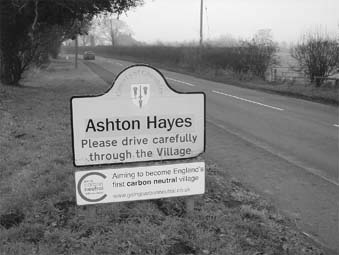
Carbon neutrality is achieved by reducing carbon emissions and balancing greenhouse gas emissions through the purchase and cancellation of an equivalent amount of carbon offsets. The English village of Ashton Hayes aspires to become England's first carbon-neutral village
In theory, the way toward carbon neutrality follows three sequential steps. First, there is a need for a reliable and transparent measure of GHG emissions. Homeowners, for instance, can use one of the several available online calculators to produce reasonably precise values. For businesses or public services, a much more detailed carbon footprint assessment is required, for example, using the World Resources Institute (WRI) GHG Protocol or the French Environment and Energy Management Agency (ADEME) program titled Bilan Carbone. The second step involves implementing measures to reduce greenhouse gas emissions, and the third step consists of acquiring carbon offsets (also called carbon credits) generated by others to balance out one's remaining emissions. Carbon offsets are generated through a “baseline and credit” scheme. Certain companies specialize in providing these offsets, such as co2logic, JPMorgan's ClimateCare, Klimaatneutraal, or TerraPass. Under such schemes, project developers, often in the developing and emerging world, are encouraged to reduce their emissions below a baseline to generate emission reduction credits that can then be sold to entities with mandatory GHG targets or people with “carbon neutral” objectives. The baseline scenario is usually defined as the business as usual scenario, for example, what would have occurred if the climate-friendly project had not been implemented.
Offsets come primarily from four types of projects: renewable energy, energy efficiency, forestry, and waste management. A feature of projects used for offsetting to reach carbon neutrality is that they are often small scale and frequently emanate from voluntary efforts that follow standards such as the Voluntary Carbon Standard or the Gold Standard. Increasingly, however, corporations engage in larger-scale efforts to gain offset credits, such as large tree-planting initiatives. The Kyoto Protocol provides an official offset program, or cap-and-trade system, for nations to “cap” or reduce their GHG emissions. While nation-states are the actual signatories to the Kyoto protocol, corporations can participate in this growing market, broadly overseen by the United Nations Framework Convention on Climate Change. Offsets are now traded on major stock exchanges and organized by institutional frameworks such as the European Union Emission Trading Scheme (EU ETS). Examples of projects that have been used to offset emissions include replacement of inefficient diesel motors with a gas motor in Africa, building of wind farms in India, or support of reforestation programs in Indonesia. More than one-third of voluntary offset credits that are essentially used to help companies reach carbon neutrality come from renewable energy projects, and another third come from forestry projects.
...
- Business Organizations, Movements, and Planning
- Balanced Scorecard
- Best Available Control Technology
- Best Management Practices
- Ceres Principles
- Certification
- Closed-Loop Supply Chain
- Compliance
- Core Competencies
- Corporate Social Responsibility
- Cost-Benefit Analysis
- Demand-Side Management
- Discounting
- Dow Jones Sustainability Index
- Ecoeffectiveness
- Ecoefficiency
- Ecoindustrial Park
- Ecological Economics
- Economic Value Added
- Emissions Trading
- Energy Performance Contracting
- Energy Service Company
- Environmental Accounting
- Environmental Assessment
- Environmental Audit
- Environmental Economics
- Environmental Impact Statement
- Environmental Indicators
- Environmental Management System
- Environmental Marketing
- Environmental Risk Assessment
- Environmental Services
- Environmentally Preferable Purchasing
- Equator Principles
- Extended Producer Responsibility
- Extended Product Responsibility
- Externalities
- Factor Four and Factor Ten
- Fair Trade
- Genuine Progress Indicator
- Global Reporting Initiative
- Global Sullivan Principles
- Industrial Ecology
- Industrial Metabolism
- Industrial Nutrients
- Informational Regulation
- Integrated Bottom Line
- International Organization for Standardization
- ISO 14000
- ISO 19011
- Leadership in Green Business
- Life Cycle Analysis
- Material Input per Service Unit (MIPS)
- Maximum Achievable Control Technology
- National Priorities List
- Natural Capital
- New Source Review
- Quantitative Risk Assessment
- Recycling, Business of
- Reverse Logistics
- Service Design
- Social Return on Investment
- Steady State Economy
- Stewardship
- Supply Chain Management
- Value Chain
- Business Profiles
- Green Business Challenges
- Green Business Solutions
- Abatement
- Appropriate Technology
- Bio-Based Material
- Biofuels
- Biological Resource Management
- Biomimicry
- Bioremediation
- Biotechnology
- Blended Value
- Brownfield Redevelopment
- Carbon Neutral
- Carbon Sequestration
- Carbon Trading
- Cause-Related Marketing
- Clean Fuels
- Clean Production
- Clean Technology
- Cogeneration
- Conservation
- Coopetition
- Cradle-to-Cradle
- Deposit Systems
- Distributed Energy
- Ecolabels
- Ecosystem Services
- Ecotourism
- Environmental Justice
- Green Building
- Green Chemistry
- Green Design
- Green Retailing
- Green Technology
- Green-Collar Jobs
- Gross National Happiness
- Integrated Pest Management
- Organic
- Pollution Offsets
- Pollution Prevention
- Precautionary Principle
- Remanufacturing
- Resource Management
- Responsible Sourcing
- Restoration
- Right to Know
- Seventh Generation
- Six Sigma
- Smart Energy
- Social Entrepreneurship
- Social Marketing
- Socially Responsible Investing
- Superfund
- Sustainability
- Sustainable Design
- Sustainable Development
- Systems Thinking
- Take Back
- Upcycle
- Voluntary Standards
- Waste Reduction
- Loading...
Get a 30 day FREE TRIAL
-
 Watch videos from a variety of sources bringing classroom topics to life
 -
Read modern, diverse business cases
-
Explore hundreds of books and reference titles

Read next

More like this
Sage Recommends
We found other relevant content for you on other Sage platforms.
Have you created a personal profile? Login or create a profile so that you can save clips, playlists and searches