
Entry
Reader's guide
Entries A-Z
Subject index
Carbon Footprint
There has been a rising awareness of the social and ethical responsibility of business among many stakeholders such as consumers, government, and environmentalists. This awareness and laws governing pollution emissions, particularly from greenhouse gases (GHGs), for example, carbon dioxide (CO2), has prompted many companies to reexamine both their methods of production as well as the negative impacts of their products on the environment. The carbon footprint is one such method for examining the environmental impact of industry. Generally, the carbon footprint refers to the total CO2 and other GHGs that are released into the atmosphere when products are created, consumed, transported, or stored. For a business, the carbon footprint represents the effect an organization has on the climate based on the total amount of GHGs produced, measured in equivalent units of CO2.
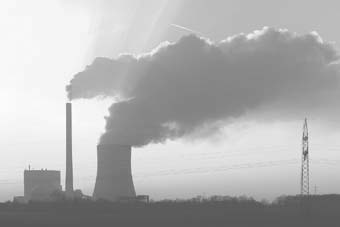
Carbon dioxide emissions are included in the calculation of a company's carbon footprint. Here is a coal-fired power plant in North Rhine-Westphalia, Germany
Calculating the Carbon Footprint
Since many companies calculate the carbon footprint of their products differently, it is difficult to directly compare products on their relative impacts on global warming. For example, for some products, how they are used may have a greater impact on global warming than how they are made, although it may be the reverse situation for other products. And yet another class of products may have global warming impacts that are inherent both in their manufacture and in their continued use. Thus, manufacturing a pair of leather shoes may create more carbon emissions, but their continued use may offset that impact. On the other hand, a car would create CO2 not only in its manufacture, but in its continued use as well. Similarly, fruits and vegetables may create carbon emissions due to refrigeration and transportation, but not as much in their manufacture or consumption.
Much of the confusion about calculating carbon footprints come from ambiguities in the definition of “carbon footprint” itself. While there is some agreement about the inclusion of carbon dioxide emissions, there is variation in whether other GHGs, such as methane (CH4), should also be included in the definition. A more difficult issue is drawing the boundary on the life cycle impacts. Should only direct emissions be included and not indirect emissions? Should all life cycle impacts be included? Should the emissions be restricted to greenhouse warming potential? Should they exclude CO2 from soils and other nonfuel sources?
Ultimately, the purpose of measuring the carbon footprint is to understand the consequences of different methods of manufacturing, storage, transportation, and consumption. The idea is to then use this knowledge to devise alternate consumption, production, distribution, and storage that will have less total carbon emissions than before.
One hundred and seventy nations formed an international agreement known as the Kyoto Protocol. Members who ratified the Kyoto Protocol were obliged to attempt to observe the targets and timetable to reduce their GHG emissions. Countries that experience shortfalls in their Kyoto emissions requirements may engage in emissions trading to purchase certified emissions reductions (CERs) or emission reduction units (ERUs). This serves to create a market value for emissions, the buying and selling of carbon credits, and also encourages greater vigilance over total national carbon emissions per country.
...
- Business Organizations, Movements, and Planning
- Balanced Scorecard
- Best Available Control Technology
- Best Management Practices
- Ceres Principles
- Certification
- Closed-Loop Supply Chain
- Compliance
- Core Competencies
- Corporate Social Responsibility
- Cost-Benefit Analysis
- Demand-Side Management
- Discounting
- Dow Jones Sustainability Index
- Ecoeffectiveness
- Ecoefficiency
- Ecoindustrial Park
- Ecological Economics
- Economic Value Added
- Emissions Trading
- Energy Performance Contracting
- Energy Service Company
- Environmental Accounting
- Environmental Assessment
- Environmental Audit
- Environmental Economics
- Environmental Impact Statement
- Environmental Indicators
- Environmental Management System
- Environmental Marketing
- Environmental Risk Assessment
- Environmental Services
- Environmentally Preferable Purchasing
- Equator Principles
- Extended Producer Responsibility
- Extended Product Responsibility
- Externalities
- Factor Four and Factor Ten
- Fair Trade
- Genuine Progress Indicator
- Global Reporting Initiative
- Global Sullivan Principles
- Industrial Ecology
- Industrial Metabolism
- Industrial Nutrients
- Informational Regulation
- Integrated Bottom Line
- International Organization for Standardization
- ISO 14000
- ISO 19011
- Leadership in Green Business
- Life Cycle Analysis
- Material Input per Service Unit (MIPS)
- Maximum Achievable Control Technology
- National Priorities List
- Natural Capital
- New Source Review
- Quantitative Risk Assessment
- Recycling, Business of
- Reverse Logistics
- Service Design
- Social Return on Investment
- Steady State Economy
- Stewardship
- Supply Chain Management
- Value Chain
- Business Profiles
- Green Business Challenges
- Green Business Solutions
- Abatement
- Appropriate Technology
- Bio-Based Material
- Biofuels
- Biological Resource Management
- Biomimicry
- Bioremediation
- Biotechnology
- Blended Value
- Brownfield Redevelopment
- Carbon Neutral
- Carbon Sequestration
- Carbon Trading
- Cause-Related Marketing
- Clean Fuels
- Clean Production
- Clean Technology
- Cogeneration
- Conservation
- Coopetition
- Cradle-to-Cradle
- Deposit Systems
- Distributed Energy
- Ecolabels
- Ecosystem Services
- Ecotourism
- Environmental Justice
- Green Building
- Green Chemistry
- Green Design
- Green Retailing
- Green Technology
- Green-Collar Jobs
- Gross National Happiness
- Integrated Pest Management
- Organic
- Pollution Offsets
- Pollution Prevention
- Precautionary Principle
- Remanufacturing
- Resource Management
- Responsible Sourcing
- Restoration
- Right to Know
- Seventh Generation
- Six Sigma
- Smart Energy
- Social Entrepreneurship
- Social Marketing
- Socially Responsible Investing
- Superfund
- Sustainability
- Sustainable Design
- Sustainable Development
- Systems Thinking
- Take Back
- Upcycle
- Voluntary Standards
- Waste Reduction
- Loading...
Get a 30 day FREE TRIAL
-
 Watch videos from a variety of sources bringing classroom topics to life
 -
Read modern, diverse business cases
-
Explore hundreds of books and reference titles

Read next

More like this
Sage Recommends
We found other relevant content for you on other Sage platforms.
Have you created a personal profile? Login or create a profile so that you can save clips, playlists and searches