
Entry
Entries A-Z
Subject index
Deserts
Deserts are an environmental extreme, characterized by low rainfall that is highly variable intraannually and interannually, with a coverage of about 27.7 Mkm2, equivalent to 35 percent of the Earth's surface and, thus, representing one of the largest terrestrial biomes. They occur mainly within latitudes between 5 and 35 degrees north of the equator and are characterized by very high aridity, very little vegetation cover and large surfaces of exposed bare soil, and high adaptations of plants and animals for survival during long droughts. According to bioecological definitions, the world's deserts represent all ecoregions of the world that harbor desert vegetation, identified by the xerophilous life-forms and the general desert-adapted physiognomy of the dominant plants.
Desert climate is characterized by precipitation of less than 9.84 in. (250 mm) with very high variability, high diurnal variations of temperature, and strong solar radiation. Desert air is very dry; incoming solar and outgoing terrestrial radiation are intense, with large daily temperature fluctuations; and potential evaporation is high. Extreme desert systems already experience wide fluctuations in rainfall and are adapted to coping with sequences of extreme conditions.
Temperatures in the Namib Desert can range from as low as minus 14 degrees F in the winter to above 122 degrees F during the warmest months; such desert variations can be connected to global climate change phenomena.
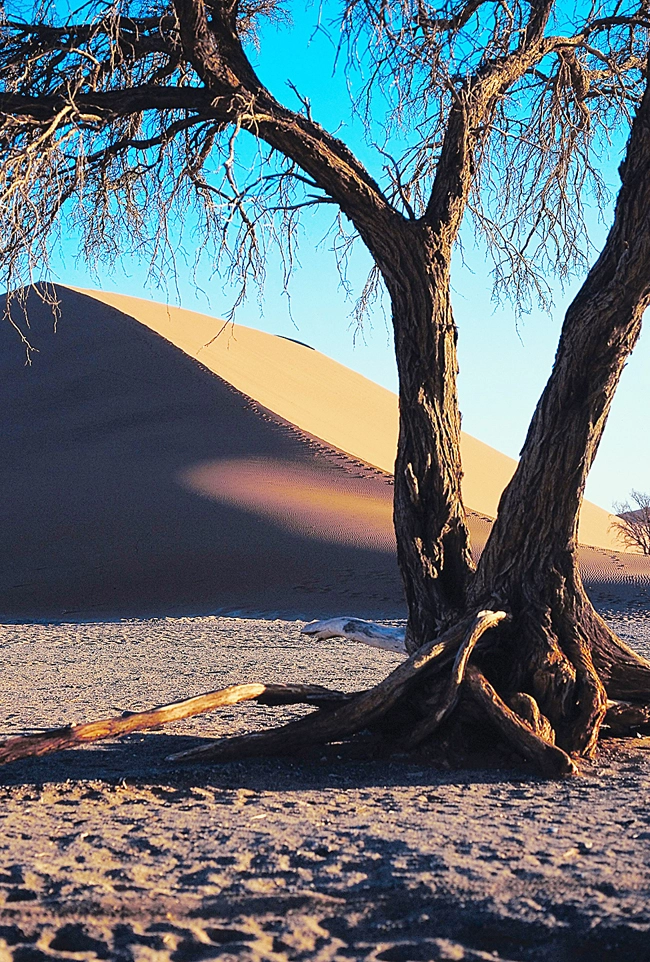
Deserts can be hot or cold. Among the hot deserts are ones with two rain seasons (Sonora desert, Karoo); with one rainy season (northern Sahara, Mohave Desert, middle-Asian deserts); deserts with summer rain (southern Sahara, inner Namib, Atacama); deserts with few rains at any season (central Australia); coastal deserts without rains, but with fog (north Chilean coastal deserts, outer Namib); and deserts without any rain or vegetation (central Sahara). The Sahara in north Africa and the Namib desert in southwest Africa are classified as the hottest deserts in the world, with average monthly temperatures above 86 degrees F (30 degrees C) during the warmest months and extremes above 122 degrees F (50 degrees C). The diurnal temperature range often is large; winter nights in the Namib Desert sometimes are as cold as minus 14 degrees F (10 degrees C) or lower.
Aridity is the most prominent indicator, commonly measured by the Aridity Index, an estimator for the ratio between mean annual precipitation and mean annual potential evapotranspiration, which is less than minus 40 for arid deserts and minus 20 for semi-deserts. Aridity is highest in the Saharan and Chilean-Peruvian deserts, followed by the Arabian, east African, Gobi, Australian, and south African deserts, and lower in the Thar and North American deserts. This high aridity, as well as typical pulse-type variations in desert environments, are caused by global atmospheric and oceanic phenomena, such as the position of the jet streams, the movement of polar-front boundaries, the intensity of the summer monsoon, El Niño Southern Oscillation events, and even longer-term ocean cycles, such as the Pacific Decadal Oscillation.
Climate Change
Driven by these large-scale forces, the intensity and frequency of rain pulses at a local scale may vary substantially with time, and future projections indicate an increasing likelihood of even more episodic climate events and inter-annual variability in deserts. Continental deserts could experience more severe, persistent droughts. In the Americas, temperate deserts are projected to expand substantially under doubled CO2 climate scenarios. About one third of the Sahel was projected to aridify with warming of 2.7–3.6 degrees F (1.5–2 degrees C) by about 2050, with a general equatorward shift of vegetation zones. Alternative climate scenarios show less pronounced changes, even shifts to wetter climates in the Sahel zone and movement of vegetation zones, accordingly. The potentially positive impact of rising atmospheric CO2 remains a significant uncertainty, which also could offset current projections, especially because it is likely to increase plant productivity, leading to contrasting scenarios.
...
- Loading...
Get a 30 day FREE TRIAL
-
 Watch videos from a variety of sources bringing classroom topics to life
 -
Read modern, diverse business cases
-
Explore hundreds of books and reference titles

Read next

More like this
Sage Recommends
We found other relevant content for you on other Sage platforms.
Have you created a personal profile? Login or create a profile so that you can save clips, playlists and searches