
Entry
Entries A-Z
Subject index
Cenozoic Era
The Cenozoic era is the most recent of the nine eras in geological time, and extends from 65 million years ago to the present. The Cenozoic era catalogues extensive climate changes, ranging from hothouse climates with warm-temperate to sub-tropical forests near both the north and south poles, to icehouse climates with ice sheets kilometers thick covering much of the high latitudes in both hemispheres. The first 30 million years of the Cenozoic were the warmest of the era and were characterized by several extreme warmth events.
The first of these climate maxima was the Initial Eocene Thermal Maximum, which occurred approximately 55 million years ago. Geological evidence suggests that at this time, atmospheric CO2 concentrations soared to nearly 20 times current levels, and temperatures in the Arctic Ocean approached those of a comfortable swimming pool, approximately 68 degrees F (20 degrees C). This climate maximum persisted for 50,000—100,000 years, before the climate cooled and then continued a gradual warming trend through the longest period of sustained hothouse warmth in the Cenozoic, the Early Eocene Climatic Optimum.
Early Eocene Climatic Optimum
The Early Eocene Climatic Optimum lasted for over 2 million years, and was characterized by warm and equable (meaning the climate was relatively similar everywhere) conditions. Deciduous, temperate forests covered Antarctica, and palm trees marched north across Wyoming and into Arctic Canada. Summer temperatures in the Arctic Ocean were approximately 59 degrees F (33 degrees C), almost 30 degrees F (17 degrees C) warmer than today, while ocean surface temperatures in the tropics were hardly different (at most, 9 degrees F, or 5 degrees C warmer) from those at present. This low equator-to-pole temperature gradient, with tropical and subtropical climate zones spanning much of the globe, was a notable characteristic of early Cenozoic hothouse climates, and understanding the mechanisms by which such a low temperature gradient would be maintained is one of the greatest challenges in paleoclimate science.
Research on the early Cenozoic era, when an extensively changing climate caused tropical forests to grow in Wyoming and ice sheets to cover a large amount of the high latitudes of both hemispheres, is revealing new insights into this extreme era.
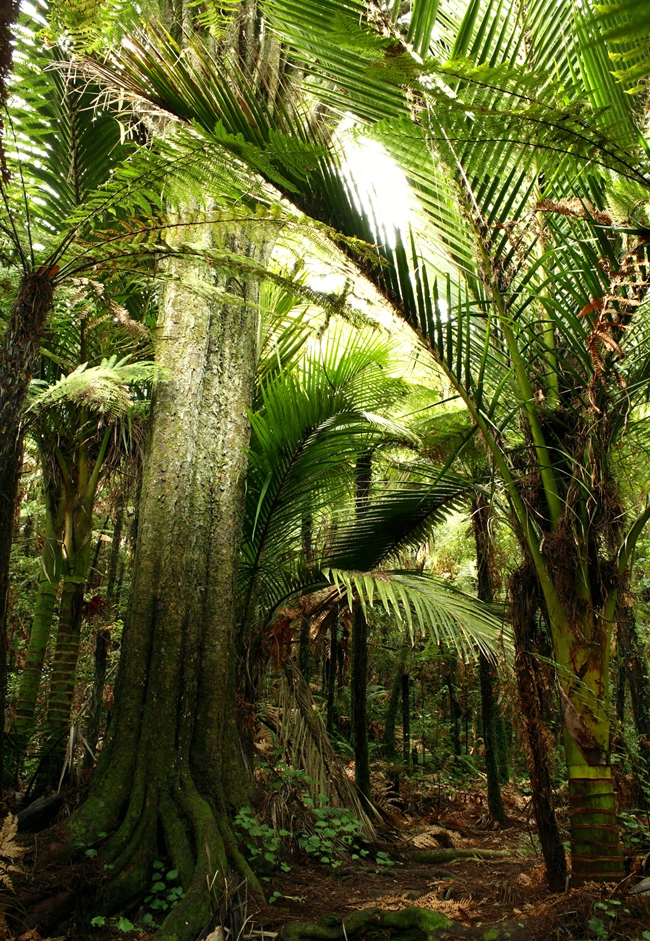
Long thought to be a time of gradual cooling, scientists have recently discovered additional thermal maxima during the later stages of the Eocene. The occurrence of all Eocene thermal maxima appear to be modulated by the eccentricity of Earth's orbit (how much the shape of a planet's orbit deviates from a circle), and these new insights into early Cenozoic climate suggest that hothouse climates are as dynamic as the icehouse climates of the later Cenozoic.
From Hothouse to Icehouse
Abrupt cooling at the Eocene/Oligocene transition (35 million years ago) marked the appearance of the first continent-spanning ice sheet on Antarctica, potentially the first Cenozoic Northern Hemisphere ice sheets, and the transition from hothouse to icehouse climate in the Cenozoic. However, much of the planet continued to experience climatic conditions warmer than the present, with cool temperate forests characterizing Arctic highlands, and warm temperate forests covering much of northern North America and Eurasia.
...
- Loading...
Get a 30 day FREE TRIAL
-
 Watch videos from a variety of sources bringing classroom topics to life
 -
Read modern, diverse business cases
-
Explore hundreds of books and reference titles

Read next

More like this
Sage Recommends
We found other relevant content for you on other Sage platforms.
Have you created a personal profile? Login or create a profile so that you can save clips, playlists and searches