
Entry
Reader's guide
Entries A-Z
Subject index
Volcanism
MEMBERS OF THE scientific community by and large concur that the Earth is undergoing a change in climate and that global warming is occurring at an increasing rate. In fact, scientific modeling suggests that Earth will experience an increase in temperature during the next 100 years at a pace up to four times greater than that in the previous 100 years. To a large extent this acceleration in the late 20th century is attributed to carbon dioxide (CO2) emissions generated by human activity. Carbon dioxide acts like a glass barrier over the Earth, preventing heat from leaking into the environment, and thus creating a greenhouse effect. Human activity has counteracted global warming to a small degree by emitting aerosols in the environment, causing global cooling.
Volcanism is another contributing factor to climate change. Each volcano affects the climate based on its location and the nature and extent of an eruption.
Similar to human activity, volcanism leads to both global warming and cooling. The effect of volcanism on climate depends on the interaction between the sun's heat and the volcanic debris. In essence, scientists believe that ongoing volcanic eruptions have maintained the Earths temperate climate for millions of years. Circumstantial evidence suggests that volcanism can influence short-term weather patterns in addition to having an effect on long-term climate change.
Volcanic dust blown into the atmosphere can remain for months and produce temporary cooling, the degree to which is dependent on the volume of dust, and the duration of which is dependent on the size of the dust particles. The strength of gases can vary greatly among volcanoes. Water vapor is typically the most abundant volcanic gas, followed by carbon dioxide and sulfur dioxide. Other principal volcanic gases include hydrogen sulfide, hydrogen chloride, and hydrogen fluoride.
Volcanoes that discharge great quantities of sulfur compounds affect the climate more significantly than those that release only dust. In fact, the greatest volcanic effect on the Earth's short-term weather patterns is caused by sulfur dioxide gas. Sulfur dioxide can form sulfuric acid aerosols that reflect the sun's heat and trigger cooling of the Earth's surface for as long as two years. Scientific literature frequently refers to the drop in global temperature after the eruption of Mount Pinatubo, Philippines, in 1991 and the very cold temperatures leading to crop failures and famine in North America and Europe for two years following the eruption of Mt. Tam-bora, Indonesia, in 1815 as examples of this effect. Furthermore, sulfuric dioxide can form acid rain, a combination of sulfuric acid and nitric acid. Acid rain, which is also caused by the burning of fossil fuels, is a critical environmental problem that can injure lakes, streams, and forests and the inhabitants of these ecosystems.
Yasur volcano in Vanuatu is one of the world's most active volcanoes, erupting dozens of times a day for about 800 years.
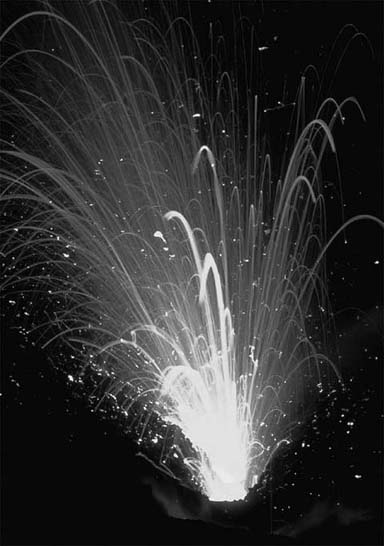
In addition, volcanoes discharge water and carbon dioxide in large quantities in the form of atmospheric gases, and can absorb and retain in the atmosphere heat radiation emanating from the ground. Estimates suggest that water makes up to 99 percent of gas in volcanic expulsions. This short-term warming of the air leads the water to become rain within a matter of hours or days and the carbon dioxide to dissolve in the ocean or to be absorbed by plants. The majority of the heat energy connected to global warming exists in the ocean. If the oceanic depth at which heat is stored is decreased, then global temperature increases are expected to be greater than predicted.
...
- Atmospheric Sciences
- Aerosols
- Anticyclones
- Atmospheric Absorption of Solar Radiation
- Atmospheric Boundary Layer
- Atmospheric Composition
- Atmospheric Emission of Infrared Radiation
- Atmospheric General Circulation Models
- Clouds, Cirrus
- Clouds, Cumulus
- Clouds, Stratus
- Condensation
- Convection
- Coriolis Force
- Cyclones
- Doldrums
- Evaporation and Transpiration
- Evolution of the Atmosphere
- Hadley Circulation
- Heat, Latent
- Heat, Sensible
- Hurricanes and Typhoons
- Hydrological Cycle
- Intertropical Convergence Zone
- Jet Streams
- Mesosphere
- Monsoons
- Precipitation
- Radiation, Absorption
- Radiation, Infrared
- Radiation, Long Wave
- Radiation, Microwave
- Radiation, Short Wave
- Radiation, Ultraviolet
- Rain
- Stratosphere
- Thermosphere
- Thunderstorms
- Trade Winds
- Troposphere
- Walker Circulation
- Waves, Gravity
- Waves, Internal
- Waves, Kelvin
- Waves, Planetary
- Waves, Rossby
- Weather
- Winds, Easterlies
- Winds, Westerlies
- Climate
- Abrupt Climate Changes
- Aerosols
- Albedo
- Anthropogenic Forcing
- Carbon Cycle
- Chaos Theory
- Climate Cycles
- Climate Forcing
- Climate Thresholds
- Climate Zones
- Climatic Data, Atmospheric Observations
- Climatic Data, Cave Records
- Climatic Data, Historical Records
- Climatic Data, Ice Observations
- Climatic Data, Instrumental Records
- Climatic Data, Lake Records
- Climatic Data, Nature of the Data
- Climatic Data, Oceanic Observations
- Climatic Data, Proxy Records
- Climatic Data, Sea Floor Records
- Climatic Data, Sediment Records
- Climatic Data, Tree Ring Records
- Detection of Climate Changes
- Earthshine
- El Niño and La Niña
- Gaia Hypothesis
- Global Warming
- Greenhouse Effect
- Greenhouse Gases
- History of Climatology
- History of Meteorology
- Hydrological Cycle
- Internal Climate Variability
- Methane Cycle
- Milankovitch Cycles
- Monsoons
- North Atlantic Oscillation
- Oxygen Cycle
- Seasonal Cycle
- Southern Oscillation
- Sunlight
- Thermodynamics
- Volcanism
- World Systems Theory
- Climate and Society
- An Inconvenient Truth
- Adaptation
- Alternative Energy, Ethanol
- Alternative Energy, Solar
- Alternative Energy, Wind
- Automobiles
- Bush (George W.) Administration
- Capitalism
- Clean Air Act, U.S.
- Clinton Administration
- Coal
- Conservation
- Culture
- Ecological Footprint
- Education
- Environmental Protection Agency (EPA)
- Framework Convention on Climate Change
- Geography
- Globalization
- Greenhouse Effect
- Greenhouse Gases
- Gross National Product
- Health
- Industrialization
- Maximum Sustainable Yield
- Measurement and Assessment
- Media, Books and Journals
- Media, Internet
- Media, TV
- Movements, Environmental
- Needs and Wants
- Nuclear Power
- Oil, Consumption of
- Policy, U.S.
- Population
- Preparedness
- Public Awareness
- Regulation
- Religion
- Resources
- Risk
- Social Ecology
- Sustainability
- Technology
- Tourism
- Climate Change, Effects
- Adaptation
- Agriculture
- Animals
- Arctic Ocean
- Attribution of Global Warming
- Aviation
- Desertification
- Deserts
- Diseases
- Drought
- Economics, Cost of Affecting Climate Change
- Economics, Impact From Climate Change
- Ecosystems
- Floods
- Food Production
- Glaciers, Retreating
- Hurricanes and Typhoons
- Impacts of Global Warming
- Oceanic Changes
- Plants
- Polar Bears
- Rainfall Patterns
- Sea Level, Rising
- Species Extinction
- Thermohaline Circulation
- Transportation
- Tsunamis
- Climate Feedbacks
- Climate Models
- Atmospheric Component of Models
- Climate Model
- Computer Models
- Energy Balance Models
- Historical Development of Climate Models
- Ice Component of Models
- Land Component of Models
- Modeling of Ice Ages
- Modeling of Ocean Circulation
- Modeling of Paleoclimates
- Ocean Component of Models
- Simulation and Predictability of Seasonal and Interannual Variations
- Validation of Climate Models
- Countries: Africa
- Algeria
- Angola
- Benin
- Botswana
- Brunei Darussalam
- Burkina Faso
- Burundi
- Côte d'Ivoire
- Cameroon
- Cape Verde
- Central African Republic
- Chad
- Comoros
- Congo
- Congo, Democratic Republic of
- Djibouti
- Egypt
- Equatorial Guinea
- Eritrea
- Ethiopia
- Gabon
- Gambia
- Ghana
- Guinea
- Guinea-Bissau
- Kenya
- Lesotho
- Liberia
- Madagascar
- Malawi
- Mali
- Mauritania
- Mauritius
- Morocco
- Mozambique
- Namibia
- Niger
- Nigeria
- Rwanda
- São Tomé and Principe
- Senegal
- Sierra Leone
- Somalia
- South Africa
- Sudan
- Swaziland
- Tanzania
- Togo
- Tunisia
- Uganda
- Zambia
- Zimbabwe
- Countries: Americas
- Antigua and Barbuda
- Argentina
- Bahamas
- Barbados
- Belize
- Bolivia
- Brazil
- Canada
- Chile
- Colombia
- Costa Rica
- Cuba
- Dominica
- Dominican Republic
- Ecuador
- El Salvador
- Grenada
- Guatemala
- Guyana
- Haiti
- Honduras
- Jamaica
- Mexico
- Nicaragua
- Panama
- Paraguay
- Peru
- Saint Kitts and Nevis
- Saint Lucia
- Saint Vincent and the Grenadines
- Suriname
- Trinidad and Tobago
- United States of America
- Uruguay
- Venezuela
- Countries: Asia
- Afghanistan
- Azerbaijan
- Bahrain
- Bangladesh
- Bhutan
- Cambodia
- China
- East Timor
- Georgia (Nation)
- India
- Indonesia
- Iran
- Iraq
- Israel
- Japan
- Jordan
- Kazakhstan
- Korea, North
- Korea, South
- Kuwait
- Kyrgyzstan
- Laos
- Lebanon
- Malaysia
- Maldives
- Mongolia
- Myanmar
- Nepal
- Oman
- Pakistan
- Philippines
- Qatar
- Russia
- Saudi Arabia
- Seychelles
- Singapore
- Sri Lanka
- Syria
- Tajikistan
- Thailand
- Turkey
- Turkmenistan
- Ukraine
- United Arab Emirates
- Uzbekistan
- Vietnam
- Yemen
- Countries: Europe
- Albania
- Andorra
- Armenia
- Austria
- Belarus
- Belgium
- Bosnia and Herzegovina
- Bulgaria
- Croatia
- Cyprus
- Czech Republic
- Denmark
- Estonia
- Finland
- France
- Germany
- Greece
- Hungary
- Iceland
- Ireland
- Italy
- Latvia
- Liechtenstein
- Lithuania
- Luxembourg
- Macedonia (FYROM)
- Malta
- Moldova
- Monaco
- Netherlands
- Norway
- Poland
- Portugal
- Romania
- San Marino
- Serbia and Montenegro
- Slovakia
- Slovenia
- Spain
- Sweden
- Switzerland
- United Kingdom
- Countries: Pacific
- Glaciology
- Government and International Agencies
- Air Force, U.S.
- Department of Defense, U.S.
- Department of Energy, U.S.
- Department of State, U.S.
- Geophysical Fluid Dynamics Laboratory
- Global Atmospheric Research Program (GARP)
- Goddard Institute for Space Studies
- National Aeronautics and Space Administration (NASA)
- National Oceanic and Atmospheric Administration (NOAA)
- National Science Foundation
- Navy, U.S.
- Office of Naval Research
- United Nations
- World Health Organization
- World Meteorological Organization
- Institutions Studying Climate Change
- Alaska Climate Research Center
- Alliance to Save Energy
- American Council for an Energy-Efficient Economy
- American Electric Power
- American Gas Association
- American Geophysical Union
- American Meteorological Society
- Antarctic Meteorology Research Center
- Applied Energy Services, Inc.
- Atmosphere, Climate and Environment Information Programme (UK)
- Atmospheric Research and Information Centre
- BP
- Canadian Association for Renewable Energies
- Cantor Fitzgerald EBS
- Center for Clean Air Policy
- Center for Energy Efficiency
- Center for International Climate and Environmental Research
- Center for International Environmental Law
- Center for Ocean-Atmospheric Prediction Studies
- Center for Science and Environment (India)
- Climate Action Network
- Climate Change Knowledge Network
- Climate Impacts LINK Project
- Climatic Research Unit
- Colorado Climate Center
- Cooperative Institute for Arctic Research
- Cornell University
- David Suzuki Foundation
- Department of Energy, U.S.
- Desert Research Institute
- Edison Electric Institute
- Environmental and Societal Impacts Group
- Environmental Defense
- Environmental Development Action in the Third World
- Environmental Financial Products, LLC
- Environmental Protection Agency (EPA)
- European Commission
- FEEM (Italy)
- Florida State University
- Foundation for International Environmental Law and Development
- Friends of the Earth
- Geophysical Fluid Dynamics Laboratory
- Global Atmospheric Research Program (GARP)
- Global Environment Facility (GEF)
- Global Industrial and Social Progress Research Institute (GISPRI)
- Greenpeace International
- Harvard University
- Heinz Center
- Idaho State Climate Services
- Indiana University
- Institute of Energy Economics (Argentina)
- Intergovernmental Panel on Climate Change (IPCC)
- International Council of Scientific Unions (ICSU)
- International Energy Agency (IEA)
- International Institute for Sustainable Development (IISD)
- International Research Institute for Climate Prediction
- International Solar Energy Society (ISES)
- International Union of Geodesy and Geophysics (IUGG)
- Joint Institute for the Study of the Atmosphere and Ocean (JISAO)
- Kyoto Mechanisms
- LDEO Climate Modeling Group
- Marshall Institute
- Midwestern Regional Climate Center
- National Academy of Sciences, U.S.
- National Association of Energy Service Companies (NAESCO)
- National Center for Atmospheric Research (NCAR)
- Natsource
- Natural Resources Defense Council (NRDC)
- New Mexico Climate Center
- OECD Annex 1 Expert Group on the UNFCCC
- OECD Climate Change Documents
- Ohio State University
- Oregon Climate Service
- Oregon State University
- Organisation for Economic Co-operation and Development (OECD)
- Penn State University
- Pew Center on Global Climate Change
- Renewable Energy Policy Project (REPP)
- Resources for the Future (RFF)
- Royal Dutch/Shell Group
- Royal Meteorological Society
- Scripps Institute of Oceanography
- Solar Energy Industries Association (SEIA)
- Stockholm Environment Institute (SEI)
- Tata Energy Research Institute (TERI)
- Trexler and Associates, Inc.
- UN Conference on Trade and Development/Earth Council Institute: Carbon Market Program
- United Nations Development Programme (UNDP)
- United Nations Environment Programme (UNEP)
- University Corporation for Atmospheric Research
- University Corporation for Atmospheric Research Joint Office for Science Support
- University of Arizona
- University of Birmingham, Meteorology and Climatology Department
- University of California
- University of Colorado
- University of Delaware, Center for Climatic Research
- University of Florida
- University of Hawaii, School of Ocean and Earth Science and Technology
- University of Illinois, Department of Atmospheric Sciences
- University of Kentucky, Agricultural Weather Center
- University of Leeds, Institute for Atmospheric Science
- University of Maine, Institute for Quaternary Studies
- University of Maryland, Department of Meteorology
- University of Miami
- University of Michigan
- University of New Hampshire
- University of Oklahoma, Weather Radar
- University of Reading, Department of Meteorology
- University of Utah, Department of Meteorology
- University of Washington, Atmospheric Science Department
- Utah Climate Center
- Weather World 2010 Project
- Western Regional Climate Center
- Woods Hole Oceanographie Institute
- World Bank
- World Business Council for Sustainable Development
- World Meteorological Organization
- World Resources Institute
- World Wildlife Fund
- Worldwatch Institute
- Oceanography
- Agulhas Current
- Antarctic Circumpolar Current
- Arctic Ocean
- Atlantic Ocean
- Benguela Current
- Current
- Ekman Layer
- Equatorial Undercurrent
- Gulf Stream
- Indian Ocean
- Kuroshio Current
- Meridional Overturning Circulation
- Mixed Layer
- Modeling of Ocean Circulation
- Pacific Ocean
- Peruvian Current
- Salinity
- Seawater, Composition of
- Somali Current
- Southern Ocean
- Thermocline
- Thermohaline Circulation
- Upwelling, Coastal
- Upwelling, Equatorial
- Western Boundary Currents
- Wind-Driven Circulation
- Paleoclimates
- Cenozoic Era
- Cretaceous Era
- Earth's Climate History
- Greenland Cores
- Holocene Era
- Jurassic Era
- Mesozoic Era
- Milankovitch Cycles
- Orbital Parameters, Eccentricity
- Orbital Parameters, Obliquity
- Orbital Parameters, Precession
- Paleozoic Era
- Pleistocene Era
- Pliocene Era
- Precambrian Era
- Quaternary Era
- Tertiary Climate
- Triassic Period
- Vostok Core
- Younger Dryas
- People
- Arakawa, Akio
- Arrhenius, Svante August
- Bolin, Bert
- Broecker, Wallace
- Bryan, Kirk
- Bryson, Reid
- Budyko, Mikhail
- Chamberlin, Thomas C.
- Charney, Jule Gregory
- Croll, James
- Fourier, Joseph
- Gore, Albert, Jr.
- Hadley, George
- Hansen, James
- Keeling, Charles David
- Lindzen, Richard
- Lorenz, Edward
- Manabe, Syukuro
- Milankovitch, Milutin
- Munk, Walter
- Phillips, Norman
- Revelle, Roger
- Richardson, Lewis Fry
- Rossby, Carl-Gustav
- Schneider, Stephen H.
- Singer, S. Fred
- Smagorinsky, Joseph
- Stommel, Henry
- Sverdrup, Harald Ulrik
- Tyndall, John
- Von Neumann, John
- Walker, Gilbert
- Washington, Warren
- Programs and Conventions
- Loading...
Get a 30 day FREE TRIAL
-
 Watch videos from a variety of sources bringing classroom topics to life
 -
Read modern, diverse business cases
-
Explore hundreds of books and reference titles

Read next

More like this
Sage Recommends
We found other relevant content for you on other Sage platforms.
Have you created a personal profile? Login or create a profile so that you can save clips, playlists and searches