
Entry
Reader's guide
Entries A-Z
Subject index
Rocketry
The opportunity to build and launch rockets has been a continuing success story in the area of hands-on science education, especially for gifted and talented children. Yet what do students actually learn from these experiences? This entry examines effective structuring of model rocket activity specifically, but also looks at the bigger picture of the structure of hands-on activities for gifted students.
A widespread interpretation of Piagetian theory favors an oversensitivity to the things a child cannot do cognitively rather than a more optimistic and challenging emphasis on what children could do easily with the proper instructional sequence, structure, and social support. This optimistic and empowering emphasis on the child's early competence and strength is both a more empowering basis for science instruction for the gifted child and is in accord with current learning theory. Moreover, much of this work looks upon the child in isolation rather than as a part of a community of learners like that in which rocket scientists engage in on a daily basis.
For instance, the scientist engages intellectually with colleagues at conferences, graduate students in labs, students in classes, and receives feedback on manuscripts from reviewers. What a rich community the rocket scientist belongs to. How can classrooms be structured to take advantage of these social practices of the rocket scientist?
Figure 1 Activity Structure for Proposed Model Rocket Activity
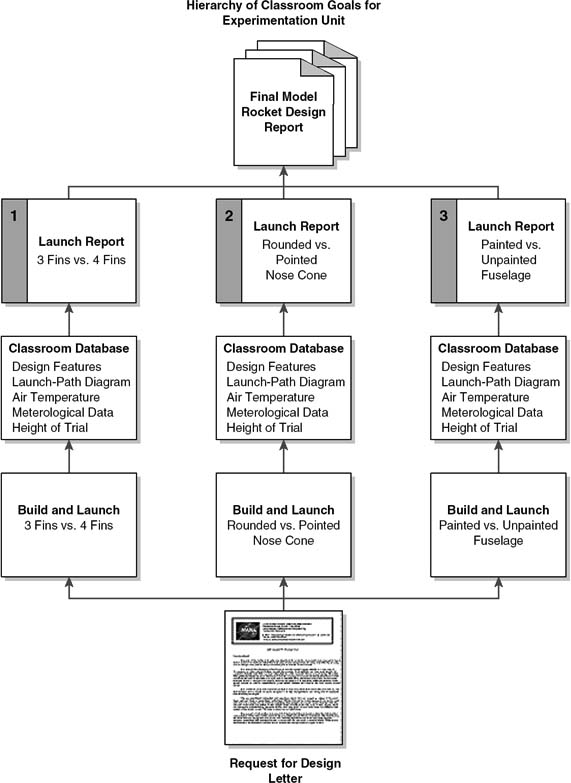
Effective learning experiences are often organized around a driving question. Frequently, however, the question that drives a project is not crafted to make connections between activities and the underlying conceptual knowledge that one might hope to foster. Although the opportunity for deep learning is there, it often does not occur because of the tendency in these hands-on approaches to get caught up in the action without appropriate opportunities for reflection and revision. In such cases, the “doing” of an activity takes precedence over “doing with understanding.” An example of the need for a well-crafted, driving question comes from projects in model rocketry. Thousands of classrooms throughout the country engage in similar types of activities. The opportunities to build and launch rockets have been extremely popular for students, teachers, and parents. Launchings frequently attract press attention, with footage shown on local news programs.
A great deal of recent research has explored whether it is possible to deepen students' understanding by creating the social structures of the scientists (this is sometimes called “participatory practices”) without dampening students' enthusiasm. For instance, can students learn about experimentation and measurement if they have an appropriate driving question behind a model rocket project? To examine this issue, it is necessary to add a learning-appropriate goal to the standard model rocket project that motivates the use of scientific and statistical methods. Indeed, there are many reasons to proclaim such projects a success. But what do students actually learn from their experiences? Research has found that many students who completed the traditional rocket project learned relatively little from the hands-on activity of simply making and launching their rockets. They did not, for example, understand what made a better or worse rocket, and they did not understand how to evaluate the effectiveness of their rockets in any systematic way. One reason for this may be that the students did not have a driving question that could foster focused inquiry. For example, when students were asked what they thought about the purpose of the activity, a typical response was, “You know, to build them and see how high they will go.”
...
- Assessment and Identification
- ACT College Admission Examination
- Aptitude Assessment
- Artistic Assessment
- Biographical Assessment of Creativity
- Cognitive Abilities Test
- Creativity Assessment
- Early Identification
- Gifted Rating Scales
- High-Stakes Testing
- Identification
- Intelligence Testing
- Iowa Acceleration Scale
- Kaufman ABC Tests
- Levels of Gifted
- Multicultural Assessment
- Musical Talent Assessment
- Naglieri Nonverbal Ability Test
- Nonverbal Tests
- Optimal Development
- Raven's Progressive Matrices
- SAT
- Stanford-Binet
- Teacher Nominations
- Teacher Rating Scales
- Test Development
- Test Preparation
- Torrance Tests of Creative Thinking
- Wechsler Intelligence Scale for Children–Fourth Edition
- Wechsler Preschool and Primary Scale of Intelligence–Third Edition
- Creativity Studies
- “Aha!” Experience
- Cognitive Development
- Creative Personality
- Creative Problem Solving
- Creative Process
- Creative Productivity
- Creativity and Mental Illnesses
- Creativity in Science
- Creativity in the Workplace
- Divergent Thinking
- Family Creativity
- Flow
- Gestalt Psychology and Creativity
- Imagination
- Innovation
- Problem Solving
- Relationship of Creativity to Intelligence
- Sex Differences in Creativity
- Cultural Issues
- Africa, Gifted Education
- Anti-Intellectualism
- Asia, Gifted Education
- Attitudes Toward Religion and Spirituality
- Australia, Gifted Education
- Canada, Gifted Education
- China, Gifted Education
- Cultural Conceptions of Giftedness
- Cultural Values
- Diversity in Gifted Education
- Elitism
- Eugenics
- Europe, Gifted Education
- Global Issues
- Grandparenting
- History of Creativity
- History of Gifted Education in the United States
- Japan, Gifted Education
- Latin America/South America, Gifted Education
- Legal Issues for Gifted
- Multicultural Creativity
- Multicultural Curriculum
- Parental Attitudes
- Parenting
- Popular Culture
- Role Models
- School Attitudes
- Sibling Relationships
- Social-Emotional Issues
- Socioeconomic Status
- Stigmatization
- Student Attitudes
- Teacher Attitudes
- Underrepresentation
- World Views
- Education
- Academic Advising
- Acceleration/A Nation Deceived
- Action Research
- Administrative Attitudes
- Administrative Decision Making
- Architecture
- Art Education
- Astronomy
- Attitudes Toward Gifted
- Best Practices
- Biology Curriculum, Gifted
- Cartooning
- Chemistry Curriculum, Gifted
- Children, Middle School
- Classical Languages Curriculum, Gifted
- Classics/Great Books
- Classroom Practices
- Cluster Grouping
- Cluster Grouping for English Language Learners
- Collaborative Learning
- College Creativity
- College Gifted
- Competencies for Teachers of Gifted
- Controversies in Gifted Education
- Creative Classroom Techniques
- Creative Teaching
- Creativity in Engineering
- Differentiation
- Dropouts, Gifted
- Elementary Enrichment
- Elementary School, Literature Curriculum
- Elementary School, Mathematics Curriculum
- Elementary School, Science Curriculum
- Elementary School, Social Studies Curriculum
- Elementary School, Writing Curriculum
- Enrichment Theories
- Extracurricular Activities
- Factor Analyses Creativity
- Gifted Child Quarterly
- Governor's Schools
- Graduate Education
- Homeschooling
- Honor Societies
- Honors Program
- Inclusion
- Independent Day and Boarding Schools
- Indiana Academy
- Individual Education Plan
- Individualized Instruction
- Instructional Management
- International Baccalaureate
- International Schools for the Gifted
- Internships
- Ivy League Colleges
- Language Arts, Curriculum
- Learning
- Learning Styles
- Mathematics, Curriculum
- Mentoring Gifted and Talented Individuals
- Meta-Analyses of Gifted Education
- Middle School Enrichment
- Middle School Movement
- Middle School, Literature Curriculum
- Middle School, Mathematics Curriculum
- Middle School, Science Curriculum
- Middle School, Social Studies Curriculum
- Middle School, Writing Curriculum
- Montessori Schools
- Music Education
- National Academies of Sciences
- National Academy of Arts, Sciences, and Engineering
- National Merit Scholarship Program
- Online Gifted Education
- Out-of-School
- Parent Nominations
- Precocious Reading
- Preschool
- Preservice Education
- Presidential Scholars
- Professional Development
- Regular Classroom
- Saturday Programs
- Scholarships
- Science, Curriculum
- Scope and Sequence
- Secondary School, Literature Curriculum
- Secondary School, Mathematics Curriculum
- Secondary School, Social Studies Curriculum
- Secondary School, Writing Curriculum
- Secondary Schools
- Self-Contained Classroom
- Service-Learning
- Single-Sex Schooling
- Social Studies, Curriculum
- Specialized Secondary Schools
- Summer Programs
- Teacher Training
- Teachers of Gifted
- Technology
- Visual Metaphor
- Web-Based Learning
- Eminent People
- Exceptionalities
- Intelligence
- Neuroscience and Genetics
- Populations
- Adolescent, Creative
- Adolescent, Gifted
- Adult, Gifted
- African American, Gifted
- Asian American, Gifted
- Autonomous Learner
- Boys, Gifted
- Criminal Gifted
- Disabilities, Gifted
- Elderly, Gifted
- Gay, Lesbian, Bisexual, and Transgender Gifted
- Gifted in the Workplace
- Girls, Gifted
- Highly Gifted
- Hispanic/Latino(a), Gifted
- Islamic American, Gifted
- Men, Gifted
- Native American, Gifted
- Poverty and Low-Income Gifted
- Rural Gifted
- Savants
- Talented Girls, Mathematics
- Talented Readers
- Valedictorians
- Very Young Creative
- Very Young Gifted
- Women, Gifted
- Programs and Interventions
- Acceleration Options
- Advanced Placement
- American Psychological Association Center for Gifted Education Policy
- Belin-Blank Center
- Brainstorming
- Career Counseling
- Center for Gifted Education
- Center for Talent Development
- Chess
- Coaching
- Competitions
- Confratute
- Council for Exceptional Children—The Association for the Gifted
- Creativity Research Journal
- Creativity Training
- Davidson Institute for Talent Development
- Early Admission, College
- Early Entrance, Kindergarten
- Effective Programs
- Evaluation of Programs
- Future Problem Solving
- Gifted Education Centers
- Gifted Education Resource Institute
- Guidance
- Halbert Robinson Center
- Institute for Research and Policy on Acceleration
- Institute of Personality Assessment and Research
- Javits Program
- Mensa
- Midwest Academic Talent Search
- National Association for Gifted Children
- National Research Center on the Gifted and Talented
- No Child Left Behind
- Nobel Prize
- Poets Laureate
- Robotics
- Rocketry
- Roeper Review
- Science Talent Search Winners
- State Associations
- State Offices of Gifted
- Storytelling
- Study of Mathematically Precocious Youth
- Summer Camps
- Supporting Emotional Needs of the Gifted
- Synectics
- Talent Identification Program
- Talent Searches
- Torrance Center for Creativity and Talent Development
- Visualization
- Wallace Research Symposium
- World Conferences
- World Council for Gifted and Talented Children
- Psychological Issues
- Absorption
- Academic Self-Concept
- Achievement Motivation
- Aspiration Development and Self-Fulfillment
- Asynchrony
- Character and Moral Development
- Consciousness
- Eccentricity and Temperament
- Emotional Development
- Emotional Intelligence
- Existential Depression
- Family Achievement
- Friendships
- Genius
- Group Dynamics
- Imagery
- Inquiry
- Intrinsic Versus Extrinsic Motivation
- Leadership
- Life Satisfaction
- Locus of Control
- Meaning of Life
- Moral Development
- Motivating Gifted Students
- Overexcitabilities
- Perfectionism
- Prodigies
- Psychotherapy
- Reaction Time
- Resilience
- Risk Taking
- School Psychologists
- Self-Actualization
- Self-Efficacy/Self-Esteem
- Social Development
- Spirituality
- Stereotype Threat
- Talent Development
- Thinking Skills
- Transpersonal Psychology
- Talent Domains
- Academic Talent
- Artistic Ability
- Athletic Giftedness
- Bilingualism and Creativity
- Cognitive Abilities
- Creative Leadership
- Dance
- Domains of Talent
- Drama
- Entrepreneurial Ability
- Everyday Creativity
- Existentially Gifted
- Factor Analyses Creativity
- Film and Film-Making Gifted
- General Creativity
- Gifted Readers
- Inventors
- Literary Creativity
- Mathematical Creativity
- Mathematical Intelligence
- Mathematical Talent
- Mathematically Precocious
- Multilingualism
- Multiple Intelligences
- Multipotentiality
- Musical Creativity
- Musical Intelligence
- Musicians
- Originality
- Performing Arts
- Playwrights
- Political Leaders
- Polymaths
- Scientifically Gifted
- Scientists
- Spiritual Intelligence
- Spiritual Leaders
- Verbal Ability
- Visual-Spatial Learners
- Writers
- Theories and Models
- Biographical Methods in Gifted Education
- Creative Communities
- Creative Organizational Climate
- Creativity and the Economic System
- Creativity Theories
- Creativity, Definition
- Curriculum Models
- Differentiated Model of Giftedness and Talent
- Dual Processing Model
- Early Ripe, Early Rot
- Enrichment Triad Model
- Giftedness, Definition
- Habits of Mind
- Historiometry
- Hollingworth's Studies of Highly Gifted Students
- Intelligence Theories
- Parallel Curriculum Model
- Positive Disintegration
- Practical Intelligence
- Psychoanalytic Theories of Creativity
- Purdue Model
- Research, Qualitative
- Research, Quantitative
- Revolving Door Identification Model
- Schoolwide Enrichment Model
- Structure of Intellect
- Terman's Studies of Genius
- Triarchic Theory
- Loading...
Get a 30 day FREE TRIAL
-
 Watch videos from a variety of sources bringing classroom topics to life
 -
Read modern, diverse business cases
-
Explore hundreds of books and reference titles

Read next

More like this
Sage Recommends
We found other relevant content for you on other Sage platforms.
Have you created a personal profile? Login or create a profile so that you can save clips, playlists and searches