
Entry
Reader's guide
Entries A-Z
Subject index
Naglieri Nonverbal Ability Test
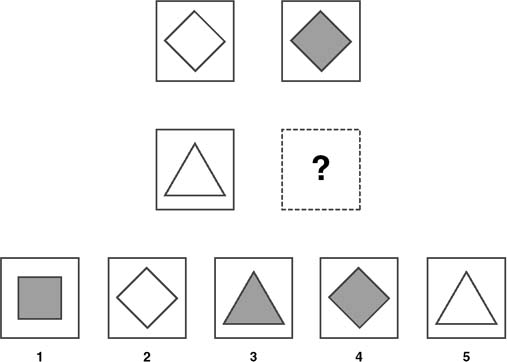
The Naglieri Nonverbal Ability Test–Second Edition (NNAT2) is a nonverbal measure of general ability based on a testing method (see Figure 1) supported by nearly a century of research. NNAT2 items assess ability without requiring the student to read, write, or speak. Students must rely on reasoning using geometric designs, not on verbal skills. The NNAT2 has been developed with the goal of providing a means of testing intelligence that is a fair assessment across gender, race, and ethnicity. The NNAT2 is a revision of the Naglieri Nonverbal Ability Test–Multilevel Form, which was a revision of the Matrix Analogies Test – Expanded Form and the Matrix Analogies Test – Short Form, which were used extensively in educational settings.
Versions and Standardization
There are two versions of the NNAT2; one uses a traditional paper-and-pencil method and the other is presented and scored online. Both versions consist of seven separate sets of items organized into levels corresponding to different grades. Each set is made up of 48 items that are presented in the colors black, blue, white, and yellow (these colors are least influenced by color-impaired vision). Each level contains items shared from both the adjacent higher and lower levels, as well as exclusive items. The shared items were used to develop a continuous scaled score across the entire standardization sample. These items yield a total raw score that is converted to a Nonverbal Ability Index standard score set at a mean of 100 with a standard deviation of 16 through an intermediate value called a Scaled Score.
The NNAT was standardized on a large nationally representative sample of more than 33,000 students in Grades K through 12 (ages 5 through 18 years). The sample closely matches the U.S. population on the basis of geographic region, socioeconomic status, urbanicity, ethnicity, and school setting. The sample included children with special needs such as those with emotional disturbance, learning disabilities, hearing and visual impairment, and those who were mentally handicapped. Children with limited English proficiency were also included in the standardization sample. More details may be obtained from the NNAT2 Technical Manual.
Validity
The validity of the NNAT has been examined in a series of published research papers. Jack Naglieri and Margaret Ronning studied mean score differences and correlations to achievement for matched samples of White (n = 2,306) and African American (n = 2,306); White (n = 1,176) and Hispanic (n = 1,176); and White (n = 466) and Asian (n = 466) students in Grades K through 12. The three pairs of groups were carefully selected from a larger sample included in the NNAT standardization sample and matched on all demographic variables.
Figure 1 Illustrative Naglieri Nonverbal Ability Test–Second Edition item
Only small differences were found between the NNAT scores for the White and African American samples (Cohen's d ratio = .25), White and Hispanic (d ratio = .17), and White and Asian (d ratio = .02) groups. In addition, the correlations between NNAT and academic achievement were strong and consistent across Grades K through 12 and similar for each of the samples. The small mean score differences and the strong correlations strongly suggest that the NNAT has utility for fair assessment of minority children and that the scores the test yields are good for statistical prediction of achievement.
...
- Assessment and Identification
- ACT College Admission Examination
- Aptitude Assessment
- Artistic Assessment
- Biographical Assessment of Creativity
- Cognitive Abilities Test
- Creativity Assessment
- Early Identification
- Gifted Rating Scales
- High-Stakes Testing
- Identification
- Intelligence Testing
- Iowa Acceleration Scale
- Kaufman ABC Tests
- Levels of Gifted
- Multicultural Assessment
- Musical Talent Assessment
- Naglieri Nonverbal Ability Test
- Nonverbal Tests
- Optimal Development
- Raven's Progressive Matrices
- SAT
- Stanford-Binet
- Teacher Nominations
- Teacher Rating Scales
- Test Development
- Test Preparation
- Torrance Tests of Creative Thinking
- Wechsler Intelligence Scale for Children–Fourth Edition
- Wechsler Preschool and Primary Scale of Intelligence–Third Edition
- Creativity Studies
- “Aha!” Experience
- Cognitive Development
- Creative Personality
- Creative Problem Solving
- Creative Process
- Creative Productivity
- Creativity and Mental Illnesses
- Creativity in Science
- Creativity in the Workplace
- Divergent Thinking
- Family Creativity
- Flow
- Gestalt Psychology and Creativity
- Imagination
- Innovation
- Problem Solving
- Relationship of Creativity to Intelligence
- Sex Differences in Creativity
- Cultural Issues
- Africa, Gifted Education
- Anti-Intellectualism
- Asia, Gifted Education
- Attitudes Toward Religion and Spirituality
- Australia, Gifted Education
- Canada, Gifted Education
- China, Gifted Education
- Cultural Conceptions of Giftedness
- Cultural Values
- Diversity in Gifted Education
- Elitism
- Eugenics
- Europe, Gifted Education
- Global Issues
- Grandparenting
- History of Creativity
- History of Gifted Education in the United States
- Japan, Gifted Education
- Latin America/South America, Gifted Education
- Legal Issues for Gifted
- Multicultural Creativity
- Multicultural Curriculum
- Parental Attitudes
- Parenting
- Popular Culture
- Role Models
- School Attitudes
- Sibling Relationships
- Social-Emotional Issues
- Socioeconomic Status
- Stigmatization
- Student Attitudes
- Teacher Attitudes
- Underrepresentation
- World Views
- Education
- Academic Advising
- Acceleration/A Nation Deceived
- Action Research
- Administrative Attitudes
- Administrative Decision Making
- Architecture
- Art Education
- Astronomy
- Attitudes Toward Gifted
- Best Practices
- Biology Curriculum, Gifted
- Cartooning
- Chemistry Curriculum, Gifted
- Children, Middle School
- Classical Languages Curriculum, Gifted
- Classics/Great Books
- Classroom Practices
- Cluster Grouping
- Cluster Grouping for English Language Learners
- Collaborative Learning
- College Creativity
- College Gifted
- Competencies for Teachers of Gifted
- Controversies in Gifted Education
- Creative Classroom Techniques
- Creative Teaching
- Creativity in Engineering
- Differentiation
- Dropouts, Gifted
- Elementary Enrichment
- Elementary School, Literature Curriculum
- Elementary School, Mathematics Curriculum
- Elementary School, Science Curriculum
- Elementary School, Social Studies Curriculum
- Elementary School, Writing Curriculum
- Enrichment Theories
- Extracurricular Activities
- Factor Analyses Creativity
- Gifted Child Quarterly
- Governor's Schools
- Graduate Education
- Homeschooling
- Honor Societies
- Honors Program
- Inclusion
- Independent Day and Boarding Schools
- Indiana Academy
- Individual Education Plan
- Individualized Instruction
- Instructional Management
- International Baccalaureate
- International Schools for the Gifted
- Internships
- Ivy League Colleges
- Language Arts, Curriculum
- Learning
- Learning Styles
- Mathematics, Curriculum
- Mentoring Gifted and Talented Individuals
- Meta-Analyses of Gifted Education
- Middle School Enrichment
- Middle School Movement
- Middle School, Literature Curriculum
- Middle School, Mathematics Curriculum
- Middle School, Science Curriculum
- Middle School, Social Studies Curriculum
- Middle School, Writing Curriculum
- Montessori Schools
- Music Education
- National Academies of Sciences
- National Academy of Arts, Sciences, and Engineering
- National Merit Scholarship Program
- Online Gifted Education
- Out-of-School
- Parent Nominations
- Precocious Reading
- Preschool
- Preservice Education
- Presidential Scholars
- Professional Development
- Regular Classroom
- Saturday Programs
- Scholarships
- Science, Curriculum
- Scope and Sequence
- Secondary School, Literature Curriculum
- Secondary School, Mathematics Curriculum
- Secondary School, Social Studies Curriculum
- Secondary School, Writing Curriculum
- Secondary Schools
- Self-Contained Classroom
- Service-Learning
- Single-Sex Schooling
- Social Studies, Curriculum
- Specialized Secondary Schools
- Summer Programs
- Teacher Training
- Teachers of Gifted
- Technology
- Visual Metaphor
- Web-Based Learning
- Eminent People
- Exceptionalities
- Intelligence
- Neuroscience and Genetics
- Populations
- Adolescent, Creative
- Adolescent, Gifted
- Adult, Gifted
- African American, Gifted
- Asian American, Gifted
- Autonomous Learner
- Boys, Gifted
- Criminal Gifted
- Disabilities, Gifted
- Elderly, Gifted
- Gay, Lesbian, Bisexual, and Transgender Gifted
- Gifted in the Workplace
- Girls, Gifted
- Highly Gifted
- Hispanic/Latino(a), Gifted
- Islamic American, Gifted
- Men, Gifted
- Native American, Gifted
- Poverty and Low-Income Gifted
- Rural Gifted
- Savants
- Talented Girls, Mathematics
- Talented Readers
- Valedictorians
- Very Young Creative
- Very Young Gifted
- Women, Gifted
- Programs and Interventions
- Acceleration Options
- Advanced Placement
- American Psychological Association Center for Gifted Education Policy
- Belin-Blank Center
- Brainstorming
- Career Counseling
- Center for Gifted Education
- Center for Talent Development
- Chess
- Coaching
- Competitions
- Confratute
- Council for Exceptional Children—The Association for the Gifted
- Creativity Research Journal
- Creativity Training
- Davidson Institute for Talent Development
- Early Admission, College
- Early Entrance, Kindergarten
- Effective Programs
- Evaluation of Programs
- Future Problem Solving
- Gifted Education Centers
- Gifted Education Resource Institute
- Guidance
- Halbert Robinson Center
- Institute for Research and Policy on Acceleration
- Institute of Personality Assessment and Research
- Javits Program
- Mensa
- Midwest Academic Talent Search
- National Association for Gifted Children
- National Research Center on the Gifted and Talented
- No Child Left Behind
- Nobel Prize
- Poets Laureate
- Robotics
- Rocketry
- Roeper Review
- Science Talent Search Winners
- State Associations
- State Offices of Gifted
- Storytelling
- Study of Mathematically Precocious Youth
- Summer Camps
- Supporting Emotional Needs of the Gifted
- Synectics
- Talent Identification Program
- Talent Searches
- Torrance Center for Creativity and Talent Development
- Visualization
- Wallace Research Symposium
- World Conferences
- World Council for Gifted and Talented Children
- Psychological Issues
- Absorption
- Academic Self-Concept
- Achievement Motivation
- Aspiration Development and Self-Fulfillment
- Asynchrony
- Character and Moral Development
- Consciousness
- Eccentricity and Temperament
- Emotional Development
- Emotional Intelligence
- Existential Depression
- Family Achievement
- Friendships
- Genius
- Group Dynamics
- Imagery
- Inquiry
- Intrinsic Versus Extrinsic Motivation
- Leadership
- Life Satisfaction
- Locus of Control
- Meaning of Life
- Moral Development
- Motivating Gifted Students
- Overexcitabilities
- Perfectionism
- Prodigies
- Psychotherapy
- Reaction Time
- Resilience
- Risk Taking
- School Psychologists
- Self-Actualization
- Self-Efficacy/Self-Esteem
- Social Development
- Spirituality
- Stereotype Threat
- Talent Development
- Thinking Skills
- Transpersonal Psychology
- Talent Domains
- Academic Talent
- Artistic Ability
- Athletic Giftedness
- Bilingualism and Creativity
- Cognitive Abilities
- Creative Leadership
- Dance
- Domains of Talent
- Drama
- Entrepreneurial Ability
- Everyday Creativity
- Existentially Gifted
- Factor Analyses Creativity
- Film and Film-Making Gifted
- General Creativity
- Gifted Readers
- Inventors
- Literary Creativity
- Mathematical Creativity
- Mathematical Intelligence
- Mathematical Talent
- Mathematically Precocious
- Multilingualism
- Multiple Intelligences
- Multipotentiality
- Musical Creativity
- Musical Intelligence
- Musicians
- Originality
- Performing Arts
- Playwrights
- Political Leaders
- Polymaths
- Scientifically Gifted
- Scientists
- Spiritual Intelligence
- Spiritual Leaders
- Verbal Ability
- Visual-Spatial Learners
- Writers
- Theories and Models
- Biographical Methods in Gifted Education
- Creative Communities
- Creative Organizational Climate
- Creativity and the Economic System
- Creativity Theories
- Creativity, Definition
- Curriculum Models
- Differentiated Model of Giftedness and Talent
- Dual Processing Model
- Early Ripe, Early Rot
- Enrichment Triad Model
- Giftedness, Definition
- Habits of Mind
- Historiometry
- Hollingworth's Studies of Highly Gifted Students
- Intelligence Theories
- Parallel Curriculum Model
- Positive Disintegration
- Practical Intelligence
- Psychoanalytic Theories of Creativity
- Purdue Model
- Research, Qualitative
- Research, Quantitative
- Revolving Door Identification Model
- Schoolwide Enrichment Model
- Structure of Intellect
- Terman's Studies of Genius
- Triarchic Theory
- Loading...
Get a 30 day FREE TRIAL
-
 Watch videos from a variety of sources bringing classroom topics to life
 -
Read modern, diverse business cases
-
Explore hundreds of books and reference titles

Read next

More like this
Sage Recommends
We found other relevant content for you on other Sage platforms.
Have you created a personal profile? Login or create a profile so that you can save clips, playlists and searches