
Entry
Reader's guide
Entries A-Z
Subject index
Asia, Gifted Education
Conceptions of giftedness are grounded in culture. Understanding how giftedness is identified and nurtured in diverse contexts helps us broaden and deepen our own perspectives. It also improves our understanding of the role of culture and context in the identification and education of gifted and talented children. Asia is the world's largest and most populated region. More than half the people in the world live there. Geographically speaking, it consists of four regions: Central Asia, Eastern Asia, Southern Asia, and Southeast Asia. Historically, each region pursued different paths in its social formation and political development. As a result, Asia is a continent with amazing diversity. It includes some of the richest countries in the word (Japan) and the poorest (Bangladesh). Asians are therefore distinctively unique in their political, social, and cultural outlooks.
Asians were identifying gifted children and developing their abilities long before there was a United States or a United Kingdom. For example, as early as the Spring and Autumn Period in the 8th century BCE, the Chinese valued talent in interpersonal intelligence, arts (including music and calligraphy), athletics (including archery and horseback riding), and arithmetic. Later, in the 3rd century BCE, the Chinese sent child prodigies through the Boy's Imperial Examination. The imperial examination system begun in ancient China served to filter talents in the society. The modern version of such a system can be seen today in the stiff competition in national examinations in Asian countries.
Giftedness in Asia
To understand giftedness in Asia, it is essential to grasp fundamental differences between Eastern and Western philosophies concerning ability. In Western societies, genetics is largely viewed as the dominating force in latent ability. Although environmental factors are acknowledged and the nature/nurture debate remains ongoing, parents generally believe that their children are born with a predetermined predisposition to certain kinds and levels of ability. Their job is to identify and develop their children's innate aptitude.
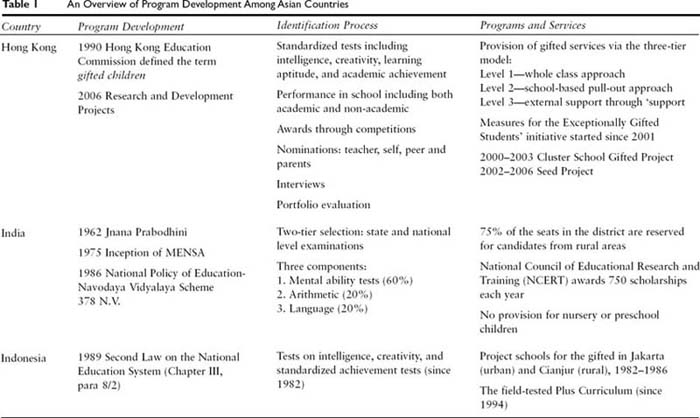
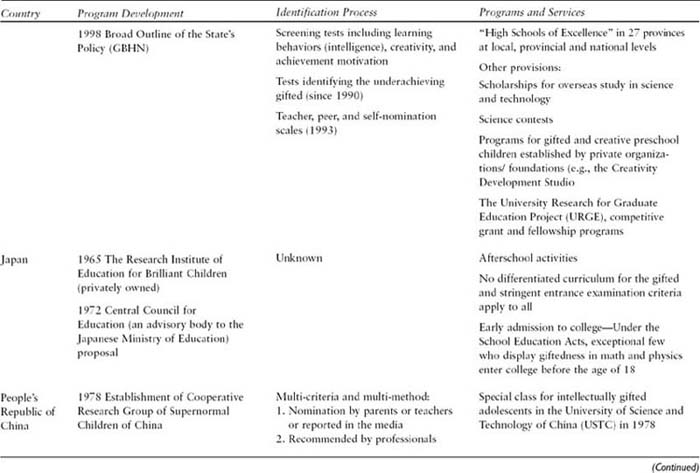
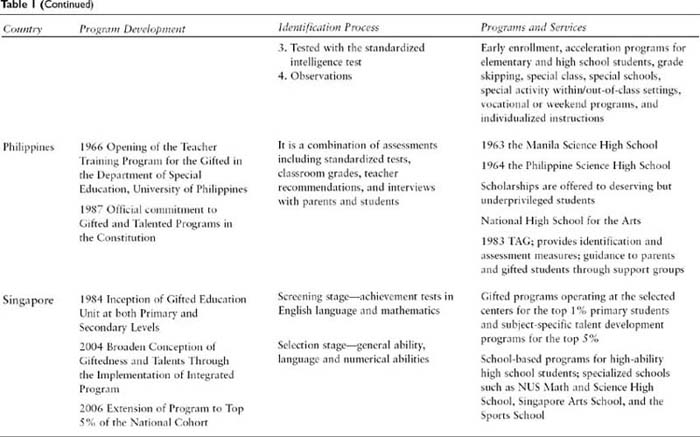
This is not the case in Asian societies. Asians view environmental forces as dominant, and they generally believe that all children are born with similar potential but with different rates of development. Therefore, the prevailing view is that with hard work, anything is possible. Though the strength of this belief varies across and within Asian countries, common parental and educational practices reflect this mindset. As a result, Asian parents and teachers approach the identification and development of children's abilities quite differently from their Western counterparts. For instance, there has been little emphasis on early identification. Gifted Asian children are often identified later than their Western counterparts.
Further, until quite recently, equity was largely a concern of Western countries. Streaming has been the norm in much of Asia for generations. The difference among societies is the age at which streaming begins and the levels at which it is maintained. Ability grouping, special classes, and elite schools have a long history. In other ways, though, Asian programs are similar because most have adapted Western models according to their own sociocultural and political contexts. However, the way in which education is funded and the goals of education differ from Western contexts. Among Asian countries, there are sharp divides between developed and developing nations.
...
- Assessment and Identification
- ACT College Admission Examination
- Aptitude Assessment
- Artistic Assessment
- Biographical Assessment of Creativity
- Cognitive Abilities Test
- Creativity Assessment
- Early Identification
- Gifted Rating Scales
- High-Stakes Testing
- Identification
- Intelligence Testing
- Iowa Acceleration Scale
- Kaufman ABC Tests
- Levels of Gifted
- Multicultural Assessment
- Musical Talent Assessment
- Naglieri Nonverbal Ability Test
- Nonverbal Tests
- Optimal Development
- Raven's Progressive Matrices
- SAT
- Stanford-Binet
- Teacher Nominations
- Teacher Rating Scales
- Test Development
- Test Preparation
- Torrance Tests of Creative Thinking
- Wechsler Intelligence Scale for Children–Fourth Edition
- Wechsler Preschool and Primary Scale of Intelligence–Third Edition
- Creativity Studies
- “Aha!” Experience
- Cognitive Development
- Creative Personality
- Creative Problem Solving
- Creative Process
- Creative Productivity
- Creativity and Mental Illnesses
- Creativity in Science
- Creativity in the Workplace
- Divergent Thinking
- Family Creativity
- Flow
- Gestalt Psychology and Creativity
- Imagination
- Innovation
- Problem Solving
- Relationship of Creativity to Intelligence
- Sex Differences in Creativity
- Cultural Issues
- Africa, Gifted Education
- Anti-Intellectualism
- Asia, Gifted Education
- Attitudes Toward Religion and Spirituality
- Australia, Gifted Education
- Canada, Gifted Education
- China, Gifted Education
- Cultural Conceptions of Giftedness
- Cultural Values
- Diversity in Gifted Education
- Elitism
- Eugenics
- Europe, Gifted Education
- Global Issues
- Grandparenting
- History of Creativity
- History of Gifted Education in the United States
- Japan, Gifted Education
- Latin America/South America, Gifted Education
- Legal Issues for Gifted
- Multicultural Creativity
- Multicultural Curriculum
- Parental Attitudes
- Parenting
- Popular Culture
- Role Models
- School Attitudes
- Sibling Relationships
- Social-Emotional Issues
- Socioeconomic Status
- Stigmatization
- Student Attitudes
- Teacher Attitudes
- Underrepresentation
- World Views
- Education
- Academic Advising
- Acceleration/A Nation Deceived
- Action Research
- Administrative Attitudes
- Administrative Decision Making
- Architecture
- Art Education
- Astronomy
- Attitudes Toward Gifted
- Best Practices
- Biology Curriculum, Gifted
- Cartooning
- Chemistry Curriculum, Gifted
- Children, Middle School
- Classical Languages Curriculum, Gifted
- Classics/Great Books
- Classroom Practices
- Cluster Grouping
- Cluster Grouping for English Language Learners
- Collaborative Learning
- College Creativity
- College Gifted
- Competencies for Teachers of Gifted
- Controversies in Gifted Education
- Creative Classroom Techniques
- Creative Teaching
- Creativity in Engineering
- Differentiation
- Dropouts, Gifted
- Elementary Enrichment
- Elementary School, Literature Curriculum
- Elementary School, Mathematics Curriculum
- Elementary School, Science Curriculum
- Elementary School, Social Studies Curriculum
- Elementary School, Writing Curriculum
- Enrichment Theories
- Extracurricular Activities
- Factor Analyses Creativity
- Gifted Child Quarterly
- Governor's Schools
- Graduate Education
- Homeschooling
- Honor Societies
- Honors Program
- Inclusion
- Independent Day and Boarding Schools
- Indiana Academy
- Individual Education Plan
- Individualized Instruction
- Instructional Management
- International Baccalaureate
- International Schools for the Gifted
- Internships
- Ivy League Colleges
- Language Arts, Curriculum
- Learning
- Learning Styles
- Mathematics, Curriculum
- Mentoring Gifted and Talented Individuals
- Meta-Analyses of Gifted Education
- Middle School Enrichment
- Middle School Movement
- Middle School, Literature Curriculum
- Middle School, Mathematics Curriculum
- Middle School, Science Curriculum
- Middle School, Social Studies Curriculum
- Middle School, Writing Curriculum
- Montessori Schools
- Music Education
- National Academies of Sciences
- National Academy of Arts, Sciences, and Engineering
- National Merit Scholarship Program
- Online Gifted Education
- Out-of-School
- Parent Nominations
- Precocious Reading
- Preschool
- Preservice Education
- Presidential Scholars
- Professional Development
- Regular Classroom
- Saturday Programs
- Scholarships
- Science, Curriculum
- Scope and Sequence
- Secondary School, Literature Curriculum
- Secondary School, Mathematics Curriculum
- Secondary School, Social Studies Curriculum
- Secondary School, Writing Curriculum
- Secondary Schools
- Self-Contained Classroom
- Service-Learning
- Single-Sex Schooling
- Social Studies, Curriculum
- Specialized Secondary Schools
- Summer Programs
- Teacher Training
- Teachers of Gifted
- Technology
- Visual Metaphor
- Web-Based Learning
- Eminent People
- Exceptionalities
- Intelligence
- Neuroscience and Genetics
- Populations
- Adolescent, Creative
- Adolescent, Gifted
- Adult, Gifted
- African American, Gifted
- Asian American, Gifted
- Autonomous Learner
- Boys, Gifted
- Criminal Gifted
- Disabilities, Gifted
- Elderly, Gifted
- Gay, Lesbian, Bisexual, and Transgender Gifted
- Gifted in the Workplace
- Girls, Gifted
- Highly Gifted
- Hispanic/Latino(a), Gifted
- Islamic American, Gifted
- Men, Gifted
- Native American, Gifted
- Poverty and Low-Income Gifted
- Rural Gifted
- Savants
- Talented Girls, Mathematics
- Talented Readers
- Valedictorians
- Very Young Creative
- Very Young Gifted
- Women, Gifted
- Programs and Interventions
- Acceleration Options
- Advanced Placement
- American Psychological Association Center for Gifted Education Policy
- Belin-Blank Center
- Brainstorming
- Career Counseling
- Center for Gifted Education
- Center for Talent Development
- Chess
- Coaching
- Competitions
- Confratute
- Council for Exceptional Children—The Association for the Gifted
- Creativity Research Journal
- Creativity Training
- Davidson Institute for Talent Development
- Early Admission, College
- Early Entrance, Kindergarten
- Effective Programs
- Evaluation of Programs
- Future Problem Solving
- Gifted Education Centers
- Gifted Education Resource Institute
- Guidance
- Halbert Robinson Center
- Institute for Research and Policy on Acceleration
- Institute of Personality Assessment and Research
- Javits Program
- Mensa
- Midwest Academic Talent Search
- National Association for Gifted Children
- National Research Center on the Gifted and Talented
- No Child Left Behind
- Nobel Prize
- Poets Laureate
- Robotics
- Rocketry
- Roeper Review
- Science Talent Search Winners
- State Associations
- State Offices of Gifted
- Storytelling
- Study of Mathematically Precocious Youth
- Summer Camps
- Supporting Emotional Needs of the Gifted
- Synectics
- Talent Identification Program
- Talent Searches
- Torrance Center for Creativity and Talent Development
- Visualization
- Wallace Research Symposium
- World Conferences
- World Council for Gifted and Talented Children
- Psychological Issues
- Absorption
- Academic Self-Concept
- Achievement Motivation
- Aspiration Development and Self-Fulfillment
- Asynchrony
- Character and Moral Development
- Consciousness
- Eccentricity and Temperament
- Emotional Development
- Emotional Intelligence
- Existential Depression
- Family Achievement
- Friendships
- Genius
- Group Dynamics
- Imagery
- Inquiry
- Intrinsic Versus Extrinsic Motivation
- Leadership
- Life Satisfaction
- Locus of Control
- Meaning of Life
- Moral Development
- Motivating Gifted Students
- Overexcitabilities
- Perfectionism
- Prodigies
- Psychotherapy
- Reaction Time
- Resilience
- Risk Taking
- School Psychologists
- Self-Actualization
- Self-Efficacy/Self-Esteem
- Social Development
- Spirituality
- Stereotype Threat
- Talent Development
- Thinking Skills
- Transpersonal Psychology
- Talent Domains
- Academic Talent
- Artistic Ability
- Athletic Giftedness
- Bilingualism and Creativity
- Cognitive Abilities
- Creative Leadership
- Dance
- Domains of Talent
- Drama
- Entrepreneurial Ability
- Everyday Creativity
- Existentially Gifted
- Factor Analyses Creativity
- Film and Film-Making Gifted
- General Creativity
- Gifted Readers
- Inventors
- Literary Creativity
- Mathematical Creativity
- Mathematical Intelligence
- Mathematical Talent
- Mathematically Precocious
- Multilingualism
- Multiple Intelligences
- Multipotentiality
- Musical Creativity
- Musical Intelligence
- Musicians
- Originality
- Performing Arts
- Playwrights
- Political Leaders
- Polymaths
- Scientifically Gifted
- Scientists
- Spiritual Intelligence
- Spiritual Leaders
- Verbal Ability
- Visual-Spatial Learners
- Writers
- Theories and Models
- Biographical Methods in Gifted Education
- Creative Communities
- Creative Organizational Climate
- Creativity and the Economic System
- Creativity Theories
- Creativity, Definition
- Curriculum Models
- Differentiated Model of Giftedness and Talent
- Dual Processing Model
- Early Ripe, Early Rot
- Enrichment Triad Model
- Giftedness, Definition
- Habits of Mind
- Historiometry
- Hollingworth's Studies of Highly Gifted Students
- Intelligence Theories
- Parallel Curriculum Model
- Positive Disintegration
- Practical Intelligence
- Psychoanalytic Theories of Creativity
- Purdue Model
- Research, Qualitative
- Research, Quantitative
- Revolving Door Identification Model
- Schoolwide Enrichment Model
- Structure of Intellect
- Terman's Studies of Genius
- Triarchic Theory
- Loading...
Get a 30 day FREE TRIAL
-
 Watch videos from a variety of sources bringing classroom topics to life
 -
Read modern, diverse business cases
-
Explore hundreds of books and reference titles

Read next

More like this
Sage Recommends
We found other relevant content for you on other Sage platforms.
Have you created a personal profile? Login or create a profile so that you can save clips, playlists and searches