
Entry
Reader's guide
Entries A-Z
Subject index
Virtuality
At the most basic level, virtuality refers to a condition or location outside the real; it is usually understood as the opposite of reality. The term has a rich history of usage in media studies scholarship, in the popular press, in traditional and interactive fiction, and in many other contexts. Virtuality may refer to simulations, to processes of imagination, or to any other kind of activity that takes place at least partially outside the physical world. Although it is a term most often associated with new media technologies, the term virtual predates digital technologies and has a long history in philosophy and literature, among other fields.
Outside electronic contexts, virtual might refer to something being either “in effect” or “almost” real (as in “Beatlemania is a virtual cult” or “That cubic zirconia ring is virtually as beautiful as a diamond ring”). It may also refer to something being created mentally (“I can imagine myself virtually sitting on a park bench”). However, the term virtuality almost always refers to simulation of reality through the use of digital technologies. Common examples of virtuality would include video games (especially titles that employ virtual reality), Web-based communities, online libraries, online storefronts, or online classrooms.
Scholarship on virtuality in digital contexts is wide-ranging in that it covers instances of virtuality as they occur in practice, the philosophy of virtuality, the technologies that make virtuality possible, and the effects of virtuality on real-world experiences and interactions. Across this scholarship certain trends have emerged that, collectively, create a better understanding of how the term virtuality might be understood in specific contexts. For example, in politics, virtuality might refer to the ability of voters to engage with candidates via social networking technology, to vote for a candidate through an online system, to share opinions and organize through Web-based communities, or otherwise to use technology in order to participate in political affairs. In romantic relationships, virtuality might refer to practices as wide-ranging as real world couples sending one another digital gifts via social networking sites to cybersex to developing a relationship with a graphical manifestation of artificial intelligence software. These activities are “virtual” because they have a historical, actual counterpart in material, physical practices of political or social engagement.
New media technologies have changed how we think about everything from relationships to politics to entertainment. The term virtuality is used to refer to a simulated reality through the use of digital technology, including video games, Web-based communities, or virtual classrooms.
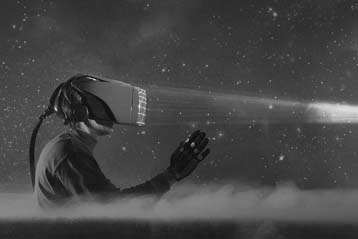
Because of the scope of the study of virtuality, there is widespread debate about its impact both in specific arenas such as those mentioned above and on public and private culture more broadly. Specifically, it is useful to consider virtuality from the perspectives offered by several leading thinkers on the subject so as to get a sense of the critical landscape.
Virtuality and Technology
A number of technologies have been designed to provide complete or partial virtual experiences for users. Early (predigital) examples would include the first military and commercial vehicle simulation machines in the mid-20th century, pioneering three-dimensional (3-D) cinema technologies, and late 19th- and early 20th-century art designed to stimulate multiple senses. As digital imaging technologies expanded in the 1980s and early 1990s, virtuality experiences could be found in some video games, in training software for professional vehicle operators (such as pilots), and in interactive art. During this period, the idea that technology would be able to provide consumers with “virtual reality” experiences increasingly captured the public imagination, and virtuality became a recurrent theme in science fiction films (such as Blade Runner, Total Recall, Altered States, and The Matrix) and gaming (such as Sega's arcade games Virtua Fighter and Virtua Racing and Nintendo's Virtual Boy console). More recently, the 2010 documentary Digital Nation: Life on the Virtual Frontier suggested that virtuality technologies are currently in use to help soldiers cope with post-traumatic stress disorder and to create sensory-focused experiences for the disabled. Themes of virtuality also continue to be explored in films like Avatar (2009) and in popular science fiction.
...
- Barthes, Roland
- Berger, John
- Bordo, Susan
- Boyd, Danah
- Doane, Mary Ann
- Douglas, Susan J.
- Ellul, Jacques
- Fiske, John
- Gamson, Joshua
- Giroux, Henry
- Guerrilla Girls
- Hall, Stuart
- Hanna, Kathleen
- hooks, bell
- Jenkins, Henry
- Jervis, Lisa
- Jhally, Sut
- Kellner, Douglas
- Kilbourne, Jean
- Kruger, Barbara
- Lasn, Kalle
- McChesney, Robert
- McLuhan, Marshall
- Miller, Mark Crispin
- Moyers, Bill
- Mulvey, Laura
- Radway, Janice
- Rushkoff, Douglas
- Steinem, Gloria
- Cognitive Script Theory
- Critical Theory
- Cultivation Theory
- Desensitization Effect
- Discourse Analysis
- Encoding and Decoding
- Feminism
- Feminist Theory: Liberal
- Feminist Theory: Marxist
- Feminist Theory: Postcolonial
- Feminist Theory: Second Wave
- Feminist Theory: Socialist
- Feminist Theory: Third Wave
- Feminist Theory: Women-of-Color and Multiracial Perspectives
- Gender Schema Theory
- Hegemony
- Ideology
- Male Gaze
- Mass Media
- Media Convergence
- Media Ethnography
- Media Globalization
- Media Rhetoric
- Mediation
- Patriarchy
- Polysemic Text
- Postfeminism
- Postmodernism
- Post-Structuralism
- Quantitative Content Analysis
- Queer Theory
- Reception Theory
- Scopophilia
- Semiotics
- Simulacra
- Social Comparison Theory
- Social Construction of Gender
- Social Learning Theory
- Televisuality
- Textual Analysis
- Transgender Studies
- Transsexuality
- Beauty and Body Image: Beauty Myths
- Beauty and Body Image: Eating Disorders
- Class Privilege
- Heterosexism
- Homophobia
- Identity
- Intersectionality
- Minority Rights
- Misogyny
- Prejudice
- Racism
- Sexism
- Sexuality
- Stereotypes
- Violence and Aggression
- Avatar
- Blogs and Blogging
- Cyberdating
- Cyberpunk
- Cyberspace and Cyberculture
- Cyborg
- Electronic Media and Social Inequality
- E-Zines: Third Wave Feminist
- Hacking and Hacktivism
- Hypermedia
- Massively Multiplayer Online Role-Playing Games
- Multi-User Dimensions
- Online New Media: GLBTQ Identity
- Online New Media: Transgender Identity
- Social Inequality
- Social Media
- Social Networking Sites: Facebook
- Social Networking Sites: Myspace
- Viral Advertising and Marketing
- Virtual Community
- Virtual Sex
- Virtuality
- Web 2.0
- Wiki
- YouTube
- Audiences: Producers of New Media
- Audiences: Reception and Injection Models
- Fairness Doctrine
- Federal Communications Commission
- Media Consolidation
- Network News Anchor Desk
- New Media
- Telecommunications Act of 1996
- Workforce
- Advertising
- Children's Programming: Cartoons
- Children's Programming: Disney and Pixar
- Comics
- E-Zines: Riot Grrrl
- Film: Hollywood
- Film: Horror
- Film: Independent
- Graphic Novels
- Men's Magazines: Lad Magazines
- Men's Magazines: Lifestyle and Health
- Music: Underrepresentation of Women Artists
- Music Videos: Representations of Men
- Music Videos: Representations of Women
- Music Videos: Tropes
- Newsrooms
- Pornification of Everyday Life
- Pornography: Gay and Lesbian
- Pornography: Heterosexual
- Pornography: Internet
- Radio
- Radio: Pirate
- Reality-Based Television: America's Next Top Model
- Reality-Based Television: Makeover Shows
- Reality-Based Television: Wedding Shows
- Romance Novels
- Sitcoms
- Soap Operas
- Sports Media: Extreme Sports and Masculinity
- Sports Media: Olympics
- Sports Media: Transgender
- Talk Shows
- Textbooks
- Toys and Games: Gender Socialization
- Toys and Games: Racial Stereotypes and Identity
- Tropes
- Tween Magazines
- Video Gaming: Representations of Femininity
- Video Gaming: Representations of Masculinity
- Video Gaming: Violence
- Women's Magazines: Fashion
- Women's Magazines: Feminist Magazines
- Women's Magazines: Lifestyle and Health
- Gay and Lesbian Portrayals on Television
- Gender and Femininity: Motherhood
- Gender and Femininity: Single/Independent Girl
- Gender and Masculinity: Black Masculinity
- Gender and Masculinity: Fatherhood
- Gender and Masculinity: Metrosexual Male
- Gender and Masculinity: White Masculinity
- Gender Embodiment
- Heroes: Action and Super Heroes
- Television
- Affirmative Action
- Cultural Politics
- Culture Jamming
- Diversity
- Empowerment
- Equal Employment Opportunity Commission
- Gender Media Monitoring
- Media Literacy
- Loading...
Get a 30 day FREE TRIAL
-
 Watch videos from a variety of sources bringing classroom topics to life
 -
Read modern, diverse business cases
-
Explore hundreds of books and reference titles

Read next

More like this
Sage Recommends
We found other relevant content for you on other Sage platforms.
Have you created a personal profile? Login or create a profile so that you can save clips, playlists and searches