
Entry
Reader's guide
Entries A-Z
Subject index
Television
Television, arguably the most important communication technology of the 20th century, has a rich history. Distinguished from previous media by its ability to receive moving images and broadcast them over the airwaves and for its ubiquity, television as a medium remains a central part of contemporary culture in the United States.
The Early Years: 1930s–50s
Although proof-of-concept television broadcasts occurred in the late 1920s and throughout the 1930s, many historians point to television's unveiling at the 1939 World's Fair in New York City as the beginning of the technology as a mass medium. At the fair, Radio Corporation of America (RCA) president David Sarnoff championed the new technology by broadcasting the events of the fair and launching televised content on the National Broadcasting Company (NBC) network. These earliest televisions displayed images in black and white on five-inch screens, were prohibitively expensive, and were able to receive only a small amount of programming. Television met with a mixture of curiosity and enthusiasm, but widespread production and adoption of the new technology did not occur in the United States until the late 1940s and early 1950s, following the end of World War II. Television programming during this period borrowed heavily from popular radio and stage acts, and variety shows and news dominated the airwaves. Milton Berle's Texaco Star Theater, Meet the Press, Ed Sullivan's Toast of the Town, and the Howdy Doody Show were some of the most popular shows during the early years of television.
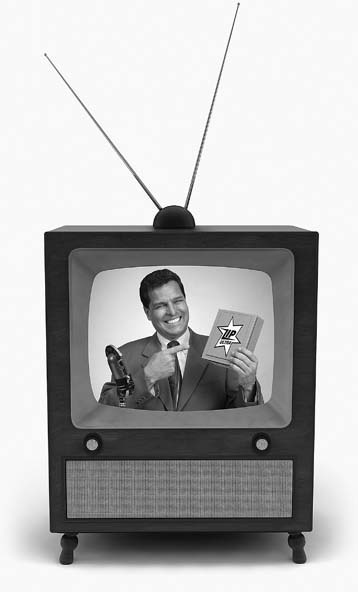
Early televisions from the 1930s and 1940s displayed images on small black-and-white screens, cost hundreds of dollars (the equivalent of around $4,000 today), and could receive a minimal amount of programming.
The Golden Age: 1950s–70s
From the early 1950s through the 1970s, television cemented its place in homes in the United States and around the world as its programming branched out from its vaudeville and radio roots to include shows that took full advantage of the immensely popular, in-demand medium. The situation comedy, the artfully directed drama, the news magazine show, and most other staples of contemporary television programming are grounded in this era. Most of the programs during the Golden Age were broadcast by the three major television networks, the American Broadcasting Company (ABC), the National Broadcasting Company (NBC), and the Columbia Broadcasting System (CBS).
Television saw some important technological changes during this era. Not only did television sets become larger, cheaper, and more dependable, but the amount and technical quality of programming increased as well. In the mid-1960s consumers started purchasing color televisions, and by the end of the decade it was common to find many homes with multiple sets.
As television adoption became widespread, many sectors of public life had to learn how to adapt. High-interest sporting events were aired during prime television viewing hours, press releases were timed to coincide with the television news cycle, and anyone interested in selling a product or idea had to learn how to best utilize the medium. For example, among the many important “firsts” for television during this period, the presidential debate between a perspiring and ill-prepared Richard Nixon and a television-primed John F. Kennedy in 1960 is seen by many as a turning point in American political life. Popular programming of the era included shows such as I Love Lucy (1951–57), Leave It to Beaver (1957–63), I Dream of Jeannie (1965–70), All in the Family (1971–79), and M∗A∗S∗H (1972–83).
...
- Barthes, Roland
- Berger, John
- Bordo, Susan
- Boyd, Danah
- Doane, Mary Ann
- Douglas, Susan J.
- Ellul, Jacques
- Fiske, John
- Gamson, Joshua
- Giroux, Henry
- Guerrilla Girls
- Hall, Stuart
- Hanna, Kathleen
- hooks, bell
- Jenkins, Henry
- Jervis, Lisa
- Jhally, Sut
- Kellner, Douglas
- Kilbourne, Jean
- Kruger, Barbara
- Lasn, Kalle
- McChesney, Robert
- McLuhan, Marshall
- Miller, Mark Crispin
- Moyers, Bill
- Mulvey, Laura
- Radway, Janice
- Rushkoff, Douglas
- Steinem, Gloria
- Cognitive Script Theory
- Critical Theory
- Cultivation Theory
- Desensitization Effect
- Discourse Analysis
- Encoding and Decoding
- Feminism
- Feminist Theory: Liberal
- Feminist Theory: Marxist
- Feminist Theory: Postcolonial
- Feminist Theory: Second Wave
- Feminist Theory: Socialist
- Feminist Theory: Third Wave
- Feminist Theory: Women-of-Color and Multiracial Perspectives
- Gender Schema Theory
- Hegemony
- Ideology
- Male Gaze
- Mass Media
- Media Convergence
- Media Ethnography
- Media Globalization
- Media Rhetoric
- Mediation
- Patriarchy
- Polysemic Text
- Postfeminism
- Postmodernism
- Post-Structuralism
- Quantitative Content Analysis
- Queer Theory
- Reception Theory
- Scopophilia
- Semiotics
- Simulacra
- Social Comparison Theory
- Social Construction of Gender
- Social Learning Theory
- Televisuality
- Textual Analysis
- Transgender Studies
- Transsexuality
- Beauty and Body Image: Beauty Myths
- Beauty and Body Image: Eating Disorders
- Class Privilege
- Heterosexism
- Homophobia
- Identity
- Intersectionality
- Minority Rights
- Misogyny
- Prejudice
- Racism
- Sexism
- Sexuality
- Stereotypes
- Violence and Aggression
- Avatar
- Blogs and Blogging
- Cyberdating
- Cyberpunk
- Cyberspace and Cyberculture
- Cyborg
- Electronic Media and Social Inequality
- E-Zines: Third Wave Feminist
- Hacking and Hacktivism
- Hypermedia
- Massively Multiplayer Online Role-Playing Games
- Multi-User Dimensions
- Online New Media: GLBTQ Identity
- Online New Media: Transgender Identity
- Social Inequality
- Social Media
- Social Networking Sites: Facebook
- Social Networking Sites: Myspace
- Viral Advertising and Marketing
- Virtual Community
- Virtual Sex
- Virtuality
- Web 2.0
- Wiki
- YouTube
- Audiences: Producers of New Media
- Audiences: Reception and Injection Models
- Fairness Doctrine
- Federal Communications Commission
- Media Consolidation
- Network News Anchor Desk
- New Media
- Telecommunications Act of 1996
- Workforce
- Advertising
- Children's Programming: Cartoons
- Children's Programming: Disney and Pixar
- Comics
- E-Zines: Riot Grrrl
- Film: Hollywood
- Film: Horror
- Film: Independent
- Graphic Novels
- Men's Magazines: Lad Magazines
- Men's Magazines: Lifestyle and Health
- Music: Underrepresentation of Women Artists
- Music Videos: Representations of Men
- Music Videos: Representations of Women
- Music Videos: Tropes
- Newsrooms
- Pornification of Everyday Life
- Pornography: Gay and Lesbian
- Pornography: Heterosexual
- Pornography: Internet
- Radio
- Radio: Pirate
- Reality-Based Television: America's Next Top Model
- Reality-Based Television: Makeover Shows
- Reality-Based Television: Wedding Shows
- Romance Novels
- Sitcoms
- Soap Operas
- Sports Media: Extreme Sports and Masculinity
- Sports Media: Olympics
- Sports Media: Transgender
- Talk Shows
- Textbooks
- Toys and Games: Gender Socialization
- Toys and Games: Racial Stereotypes and Identity
- Tropes
- Tween Magazines
- Video Gaming: Representations of Femininity
- Video Gaming: Representations of Masculinity
- Video Gaming: Violence
- Women's Magazines: Fashion
- Women's Magazines: Feminist Magazines
- Women's Magazines: Lifestyle and Health
- Gay and Lesbian Portrayals on Television
- Gender and Femininity: Motherhood
- Gender and Femininity: Single/Independent Girl
- Gender and Masculinity: Black Masculinity
- Gender and Masculinity: Fatherhood
- Gender and Masculinity: Metrosexual Male
- Gender and Masculinity: White Masculinity
- Gender Embodiment
- Heroes: Action and Super Heroes
- Television
- Affirmative Action
- Cultural Politics
- Culture Jamming
- Diversity
- Empowerment
- Equal Employment Opportunity Commission
- Gender Media Monitoring
- Media Literacy
- Loading...
Get a 30 day FREE TRIAL
-
 Watch videos from a variety of sources bringing classroom topics to life
 -
Read modern, diverse business cases
-
Explore hundreds of books and reference titles

Read next

More like this
Sage Recommends
We found other relevant content for you on other Sage platforms.
Have you created a personal profile? Login or create a profile so that you can save clips, playlists and searches