
Entry
Reader's guide
Entries A-Z
Subject index
Social Networking Sites: Facebook
Online social networks and face-to-face social networks form for similar reasons: like-minded individuals associate for mutual gain and the greater good. Currently the most popular online social networking Website, Facebook began as a Website exclusively for college students but is now available to the public worldwide. Facebook claims more than 500 million active users. Approximately 150 million users access their accounts via mobile telephone. Many scholars recognize that Facebook provides “social space” for the formation of conversations, relationships, groups, and social networks.
Unlike other social networking Websites, such as Myspace, Facebook provides a template to assist each new user to develop a Facebook homepage, also called the user's profile. The template provides a series of standard questions about demographic information (such as name, birth date, sex, and job), questions concerning popular culture (such as favorite television shows, movies, and quotations), and questions related to personal information (such as relational goals—to make friends and/or to meet potential dating partners). However, the new user is never asked information about nationality, ethnicity, or race. The user may answer as many or as few of these questions as desired. After completing the template, users can elect to personalize their profiles further by displaying a profile photograph, a personal Website, or selected applications available via the Facebook Website.
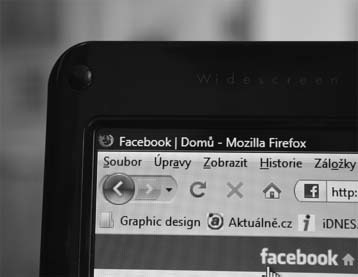
A laptop user in the Czech Republic posting a photo of his or her computer screen while browsing Facebook reinforces the company's claim that it has over 500 million active users in over 200 countries. In most countries as of early 201 I, Facebook was either the first, second, or third most popular Website.
Applications range from informational (for example, to display “bumper stickers” that represent users' philosophies) to serious (for example, to display charities and political candidates that the user supports financially and thus to encourage others to do so) to frivolous (for example, to take the quiz “What kind of chocolate are you?”). Facebook now claims to display 550,000 active applications offered by independent developers for the Facebook Website.
Networking on Facebook
A user's individual Facebook network consists of the user and the “friends” listed on his or her profile. Users acquire friends by employing Facebook's search function to discover known associates by entering their names and/or e-mail addresses. After locating an associate's profile, the user sends a friend request. When the recipient confirms the request, the Facebook friendship is established and each party is listed on the other's profile page as a friend. According to Facebook, the average user has 130 friends.
Facebook friendships can be formed online or, as is more often the case, as a supplement to offline relationships. Users typically “interact” on Facebook by posting brief updates about their lives (“had a great dinner with friends tonight”) as well as displaying photographs (perhaps a picture of the dinner itself) and links to YouTube sites to display typically music videos they recommend. Friends can read these posts and respond either by clicking the “like” button or by posting comments about them. Updates are often “twittered” to the Facebook accounts, as the software programs link and users can update both accounts simultaneously. According to Facebook, about half of its active users log on to Facebook in any given day.
...
- Barthes, Roland
- Berger, John
- Bordo, Susan
- Boyd, Danah
- Doane, Mary Ann
- Douglas, Susan J.
- Ellul, Jacques
- Fiske, John
- Gamson, Joshua
- Giroux, Henry
- Guerrilla Girls
- Hall, Stuart
- Hanna, Kathleen
- hooks, bell
- Jenkins, Henry
- Jervis, Lisa
- Jhally, Sut
- Kellner, Douglas
- Kilbourne, Jean
- Kruger, Barbara
- Lasn, Kalle
- McChesney, Robert
- McLuhan, Marshall
- Miller, Mark Crispin
- Moyers, Bill
- Mulvey, Laura
- Radway, Janice
- Rushkoff, Douglas
- Steinem, Gloria
- Cognitive Script Theory
- Critical Theory
- Cultivation Theory
- Desensitization Effect
- Discourse Analysis
- Encoding and Decoding
- Feminism
- Feminist Theory: Liberal
- Feminist Theory: Marxist
- Feminist Theory: Postcolonial
- Feminist Theory: Second Wave
- Feminist Theory: Socialist
- Feminist Theory: Third Wave
- Feminist Theory: Women-of-Color and Multiracial Perspectives
- Gender Schema Theory
- Hegemony
- Ideology
- Male Gaze
- Mass Media
- Media Convergence
- Media Ethnography
- Media Globalization
- Media Rhetoric
- Mediation
- Patriarchy
- Polysemic Text
- Postfeminism
- Postmodernism
- Post-Structuralism
- Quantitative Content Analysis
- Queer Theory
- Reception Theory
- Scopophilia
- Semiotics
- Simulacra
- Social Comparison Theory
- Social Construction of Gender
- Social Learning Theory
- Televisuality
- Textual Analysis
- Transgender Studies
- Transsexuality
- Beauty and Body Image: Beauty Myths
- Beauty and Body Image: Eating Disorders
- Class Privilege
- Heterosexism
- Homophobia
- Identity
- Intersectionality
- Minority Rights
- Misogyny
- Prejudice
- Racism
- Sexism
- Sexuality
- Stereotypes
- Violence and Aggression
- Avatar
- Blogs and Blogging
- Cyberdating
- Cyberpunk
- Cyberspace and Cyberculture
- Cyborg
- Electronic Media and Social Inequality
- E-Zines: Third Wave Feminist
- Hacking and Hacktivism
- Hypermedia
- Massively Multiplayer Online Role-Playing Games
- Multi-User Dimensions
- Online New Media: GLBTQ Identity
- Online New Media: Transgender Identity
- Social Inequality
- Social Media
- Social Networking Sites: Facebook
- Social Networking Sites: Myspace
- Viral Advertising and Marketing
- Virtual Community
- Virtual Sex
- Virtuality
- Web 2.0
- Wiki
- YouTube
- Audiences: Producers of New Media
- Audiences: Reception and Injection Models
- Fairness Doctrine
- Federal Communications Commission
- Media Consolidation
- Network News Anchor Desk
- New Media
- Telecommunications Act of 1996
- Workforce
- Advertising
- Children's Programming: Cartoons
- Children's Programming: Disney and Pixar
- Comics
- E-Zines: Riot Grrrl
- Film: Hollywood
- Film: Horror
- Film: Independent
- Graphic Novels
- Men's Magazines: Lad Magazines
- Men's Magazines: Lifestyle and Health
- Music: Underrepresentation of Women Artists
- Music Videos: Representations of Men
- Music Videos: Representations of Women
- Music Videos: Tropes
- Newsrooms
- Pornification of Everyday Life
- Pornography: Gay and Lesbian
- Pornography: Heterosexual
- Pornography: Internet
- Radio
- Radio: Pirate
- Reality-Based Television: America's Next Top Model
- Reality-Based Television: Makeover Shows
- Reality-Based Television: Wedding Shows
- Romance Novels
- Sitcoms
- Soap Operas
- Sports Media: Extreme Sports and Masculinity
- Sports Media: Olympics
- Sports Media: Transgender
- Talk Shows
- Textbooks
- Toys and Games: Gender Socialization
- Toys and Games: Racial Stereotypes and Identity
- Tropes
- Tween Magazines
- Video Gaming: Representations of Femininity
- Video Gaming: Representations of Masculinity
- Video Gaming: Violence
- Women's Magazines: Fashion
- Women's Magazines: Feminist Magazines
- Women's Magazines: Lifestyle and Health
- Gay and Lesbian Portrayals on Television
- Gender and Femininity: Motherhood
- Gender and Femininity: Single/Independent Girl
- Gender and Masculinity: Black Masculinity
- Gender and Masculinity: Fatherhood
- Gender and Masculinity: Metrosexual Male
- Gender and Masculinity: White Masculinity
- Gender Embodiment
- Heroes: Action and Super Heroes
- Television
- Affirmative Action
- Cultural Politics
- Culture Jamming
- Diversity
- Empowerment
- Equal Employment Opportunity Commission
- Gender Media Monitoring
- Media Literacy
- Loading...
Get a 30 day FREE TRIAL
-
 Watch videos from a variety of sources bringing classroom topics to life
 -
Read modern, diverse business cases
-
Explore hundreds of books and reference titles

Read next

More like this
Sage Recommends
We found other relevant content for you on other Sage platforms.
Have you created a personal profile? Login or create a profile so that you can save clips, playlists and searches