
Entry
Reader's guide
Entries A-Z
Subject index
Radio
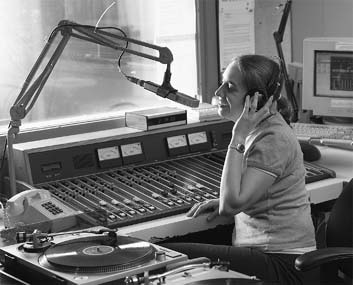
Women have been a part of commercial radio since its inception in 1920. In radio's first four decades, the majority were either secretaries or entertainers, but even in that more traditional time in American history, a few women were station owners, sales managers, program directors, and occasionally news commentators or announcers. A major change occurred as a result of the women's movement of the 1960s and 1970s, and more women were able to enter areas of broadcasting previously closed to them; today it is not unusual to hear women as disc jockeys, news anchors, and talk show hosts, and a number of women are general managers or owners.
The first woman announcer was probably Sybil Herrold, the wife of early broadcast pioneer Charles “Doc” Herrold. As early as 1912, she hosted a weekly radio program on her husband's station at the Herrold College of Wireless in San Jose, California. When the first three commercial stations went on the air in 1920, most of their announcers, and all of their managers, were men, but at one station, 1XE (later called WGI) in Medford Hillside, Massachusetts, there was a female announcer, Eunice Randall. Randall not only announced some of the programs, but, as time passed, she read bedtime stories to the children, reported the news, and sometimes performed as a vocalist. In the early 1920s, when radio was still new, gender roles were not yet rigid; sometimes, it was a man who read the bedtime stories. A few other stations had a female announcer, and some had a female musical director, who arranged the programs. (Radio always needed live performers, since audiotape had not yet been invented.) Although some women were studio hostesses (the equivalent of a receptionist), just as many found work as vocalists. Some of the best-known opera singers, like Madame Louise Homer and Mary Garden, were heard on radio, as was African American blues singer Bessie Smith. The first woman to own a radio station was Marie Zimmerman, who began operating WIAE in Vinton, Iowa, in the summer of 1922; the next two women owners were preacher Aimee Semple McPherson (KFSG in Los Angeles in 1924) and theater owner Mary Costigan (KFXY in Flagstaff, Arizona, in 1925).
Now that women had the right to vote, members of the newly founded League of Women Voters sponsored informational radio programs, and female politicians took to the airwaves to campaign; some male journalists were surprised to discover that women did not automatically vote for someone just because she was female. Among the news makers heard on radio in the early 1920s were pioneering feminist Carrie Chapman Catt and Harvard astronomer Annie Jump Cannon, as well as a number of female movie stars, authors, and poets. Thanks to radio, the average person became more aware of women in nontraditional occupations, as women lawyers, business executives, and doctors also gave radio talks.
Despite early female radio station owners, program directors, and even at times news commentators or announcers, women did not enter the realm of disc jockeying until the 1960s and 1970s. Radio news has not progressed as far—21st-century radio stations usually use a team with a male anchor and a female coanchor to report the news.
...
- Barthes, Roland
- Berger, John
- Bordo, Susan
- Boyd, Danah
- Doane, Mary Ann
- Douglas, Susan J.
- Ellul, Jacques
- Fiske, John
- Gamson, Joshua
- Giroux, Henry
- Guerrilla Girls
- Hall, Stuart
- Hanna, Kathleen
- hooks, bell
- Jenkins, Henry
- Jervis, Lisa
- Jhally, Sut
- Kellner, Douglas
- Kilbourne, Jean
- Kruger, Barbara
- Lasn, Kalle
- McChesney, Robert
- McLuhan, Marshall
- Miller, Mark Crispin
- Moyers, Bill
- Mulvey, Laura
- Radway, Janice
- Rushkoff, Douglas
- Steinem, Gloria
- Cognitive Script Theory
- Critical Theory
- Cultivation Theory
- Desensitization Effect
- Discourse Analysis
- Encoding and Decoding
- Feminism
- Feminist Theory: Liberal
- Feminist Theory: Marxist
- Feminist Theory: Postcolonial
- Feminist Theory: Second Wave
- Feminist Theory: Socialist
- Feminist Theory: Third Wave
- Feminist Theory: Women-of-Color and Multiracial Perspectives
- Gender Schema Theory
- Hegemony
- Ideology
- Male Gaze
- Mass Media
- Media Convergence
- Media Ethnography
- Media Globalization
- Media Rhetoric
- Mediation
- Patriarchy
- Polysemic Text
- Postfeminism
- Postmodernism
- Post-Structuralism
- Quantitative Content Analysis
- Queer Theory
- Reception Theory
- Scopophilia
- Semiotics
- Simulacra
- Social Comparison Theory
- Social Construction of Gender
- Social Learning Theory
- Televisuality
- Textual Analysis
- Transgender Studies
- Transsexuality
- Beauty and Body Image: Beauty Myths
- Beauty and Body Image: Eating Disorders
- Class Privilege
- Heterosexism
- Homophobia
- Identity
- Intersectionality
- Minority Rights
- Misogyny
- Prejudice
- Racism
- Sexism
- Sexuality
- Stereotypes
- Violence and Aggression
- Avatar
- Blogs and Blogging
- Cyberdating
- Cyberpunk
- Cyberspace and Cyberculture
- Cyborg
- Electronic Media and Social Inequality
- E-Zines: Third Wave Feminist
- Hacking and Hacktivism
- Hypermedia
- Massively Multiplayer Online Role-Playing Games
- Multi-User Dimensions
- Online New Media: GLBTQ Identity
- Online New Media: Transgender Identity
- Social Inequality
- Social Media
- Social Networking Sites: Facebook
- Social Networking Sites: Myspace
- Viral Advertising and Marketing
- Virtual Community
- Virtual Sex
- Virtuality
- Web 2.0
- Wiki
- YouTube
- Audiences: Producers of New Media
- Audiences: Reception and Injection Models
- Fairness Doctrine
- Federal Communications Commission
- Media Consolidation
- Network News Anchor Desk
- New Media
- Telecommunications Act of 1996
- Workforce
- Advertising
- Children's Programming: Cartoons
- Children's Programming: Disney and Pixar
- Comics
- E-Zines: Riot Grrrl
- Film: Hollywood
- Film: Horror
- Film: Independent
- Graphic Novels
- Men's Magazines: Lad Magazines
- Men's Magazines: Lifestyle and Health
- Music: Underrepresentation of Women Artists
- Music Videos: Representations of Men
- Music Videos: Representations of Women
- Music Videos: Tropes
- Newsrooms
- Pornification of Everyday Life
- Pornography: Gay and Lesbian
- Pornography: Heterosexual
- Pornography: Internet
- Radio
- Radio: Pirate
- Reality-Based Television: America's Next Top Model
- Reality-Based Television: Makeover Shows
- Reality-Based Television: Wedding Shows
- Romance Novels
- Sitcoms
- Soap Operas
- Sports Media: Extreme Sports and Masculinity
- Sports Media: Olympics
- Sports Media: Transgender
- Talk Shows
- Textbooks
- Toys and Games: Gender Socialization
- Toys and Games: Racial Stereotypes and Identity
- Tropes
- Tween Magazines
- Video Gaming: Representations of Femininity
- Video Gaming: Representations of Masculinity
- Video Gaming: Violence
- Women's Magazines: Fashion
- Women's Magazines: Feminist Magazines
- Women's Magazines: Lifestyle and Health
- Gay and Lesbian Portrayals on Television
- Gender and Femininity: Motherhood
- Gender and Femininity: Single/Independent Girl
- Gender and Masculinity: Black Masculinity
- Gender and Masculinity: Fatherhood
- Gender and Masculinity: Metrosexual Male
- Gender and Masculinity: White Masculinity
- Gender Embodiment
- Heroes: Action and Super Heroes
- Television
- Affirmative Action
- Cultural Politics
- Culture Jamming
- Diversity
- Empowerment
- Equal Employment Opportunity Commission
- Gender Media Monitoring
- Media Literacy
- Loading...
Get a 30 day FREE TRIAL
-
 Watch videos from a variety of sources bringing classroom topics to life
 -
Read modern, diverse business cases
-
Explore hundreds of books and reference titles

Read next

More like this
Sage Recommends
We found other relevant content for you on other Sage platforms.
Have you created a personal profile? Login or create a profile so that you can save clips, playlists and searches