
Entry
Reader's guide
Entries A-Z
Subject index
Misogyny
Deriving from the Greek misogynia (misein, “to hate,” and gyri?, “woman”), misogyny means the hatred, dislike of, or prejudice against women. Misogyny supports patriarchy, systematic male dominance, and female subjugation. In practice, misogyny objectifies women (especially sexually), limits women's economic and political power, and causes violence against women. Media critics study whether misogynic media contributes to women's lower pay, depression, eating disorders, rape, mutilation, and murder.
Misogyny is culturally contingent across centuries and continents. Greek philosopher Plato argued that women are inferior to men because women are closer to animals. Sigmund Freud employed Aristotle's notion that women are deviant, “mutilated males.” Buddhist, Christian, Hebrew, Hindu, and Muslim texts imagine women as inferior, wicked, lustful, and inducing men to sin. These texts reduce women to body parts, especially sex organs. Anthropologists found the men in New Guinea and the Amazon Basin used gang rape and male-only homosocial spaces to avoid the polluting influences of women, especially their genitalia and menstrual blood. Renaissance-era French employed gang rape to discipline women who transgressed sexual codes. Today, the World Health Organization estimates that between 100 million and 140 million females worldwide have endured genital mutilation.
Media promote misogyny in several ways. Media often represent women and girls as inadequate unless they conform to Western standards of beauty that are expensive, labor-intensive, painful, unhealthy, and unattainable. Beauty standards become means to discriminate against women, who, even as athletes and news anchors, must conform or risk their reputations and careers. Because misogyny is a cultural norm, women in media may embrace feminine standards of beauty and sexual objectification and experience them as empowering. However extreme or subtle, misogynic media often depict women as sexual objects for men's pleasurable consumption. Blatant misogyny appears in television's The Man Show; in Howard Stern's, Eminem's, and Snoop Dog's multimedia content; in advertisements for beer and hard liquor; in hardcore pornography featuring painful, degrading sexual acts on women; and in “soft-core” content like Girls Gone Wild. Subtler, perhaps, is the misogyny in Disney's Beauty and the Beast (1991), which features a courtship between the angry, abusive Beast and Belle (whose name means “beautiful”), who overcomes maltreatment with her beauty and love. Belle's faith is rewarded with heterosexual union with the wealthy, reformed, handsome Beast-prince. Such narratives glamorize intimate partner violence, which kills more than 1,000 women and 300 men annually in the United States. The World Health Organization reports that between 40 and 70 percent of female murder victims in Australia, Canada, Israel, South Africa, and the United States were killed by husbands or boyfriends, compared to 4 percent of United States and 8.6 percent of Australian male homicide victims. Misogynic media may carry paradoxical messages that feature violence against women yet enable critique of patriarchy; feminist media scholars find both tendencies in the films of Alfred Hitchcock.
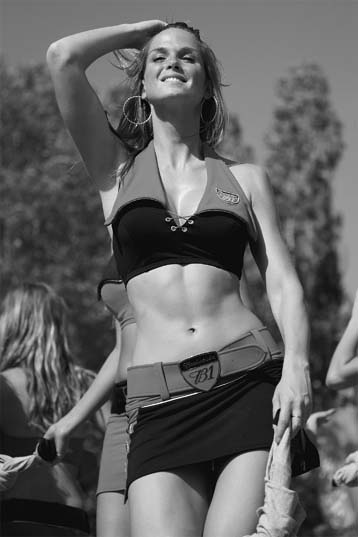
Anheuser-Busch uses “Bud girls” to promote their Budweiser beer at the 2008 Canadian Grand Prix. Misogyny perpetuates female subjugation and objectifies women, usually in a sexual manner.
Misogynic media and its critique frequently carry additional messages that reflect hate or dislike of nonwhite, lesbian, gay, bisexual, transgender, poor, and disabled “others.” Feminist scholars argue that academic and popular critiques of misogynic rap music enact a racist double standard that criticizes black men for sexually objectifying women and ignores white men's routine objectification and victimization of women. Such critiques also ignore violence against women in military and occupied zones. During wars and terrorist attacks, when masculinity appears threatened, media portray women as weak victims and men as strong heroes who repair white heterosexual patriarchal order. Research on misogyny and homophobia suggests each has agency; they may act together or mask each other as social forces.
...
- Barthes, Roland
- Berger, John
- Bordo, Susan
- Boyd, Danah
- Doane, Mary Ann
- Douglas, Susan J.
- Ellul, Jacques
- Fiske, John
- Gamson, Joshua
- Giroux, Henry
- Guerrilla Girls
- Hall, Stuart
- Hanna, Kathleen
- hooks, bell
- Jenkins, Henry
- Jervis, Lisa
- Jhally, Sut
- Kellner, Douglas
- Kilbourne, Jean
- Kruger, Barbara
- Lasn, Kalle
- McChesney, Robert
- McLuhan, Marshall
- Miller, Mark Crispin
- Moyers, Bill
- Mulvey, Laura
- Radway, Janice
- Rushkoff, Douglas
- Steinem, Gloria
- Cognitive Script Theory
- Critical Theory
- Cultivation Theory
- Desensitization Effect
- Discourse Analysis
- Encoding and Decoding
- Feminism
- Feminist Theory: Liberal
- Feminist Theory: Marxist
- Feminist Theory: Postcolonial
- Feminist Theory: Second Wave
- Feminist Theory: Socialist
- Feminist Theory: Third Wave
- Feminist Theory: Women-of-Color and Multiracial Perspectives
- Gender Schema Theory
- Hegemony
- Ideology
- Male Gaze
- Mass Media
- Media Convergence
- Media Ethnography
- Media Globalization
- Media Rhetoric
- Mediation
- Patriarchy
- Polysemic Text
- Postfeminism
- Postmodernism
- Post-Structuralism
- Quantitative Content Analysis
- Queer Theory
- Reception Theory
- Scopophilia
- Semiotics
- Simulacra
- Social Comparison Theory
- Social Construction of Gender
- Social Learning Theory
- Televisuality
- Textual Analysis
- Transgender Studies
- Transsexuality
- Beauty and Body Image: Beauty Myths
- Beauty and Body Image: Eating Disorders
- Class Privilege
- Heterosexism
- Homophobia
- Identity
- Intersectionality
- Minority Rights
- Misogyny
- Prejudice
- Racism
- Sexism
- Sexuality
- Stereotypes
- Violence and Aggression
- Avatar
- Blogs and Blogging
- Cyberdating
- Cyberpunk
- Cyberspace and Cyberculture
- Cyborg
- Electronic Media and Social Inequality
- E-Zines: Third Wave Feminist
- Hacking and Hacktivism
- Hypermedia
- Massively Multiplayer Online Role-Playing Games
- Multi-User Dimensions
- Online New Media: GLBTQ Identity
- Online New Media: Transgender Identity
- Social Inequality
- Social Media
- Social Networking Sites: Facebook
- Social Networking Sites: Myspace
- Viral Advertising and Marketing
- Virtual Community
- Virtual Sex
- Virtuality
- Web 2.0
- Wiki
- YouTube
- Audiences: Producers of New Media
- Audiences: Reception and Injection Models
- Fairness Doctrine
- Federal Communications Commission
- Media Consolidation
- Network News Anchor Desk
- New Media
- Telecommunications Act of 1996
- Workforce
- Advertising
- Children's Programming: Cartoons
- Children's Programming: Disney and Pixar
- Comics
- E-Zines: Riot Grrrl
- Film: Hollywood
- Film: Horror
- Film: Independent
- Graphic Novels
- Men's Magazines: Lad Magazines
- Men's Magazines: Lifestyle and Health
- Music: Underrepresentation of Women Artists
- Music Videos: Representations of Men
- Music Videos: Representations of Women
- Music Videos: Tropes
- Newsrooms
- Pornification of Everyday Life
- Pornography: Gay and Lesbian
- Pornography: Heterosexual
- Pornography: Internet
- Radio
- Radio: Pirate
- Reality-Based Television: America's Next Top Model
- Reality-Based Television: Makeover Shows
- Reality-Based Television: Wedding Shows
- Romance Novels
- Sitcoms
- Soap Operas
- Sports Media: Extreme Sports and Masculinity
- Sports Media: Olympics
- Sports Media: Transgender
- Talk Shows
- Textbooks
- Toys and Games: Gender Socialization
- Toys and Games: Racial Stereotypes and Identity
- Tropes
- Tween Magazines
- Video Gaming: Representations of Femininity
- Video Gaming: Representations of Masculinity
- Video Gaming: Violence
- Women's Magazines: Fashion
- Women's Magazines: Feminist Magazines
- Women's Magazines: Lifestyle and Health
- Gay and Lesbian Portrayals on Television
- Gender and Femininity: Motherhood
- Gender and Femininity: Single/Independent Girl
- Gender and Masculinity: Black Masculinity
- Gender and Masculinity: Fatherhood
- Gender and Masculinity: Metrosexual Male
- Gender and Masculinity: White Masculinity
- Gender Embodiment
- Heroes: Action and Super Heroes
- Television
- Affirmative Action
- Cultural Politics
- Culture Jamming
- Diversity
- Empowerment
- Equal Employment Opportunity Commission
- Gender Media Monitoring
- Media Literacy
- Loading...
Get a 30 day FREE TRIAL
-
 Watch videos from a variety of sources bringing classroom topics to life
 -
Read modern, diverse business cases
-
Explore hundreds of books and reference titles

Read next

More like this
Sage Recommends
We found other relevant content for you on other Sage platforms.
Have you created a personal profile? Login or create a profile so that you can save clips, playlists and searches