
Entry
Reader's guide
Entries A-Z
Subject index
Homophobia
Although the exact definition of homophobia remains elusive, it has ranged from discomfort when in close proximity to homosexuals (part of its original definition) to a deeply seated revulsion toward homosexuals ensconced within antigay attitudes. Primarily, the term appears to suggest the manifestations of ideologies that are extensions of heterosexism. That is, the undergirding mentality concerning homophobia is that gayness is inherently contrary to the supposedly positive nature of heterosexuality and that heterosexuality should therefore be accepted as a positive prescriptive view toward sexual and affectional orientation.
Increasingly, media depictions of homophobia are grounded not only in questioning heterocentric paradigms but also in critically analyzing the communicative messages that underscore the creation of homophobia. For example, mediated depictions of homophobic utterances have been critiqued for underlying assumptions of behavioral expectations and psychological assessments. Additionally, media news outlets have covered the presence of organized homophobia, particularly related to legislative events such as California's anti-marriage-equality proposition, Proposition 8. Because of an increase in media exposure, orchestrated efforts both to promote and to curtail homophobia have been covered, while mediated attacks against homophobia have also been instrumental in ensuring the distribution of homophobic messages.
In relation to new media, homophobia continues to be present within numerous social networking sites, prompting consideration of the impact of such electronic communication on participants. With a growing number of Americans considering pervasive antigay and homophobic messages from organized religious and political entities, increasing counterefforts are being used to combat such discourse. Examples include numerous social networking sites but also mediated counterattacks to remedy the influence of homophobia, particularly in terms of messages geared toward youth.
Although originally homophobia was assumed to be primarily a psychological phenomenon, its additional influence within political and social spheres is becoming more apparent. In consideration of the rash of protests and media appearances of the staunchly homophobic Westboro Baptist Church, the intersection of homophobia and religious doctrine may have reached a cultural zenith. Homophobia was assumed to be an undercurrent to legislative actions taken to ensure a forestalling of marriage equality. These efforts were coupled with political polemics suggesting that homophobia was linked with political opportunity. Examples of such events include mediated reactions to hearings on “Don't Ask, Don't Tell” (the measure designed to forestall service by openly gay and bisexual members of the military), the Employment Nondiscrimination Act (ENDA), the Matthew Shepard Hate Crimes Prevention Act, and California's Proposition 8. By 2011, only the hate crimes bill had become law; progress on each of the other bills was stalled at the legislative level. Increasingly, mediated depictions of homophobia may underscore the motivation behind these legislative actions.
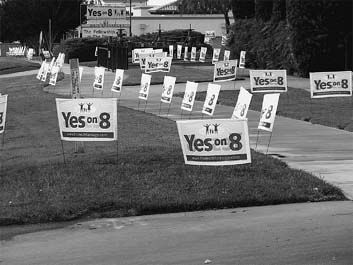
There was no mistaking this California citizen's stance on gay marriage when Proposition 8 was on the 2008 ballot. A “yes” vote supported the statement that “only marriage between a man and a woman is valid or recognized in California” and eliminated the rights of same-sex couples to marry.
With increased attention to the role of hate crimes that are underscored by homophobia, including the murder of Matthew Shepard and attacks in the Bronx, homophobia has been identified as an underlying motivation for not only vitriolic but also corporal attacks. The intersection between homophobia and the likelihood of physical assault is becoming more pronounced. As a result, homophobia may also be linked to the masking of lesbian, gay, bisexual, and transsexual/transgender (LGBT) characters in media. For example, mediated depictions of openly gay characters have traditionally been either stereotypical, affixed to societal scorn or ridicule, or simply nonexistent. Some mediated depictions included illustrations of the negative impact of both homophobia and acquired immune deficiency syndrome (AIDS). Thereafter, an increasing number of openly gay, permanent characters were featured in mediated depictions, as were considerations of the emergent role of homophobia within social settings.
...
- Barthes, Roland
- Berger, John
- Bordo, Susan
- Boyd, Danah
- Doane, Mary Ann
- Douglas, Susan J.
- Ellul, Jacques
- Fiske, John
- Gamson, Joshua
- Giroux, Henry
- Guerrilla Girls
- Hall, Stuart
- Hanna, Kathleen
- hooks, bell
- Jenkins, Henry
- Jervis, Lisa
- Jhally, Sut
- Kellner, Douglas
- Kilbourne, Jean
- Kruger, Barbara
- Lasn, Kalle
- McChesney, Robert
- McLuhan, Marshall
- Miller, Mark Crispin
- Moyers, Bill
- Mulvey, Laura
- Radway, Janice
- Rushkoff, Douglas
- Steinem, Gloria
- Cognitive Script Theory
- Critical Theory
- Cultivation Theory
- Desensitization Effect
- Discourse Analysis
- Encoding and Decoding
- Feminism
- Feminist Theory: Liberal
- Feminist Theory: Marxist
- Feminist Theory: Postcolonial
- Feminist Theory: Second Wave
- Feminist Theory: Socialist
- Feminist Theory: Third Wave
- Feminist Theory: Women-of-Color and Multiracial Perspectives
- Gender Schema Theory
- Hegemony
- Ideology
- Male Gaze
- Mass Media
- Media Convergence
- Media Ethnography
- Media Globalization
- Media Rhetoric
- Mediation
- Patriarchy
- Polysemic Text
- Postfeminism
- Postmodernism
- Post-Structuralism
- Quantitative Content Analysis
- Queer Theory
- Reception Theory
- Scopophilia
- Semiotics
- Simulacra
- Social Comparison Theory
- Social Construction of Gender
- Social Learning Theory
- Televisuality
- Textual Analysis
- Transgender Studies
- Transsexuality
- Beauty and Body Image: Beauty Myths
- Beauty and Body Image: Eating Disorders
- Class Privilege
- Heterosexism
- Homophobia
- Identity
- Intersectionality
- Minority Rights
- Misogyny
- Prejudice
- Racism
- Sexism
- Sexuality
- Stereotypes
- Violence and Aggression
- Avatar
- Blogs and Blogging
- Cyberdating
- Cyberpunk
- Cyberspace and Cyberculture
- Cyborg
- Electronic Media and Social Inequality
- E-Zines: Third Wave Feminist
- Hacking and Hacktivism
- Hypermedia
- Massively Multiplayer Online Role-Playing Games
- Multi-User Dimensions
- Online New Media: GLBTQ Identity
- Online New Media: Transgender Identity
- Social Inequality
- Social Media
- Social Networking Sites: Facebook
- Social Networking Sites: Myspace
- Viral Advertising and Marketing
- Virtual Community
- Virtual Sex
- Virtuality
- Web 2.0
- Wiki
- YouTube
- Audiences: Producers of New Media
- Audiences: Reception and Injection Models
- Fairness Doctrine
- Federal Communications Commission
- Media Consolidation
- Network News Anchor Desk
- New Media
- Telecommunications Act of 1996
- Workforce
- Advertising
- Children's Programming: Cartoons
- Children's Programming: Disney and Pixar
- Comics
- E-Zines: Riot Grrrl
- Film: Hollywood
- Film: Horror
- Film: Independent
- Graphic Novels
- Men's Magazines: Lad Magazines
- Men's Magazines: Lifestyle and Health
- Music: Underrepresentation of Women Artists
- Music Videos: Representations of Men
- Music Videos: Representations of Women
- Music Videos: Tropes
- Newsrooms
- Pornification of Everyday Life
- Pornography: Gay and Lesbian
- Pornography: Heterosexual
- Pornography: Internet
- Radio
- Radio: Pirate
- Reality-Based Television: America's Next Top Model
- Reality-Based Television: Makeover Shows
- Reality-Based Television: Wedding Shows
- Romance Novels
- Sitcoms
- Soap Operas
- Sports Media: Extreme Sports and Masculinity
- Sports Media: Olympics
- Sports Media: Transgender
- Talk Shows
- Textbooks
- Toys and Games: Gender Socialization
- Toys and Games: Racial Stereotypes and Identity
- Tropes
- Tween Magazines
- Video Gaming: Representations of Femininity
- Video Gaming: Representations of Masculinity
- Video Gaming: Violence
- Women's Magazines: Fashion
- Women's Magazines: Feminist Magazines
- Women's Magazines: Lifestyle and Health
- Gay and Lesbian Portrayals on Television
- Gender and Femininity: Motherhood
- Gender and Femininity: Single/Independent Girl
- Gender and Masculinity: Black Masculinity
- Gender and Masculinity: Fatherhood
- Gender and Masculinity: Metrosexual Male
- Gender and Masculinity: White Masculinity
- Gender Embodiment
- Heroes: Action and Super Heroes
- Television
- Affirmative Action
- Cultural Politics
- Culture Jamming
- Diversity
- Empowerment
- Equal Employment Opportunity Commission
- Gender Media Monitoring
- Media Literacy
- Loading...
Get a 30 day FREE TRIAL
-
 Watch videos from a variety of sources bringing classroom topics to life
 -
Read modern, diverse business cases
-
Explore hundreds of books and reference titles

Read next

More like this
Sage Recommends
We found other relevant content for you on other Sage platforms.
Have you created a personal profile? Login or create a profile so that you can save clips, playlists and searches