
Entry
Reader's guide
Entries A-Z
Subject index
Guerrilla Girls
Established in 1985, the Guerrilla Girls are a grassroots feminist group seeking to raise awareness about sexism and racism in art, politics, and popular culture. They are artists and activists who wear gorilla masks and adopt the names of deceased female artists as pseudonyms in order to remain anonymous. They engage in various forms of culture jamming in order to expose institutions and individuals in power who actively exclude women and artists of color from exhibitions, funding, and other opportunities in culture and media. Based in New York City, the Guerrilla Girls have launched hundreds of art assault campaigns to raise awareness and work toward more inclusion and diversity in the creative arts. They are known for using satire, irony, and shocking statistics as weapons of cultural critique. Provocative imagery and catchy slogans are also among the tools they use. They have found humor to be an effective weapon against discrimination and use it to draw people into their messages, provoke a response, and then prompt them to think critically about inequality. The Guerrilla Girls are considered to be the feminist conscience of the art world. They have used posters, billboards, postcards, and sticker campaigns as ways to publicize prejudice, racism, and sexism. The Guerrilla Girls also give lectures and conduct workshops for feminist activists.
Strategies
The group originally adopted the name Guerrilla Girls as a way to liken sexist politics to guerrilla warfare. Rather than employing direct confrontation, they use strategies of anonymity, mobility, and ambush. Instead of violent protest or military warfare, they engage in culture jamming aimed at sabotaging the overwhelmingly white, male, heterosexual power bloc.
Wearing gorilla masks and using pseudonyms of deceased female artists during their art assaults disguise member identities, keeping the focus of their grassroots feminist campaigns on the issues at hand as opposed to the individuals protesting.
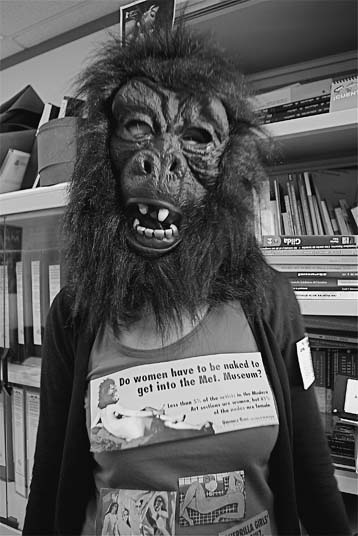
They also play on the term guerrilla by wearing gorilla masks during their campaigns. The masks disguise the members' identities, a strategy used to keep the focus of their campaigns on issues of inequality as opposed to their individual personalities. The Guerrilla Girls also adopt the names of deceased female artists and authors to protect their identities. This strategy pays homage to the talents of artists such as Frida Kahlo, Lee Krasner, Käthe Kollwitz, Anaïs Nin, Georgia O'Keeffe, and Gertrude Stein, among others.
In addition to securing anonymity, the gorilla mask displaces stereotypical definitions of feminine beauty. In many of their awareness campaigns, the Guerrilla Girls re-figure classical works of art, especially female nudes, with gorilla masks. The Guerrilla Girls themselves have also been pictured wearing the masks while also wearing stockings, high heels, or short skirts as a way to confound people's stereotypes of ideal feminine beauty. The Guerrilla Girls even consider the masks to play with the conception of manhood. In a comic move, they believe the masks bring a sense of “mask-ulinity” to their agenda.
“Reclaiming” is another important concept for the Guerrilla Girls. They actively seek to reclaim the “F word” (feminism), the “G word” (girl), and public space itself. Feminism holds a contentious place in the popular imagination. As part of an antisexist agenda, the Guerrilla Girls proudly use the F word in order to promote the ideals of feminism: equal opportunity, equal access to healthcare and education, freedom from harassment and sexual exploitation, reproductive rights, and human rights for women everywhere. They also use the G word to reconfigure the ways in which women are infantilized and marginalized. Finally, the Guerrilla Girls seek to reclaim public space for women. Because women have been historically excluded from full participation in public spaces, it is particularly significant that the Guerrilla Girls conduct most of their awareness campaigns in the city streets and other public sites.
...
- Barthes, Roland
- Berger, John
- Bordo, Susan
- Boyd, Danah
- Doane, Mary Ann
- Douglas, Susan J.
- Ellul, Jacques
- Fiske, John
- Gamson, Joshua
- Giroux, Henry
- Guerrilla Girls
- Hall, Stuart
- Hanna, Kathleen
- hooks, bell
- Jenkins, Henry
- Jervis, Lisa
- Jhally, Sut
- Kellner, Douglas
- Kilbourne, Jean
- Kruger, Barbara
- Lasn, Kalle
- McChesney, Robert
- McLuhan, Marshall
- Miller, Mark Crispin
- Moyers, Bill
- Mulvey, Laura
- Radway, Janice
- Rushkoff, Douglas
- Steinem, Gloria
- Cognitive Script Theory
- Critical Theory
- Cultivation Theory
- Desensitization Effect
- Discourse Analysis
- Encoding and Decoding
- Feminism
- Feminist Theory: Liberal
- Feminist Theory: Marxist
- Feminist Theory: Postcolonial
- Feminist Theory: Second Wave
- Feminist Theory: Socialist
- Feminist Theory: Third Wave
- Feminist Theory: Women-of-Color and Multiracial Perspectives
- Gender Schema Theory
- Hegemony
- Ideology
- Male Gaze
- Mass Media
- Media Convergence
- Media Ethnography
- Media Globalization
- Media Rhetoric
- Mediation
- Patriarchy
- Polysemic Text
- Postfeminism
- Postmodernism
- Post-Structuralism
- Quantitative Content Analysis
- Queer Theory
- Reception Theory
- Scopophilia
- Semiotics
- Simulacra
- Social Comparison Theory
- Social Construction of Gender
- Social Learning Theory
- Televisuality
- Textual Analysis
- Transgender Studies
- Transsexuality
- Beauty and Body Image: Beauty Myths
- Beauty and Body Image: Eating Disorders
- Class Privilege
- Heterosexism
- Homophobia
- Identity
- Intersectionality
- Minority Rights
- Misogyny
- Prejudice
- Racism
- Sexism
- Sexuality
- Stereotypes
- Violence and Aggression
- Avatar
- Blogs and Blogging
- Cyberdating
- Cyberpunk
- Cyberspace and Cyberculture
- Cyborg
- Electronic Media and Social Inequality
- E-Zines: Third Wave Feminist
- Hacking and Hacktivism
- Hypermedia
- Massively Multiplayer Online Role-Playing Games
- Multi-User Dimensions
- Online New Media: GLBTQ Identity
- Online New Media: Transgender Identity
- Social Inequality
- Social Media
- Social Networking Sites: Facebook
- Social Networking Sites: Myspace
- Viral Advertising and Marketing
- Virtual Community
- Virtual Sex
- Virtuality
- Web 2.0
- Wiki
- YouTube
- Audiences: Producers of New Media
- Audiences: Reception and Injection Models
- Fairness Doctrine
- Federal Communications Commission
- Media Consolidation
- Network News Anchor Desk
- New Media
- Telecommunications Act of 1996
- Workforce
- Advertising
- Children's Programming: Cartoons
- Children's Programming: Disney and Pixar
- Comics
- E-Zines: Riot Grrrl
- Film: Hollywood
- Film: Horror
- Film: Independent
- Graphic Novels
- Men's Magazines: Lad Magazines
- Men's Magazines: Lifestyle and Health
- Music: Underrepresentation of Women Artists
- Music Videos: Representations of Men
- Music Videos: Representations of Women
- Music Videos: Tropes
- Newsrooms
- Pornification of Everyday Life
- Pornography: Gay and Lesbian
- Pornography: Heterosexual
- Pornography: Internet
- Radio
- Radio: Pirate
- Reality-Based Television: America's Next Top Model
- Reality-Based Television: Makeover Shows
- Reality-Based Television: Wedding Shows
- Romance Novels
- Sitcoms
- Soap Operas
- Sports Media: Extreme Sports and Masculinity
- Sports Media: Olympics
- Sports Media: Transgender
- Talk Shows
- Textbooks
- Toys and Games: Gender Socialization
- Toys and Games: Racial Stereotypes and Identity
- Tropes
- Tween Magazines
- Video Gaming: Representations of Femininity
- Video Gaming: Representations of Masculinity
- Video Gaming: Violence
- Women's Magazines: Fashion
- Women's Magazines: Feminist Magazines
- Women's Magazines: Lifestyle and Health
- Gay and Lesbian Portrayals on Television
- Gender and Femininity: Motherhood
- Gender and Femininity: Single/Independent Girl
- Gender and Masculinity: Black Masculinity
- Gender and Masculinity: Fatherhood
- Gender and Masculinity: Metrosexual Male
- Gender and Masculinity: White Masculinity
- Gender Embodiment
- Heroes: Action and Super Heroes
- Television
- Affirmative Action
- Cultural Politics
- Culture Jamming
- Diversity
- Empowerment
- Equal Employment Opportunity Commission
- Gender Media Monitoring
- Media Literacy
- Loading...
Get a 30 day FREE TRIAL
-
 Watch videos from a variety of sources bringing classroom topics to life
 -
Read modern, diverse business cases
-
Explore hundreds of books and reference titles

Read next

More like this
Sage Recommends
We found other relevant content for you on other Sage platforms.
Have you created a personal profile? Login or create a profile so that you can save clips, playlists and searches