
Entry
Reader's guide
Entries A-Z
Subject index
Feminist Theory: Postcolonial
Postcolonial feminist theory considers the critical importance feminist politics play in the struggle against colonization while simultaneously racializing traditional feminist theory. As an academic discipline, postcolonial feminist theory is invested in revisioning, remembering, and critically interrogating colonialism through a feminist lens. Postcolonial feminist theory begins from an intersectional identity-based perspective, placing equal emphasis on the overlapping set of subject positions affected by colonization: gender, class, sexuality, race, caste, nationality, development, religion, and other identity markers. It rejects debates over whose interests should come first, those of anticolonization or those of feminist groups, suggesting that the two groups are linked because colonial dominances disproportionately impact women and feminist struggles, often ignoring the complexities of colonization while contributing to them. Furthermore, many women's experiences in patriarchy are similar to those of colonized subjects under imperialism; both patriarchy and imperialism exert dominance. Feminism and postcolonial theory actively resist this oppression. Thus, postcolonial feminist theory takes as its point of departure a theoretical perspective that is inclusive of multiple struggles embedded within the colonial system.
Postcolonial feminist theory is not just concerned with the conditions of people in territories formally or currently colonized; it is also greatly invested in past and contemporary struggles of colonial discourse. Colonial discourses, or ways of knowing, are critical to postcolonial feminist theorists because these theorists believe language and representation produce and maintain the power of both patriarchy and colonialism. Accordingly, postcolonial feminist theory is heavily invested in critically considering the role of language in representations and identity construction, bringing attention to ways in which discursive colonization adversely affects the material realities of women. Scholars with this perspective understand not only that language is a tool of imperialism but also that language can be used as a means to resist and subvert patriarchal and imperial power. In efforts to break down linguistic colonization, feminist postcolonial scholars have used two main strategies: (1) abrogation, or the rejection of imperial cultural as central, and (2) appropriation, the reconstitution of colonial discourse.
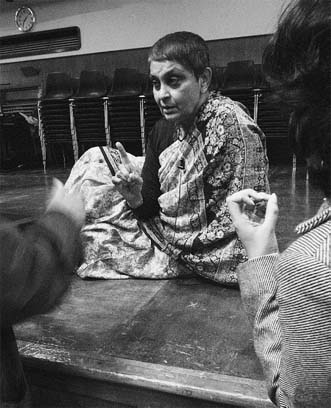
Gayatri Chakravorty Spivak, speaking here at the University of London in 2007, often objects to being labeled as a postcolonial feminist; however, the views of Spivak and Chandra Talpade Mohanty are generally seen as signifying the emergence of the movement.
The roots of postcolonial feminist theory are often attributed to black feminist theory and Third World feminism—both strands of scholarship that critique the centrality of the white Western brand of feminism that privileges “woman” as the foundational category of oppression. While there is no original movement leader or formal point of entry, postcolonial feminist theory was said to have emerged in the 1980s when feminists such as Chandra Talpade Mohanty and Gayatri Chakravorty Spivak (who, while often denying the title postcolonial feminist, tends to be the only feminist voice consistently mentioned in contemporary postcolonial studies) accused Western feminists of deploying universal feminist rhetoric while failing to recognize their Eurocentric biases. These early writings claimed that gender was always and already racialized and that the very popular Western slogan “Sisterhood Is Global” falsely assumed that white Western women's concerns were relevant to women worldwide. These scholars, writing on behalf of mostly women of color and Third World women, accused Western middle-class feminists of silencing the concerns of women who did not share their North American economic status. Any type of privileging of gender, postcolonial feminists argued, ignores women who face colonial conditions. Here the term double colonization proved useful to describe the experiences of women who face both patriarchal and colonial oppression. One particularly pervasive example of double colonization is the violent use of women's bodies as literal sites of struggle between male colonizers and the males colonized.
...
- Barthes, Roland
- Berger, John
- Bordo, Susan
- Boyd, Danah
- Doane, Mary Ann
- Douglas, Susan J.
- Ellul, Jacques
- Fiske, John
- Gamson, Joshua
- Giroux, Henry
- Guerrilla Girls
- Hall, Stuart
- Hanna, Kathleen
- hooks, bell
- Jenkins, Henry
- Jervis, Lisa
- Jhally, Sut
- Kellner, Douglas
- Kilbourne, Jean
- Kruger, Barbara
- Lasn, Kalle
- McChesney, Robert
- McLuhan, Marshall
- Miller, Mark Crispin
- Moyers, Bill
- Mulvey, Laura
- Radway, Janice
- Rushkoff, Douglas
- Steinem, Gloria
- Cognitive Script Theory
- Critical Theory
- Cultivation Theory
- Desensitization Effect
- Discourse Analysis
- Encoding and Decoding
- Feminism
- Feminist Theory: Liberal
- Feminist Theory: Marxist
- Feminist Theory: Postcolonial
- Feminist Theory: Second Wave
- Feminist Theory: Socialist
- Feminist Theory: Third Wave
- Feminist Theory: Women-of-Color and Multiracial Perspectives
- Gender Schema Theory
- Hegemony
- Ideology
- Male Gaze
- Mass Media
- Media Convergence
- Media Ethnography
- Media Globalization
- Media Rhetoric
- Mediation
- Patriarchy
- Polysemic Text
- Postfeminism
- Postmodernism
- Post-Structuralism
- Quantitative Content Analysis
- Queer Theory
- Reception Theory
- Scopophilia
- Semiotics
- Simulacra
- Social Comparison Theory
- Social Construction of Gender
- Social Learning Theory
- Televisuality
- Textual Analysis
- Transgender Studies
- Transsexuality
- Beauty and Body Image: Beauty Myths
- Beauty and Body Image: Eating Disorders
- Class Privilege
- Heterosexism
- Homophobia
- Identity
- Intersectionality
- Minority Rights
- Misogyny
- Prejudice
- Racism
- Sexism
- Sexuality
- Stereotypes
- Violence and Aggression
- Avatar
- Blogs and Blogging
- Cyberdating
- Cyberpunk
- Cyberspace and Cyberculture
- Cyborg
- Electronic Media and Social Inequality
- E-Zines: Third Wave Feminist
- Hacking and Hacktivism
- Hypermedia
- Massively Multiplayer Online Role-Playing Games
- Multi-User Dimensions
- Online New Media: GLBTQ Identity
- Online New Media: Transgender Identity
- Social Inequality
- Social Media
- Social Networking Sites: Facebook
- Social Networking Sites: Myspace
- Viral Advertising and Marketing
- Virtual Community
- Virtual Sex
- Virtuality
- Web 2.0
- Wiki
- YouTube
- Audiences: Producers of New Media
- Audiences: Reception and Injection Models
- Fairness Doctrine
- Federal Communications Commission
- Media Consolidation
- Network News Anchor Desk
- New Media
- Telecommunications Act of 1996
- Workforce
- Advertising
- Children's Programming: Cartoons
- Children's Programming: Disney and Pixar
- Comics
- E-Zines: Riot Grrrl
- Film: Hollywood
- Film: Horror
- Film: Independent
- Graphic Novels
- Men's Magazines: Lad Magazines
- Men's Magazines: Lifestyle and Health
- Music: Underrepresentation of Women Artists
- Music Videos: Representations of Men
- Music Videos: Representations of Women
- Music Videos: Tropes
- Newsrooms
- Pornification of Everyday Life
- Pornography: Gay and Lesbian
- Pornography: Heterosexual
- Pornography: Internet
- Radio
- Radio: Pirate
- Reality-Based Television: America's Next Top Model
- Reality-Based Television: Makeover Shows
- Reality-Based Television: Wedding Shows
- Romance Novels
- Sitcoms
- Soap Operas
- Sports Media: Extreme Sports and Masculinity
- Sports Media: Olympics
- Sports Media: Transgender
- Talk Shows
- Textbooks
- Toys and Games: Gender Socialization
- Toys and Games: Racial Stereotypes and Identity
- Tropes
- Tween Magazines
- Video Gaming: Representations of Femininity
- Video Gaming: Representations of Masculinity
- Video Gaming: Violence
- Women's Magazines: Fashion
- Women's Magazines: Feminist Magazines
- Women's Magazines: Lifestyle and Health
- Gay and Lesbian Portrayals on Television
- Gender and Femininity: Motherhood
- Gender and Femininity: Single/Independent Girl
- Gender and Masculinity: Black Masculinity
- Gender and Masculinity: Fatherhood
- Gender and Masculinity: Metrosexual Male
- Gender and Masculinity: White Masculinity
- Gender Embodiment
- Heroes: Action and Super Heroes
- Television
- Affirmative Action
- Cultural Politics
- Culture Jamming
- Diversity
- Empowerment
- Equal Employment Opportunity Commission
- Gender Media Monitoring
- Media Literacy
- Loading...
Get a 30 day FREE TRIAL
-
 Watch videos from a variety of sources bringing classroom topics to life
 -
Read modern, diverse business cases
-
Explore hundreds of books and reference titles

Read next

More like this
Sage Recommends
We found other relevant content for you on other Sage platforms.
Have you created a personal profile? Login or create a profile so that you can save clips, playlists and searches