
Entry
Reader's guide
Entries A-Z
Subject index
Electronic Media and Social Inequality
Electronic media—including radio, television, and the Internet—have been historically male-dominated in their productions, developments, representations, and industries. Whereas the introduction of each new medium brings with it the hope that it will empower underrepresented groups and foster social equality, new media also deepen divisions between underrepresented groups and those in power. Electronic media enable new types of participation, including the development of identities, access to knowledge, and the building of communities for those with access. Notwithstanding, electronic media also have created challenges and concerns about media literacy, knowledge gaps, and the “digital divide” for those individuals without access to them. As a result, women with higher socioeconomic status in more industrially or postindustrially developed societies experience benefits from these technologies, whereas women of lower socioeconomic status from less developed parts of the world struggle to gain access to them.
Radio and Television
Early developments in radio created opportunities for women to engage in the new medium. Some women received training from the U.S. Navy as radio operators during World War I; other women participated as wireless amateurs, or hams, in clubs and Girl Scout activities. Entertainment programming on radio featured the comedic talents of Gracie Allen and Lucille Ball. Other programming targeted housewives, with shows featuring advice about housekeeping and consumer products. Before and during World War II, radio recruited women to join the workforce and support the war effort. After the shift from radio networks to formats in the 1950s and 1960s, much of the radio programming moved to television, and women's roles in radio shifted to on-air talent and production activities. Currently, about a dozen women run their own national radio programs, and about 20 percent of radio news directors are women. National Public Radio (NPR) offers more opportunities for hosting: Three of its five major shows feature women. Also, women have held top positions in NPR, including chief executive officer and head of news.
The segue from radio programming to television defined early possibilities for the representation of women. Like radio, television became a domestic medium. It attracted domestic audiences through shows such as The Kate Smith Hour (1950–54), which offered advice and product announcements. Shows such as soap operas—another carryover from radio—attempted to draw homemakers into watching during the afternoons. Evening programming such as situation comedies, or sitcoms, affirmed women's roles within the home or in secretarial positions subordinate to those of male authority figures.
Some women played important roles in early television. Lucille Ball changed the nature of television production with her show I Love Lucy (1951–57). She requested that the show be recorded on film instead of performed live for broadcast. The major broadcasters turned her down, so she and her husband, Desi Arnaz, funded the program's production through their own company, Desilu. In using film cameras, Ball created the opportunity for syndication, proving to the networks that reruns offered an additional source of income. Ball's innovation still defines the industry today.
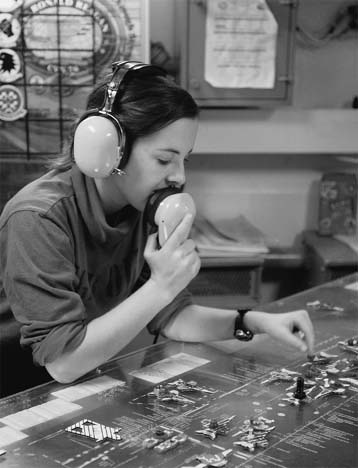
A member of the U.S. Navy updates an ouija board—a system used to track the movement of every airplane on a carrier—in Baltimore, Maryland. During World War I, the U.S. Navy trained women as radio operators, marking the first time women were accepted into certain branches of the armed forces.
 <>
<>...
- Barthes, Roland
- Berger, John
- Bordo, Susan
- Boyd, Danah
- Doane, Mary Ann
- Douglas, Susan J.
- Ellul, Jacques
- Fiske, John
- Gamson, Joshua
- Giroux, Henry
- Guerrilla Girls
- Hall, Stuart
- Hanna, Kathleen
- hooks, bell
- Jenkins, Henry
- Jervis, Lisa
- Jhally, Sut
- Kellner, Douglas
- Kilbourne, Jean
- Kruger, Barbara
- Lasn, Kalle
- McChesney, Robert
- McLuhan, Marshall
- Miller, Mark Crispin
- Moyers, Bill
- Mulvey, Laura
- Radway, Janice
- Rushkoff, Douglas
- Steinem, Gloria
- Cognitive Script Theory
- Critical Theory
- Cultivation Theory
- Desensitization Effect
- Discourse Analysis
- Encoding and Decoding
- Feminism
- Feminist Theory: Liberal
- Feminist Theory: Marxist
- Feminist Theory: Postcolonial
- Feminist Theory: Second Wave
- Feminist Theory: Socialist
- Feminist Theory: Third Wave
- Feminist Theory: Women-of-Color and Multiracial Perspectives
- Gender Schema Theory
- Hegemony
- Ideology
- Male Gaze
- Mass Media
- Media Convergence
- Media Ethnography
- Media Globalization
- Media Rhetoric
- Mediation
- Patriarchy
- Polysemic Text
- Postfeminism
- Postmodernism
- Post-Structuralism
- Quantitative Content Analysis
- Queer Theory
- Reception Theory
- Scopophilia
- Semiotics
- Simulacra
- Social Comparison Theory
- Social Construction of Gender
- Social Learning Theory
- Televisuality
- Textual Analysis
- Transgender Studies
- Transsexuality
- Beauty and Body Image: Beauty Myths
- Beauty and Body Image: Eating Disorders
- Class Privilege
- Heterosexism
- Homophobia
- Identity
- Intersectionality
- Minority Rights
- Misogyny
- Prejudice
- Racism
- Sexism
- Sexuality
- Stereotypes
- Violence and Aggression
- Avatar
- Blogs and Blogging
- Cyberdating
- Cyberpunk
- Cyberspace and Cyberculture
- Cyborg
- Electronic Media and Social Inequality
- E-Zines: Third Wave Feminist
- Hacking and Hacktivism
- Hypermedia
- Massively Multiplayer Online Role-Playing Games
- Multi-User Dimensions
- Online New Media: GLBTQ Identity
- Online New Media: Transgender Identity
- Social Inequality
- Social Media
- Social Networking Sites: Facebook
- Social Networking Sites: Myspace
- Viral Advertising and Marketing
- Virtual Community
- Virtual Sex
- Virtuality
- Web 2.0
- Wiki
- YouTube
- Audiences: Producers of New Media
- Audiences: Reception and Injection Models
- Fairness Doctrine
- Federal Communications Commission
- Media Consolidation
- Network News Anchor Desk
- New Media
- Telecommunications Act of 1996
- Workforce
- Advertising
- Children's Programming: Cartoons
- Children's Programming: Disney and Pixar
- Comics
- E-Zines: Riot Grrrl
- Film: Hollywood
- Film: Horror
- Film: Independent
- Graphic Novels
- Men's Magazines: Lad Magazines
- Men's Magazines: Lifestyle and Health
- Music: Underrepresentation of Women Artists
- Music Videos: Representations of Men
- Music Videos: Representations of Women
- Music Videos: Tropes
- Newsrooms
- Pornification of Everyday Life
- Pornography: Gay and Lesbian
- Pornography: Heterosexual
- Pornography: Internet
- Radio
- Radio: Pirate
- Reality-Based Television: America's Next Top Model
- Reality-Based Television: Makeover Shows
- Reality-Based Television: Wedding Shows
- Romance Novels
- Sitcoms
- Soap Operas
- Sports Media: Extreme Sports and Masculinity
- Sports Media: Olympics
- Sports Media: Transgender
- Talk Shows
- Textbooks
- Toys and Games: Gender Socialization
- Toys and Games: Racial Stereotypes and Identity
- Tropes
- Tween Magazines
- Video Gaming: Representations of Femininity
- Video Gaming: Representations of Masculinity
- Video Gaming: Violence
- Women's Magazines: Fashion
- Women's Magazines: Feminist Magazines
- Women's Magazines: Lifestyle and Health
- Gay and Lesbian Portrayals on Television
- Gender and Femininity: Motherhood
- Gender and Femininity: Single/Independent Girl
- Gender and Masculinity: Black Masculinity
- Gender and Masculinity: Fatherhood
- Gender and Masculinity: Metrosexual Male
- Gender and Masculinity: White Masculinity
- Gender Embodiment
- Heroes: Action and Super Heroes
- Television
- Affirmative Action
- Cultural Politics
- Culture Jamming
- Diversity
- Empowerment
- Equal Employment Opportunity Commission
- Gender Media Monitoring
- Media Literacy
- Loading...
Get a 30 day FREE TRIAL
-
 Watch videos from a variety of sources bringing classroom topics to life
 -
Read modern, diverse business cases
-
Explore hundreds of books and reference titles

Read next

More like this
Sage Recommends
We found other relevant content for you on other Sage platforms.
Have you created a personal profile? Login or create a profile so that you can save clips, playlists and searches