
Entry
Reader's guide
Entries A-Z
Subject index
Cyberpunk
Cyberpunk is a term used to describe a subgenre of science fiction popularized in the mid-1980s by novels such as William Gibson's Neuromancer (1984) and films such as Ridley Scott's Blade Runner (1982). The word was coined in a short story by Bruce Bethke titled “Cyberpunk” and published in 1983. Cyberpunk fiction is marked by an attention to how digital and cybernetic technological innovation alters the human condition. This recurring theme is frequently explored via plots, settings, and characters that hark back to hard-nosed detective novels of the 1920s and 1930s as well as the noir films of the 1940s and early 1950s. Starting in the early 1990s, a cyberpunk subculture formed, in part in response to the intersection of ideas about technology found in cyberpunk fiction and real-world technological change.
Most cyberpunk fiction is dystopian and finds socially marginalized main characters addressing the consequences of technology run amok. Murder, drug use, prostitution, and war are all common tropes in the genre, as is technological enslavement, networked neurosystems, and urban decay. Popular examples of cyberpunk fiction include novels such as Gibson's Sprawl trilogy (1984–88); Snow Crash (1992), by Neal Stephenson; and Islands in the Net (1988), by Bruce Sterling. Cyberpunk fiction can also be seen in films such as Tetsuo, the Iron Man (1989), Dark City (1998), the Matrix trilogy (1999–2003), and Hackers (1995). Cyberpunk narratives are usually understood to be postmodern, in that they often deliberately blur the lines between reality and fiction, are presented in a fragmented manner, and make many references to popular culture. Most narratives are fast paced, complex, and full of technical jargon. In addition, because of its connection to classic crime stories and noir, characters often use language and engage in activities that are usually associated with culture from the first half of the 20th century, even though most cyberpunk plots take place in the future.
Gendered representations in cyberpunk fiction can be understood as fluid and ambiguous, since many characters choose to perform, define, or change their identities through technological means. However, although gender can be fluid, it is also common for characters to use technology to attain hypermascu-line or hyperfeminine ideals of physical appearance or emotional character. For example, Dani Cavallaro has explained that the character of Molly in Gibson's Neuromancer undergoes both sexual and financial hardships in order to get visual implants and weapons grafted onto her body, making her an archetype for many other women characters in the genre. Women in cyberpunk are often placed in situations in which their reproductive or sexual qualities are threatened to be replaced by technology, so augmenting their natural bodies with cybernetics is seen as a pathway to attaining a culturally valued femininity.
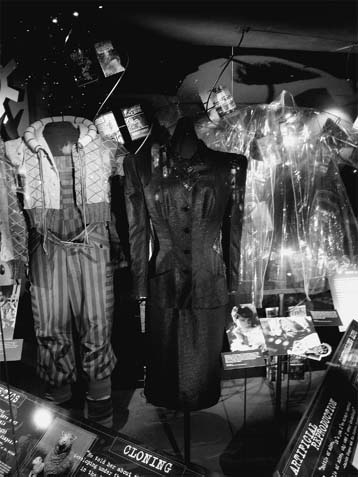
Costumes from the cyberpunk science-fiction film Blade Runner are on display at the Science Fiction Museum and Hall of Fame in Seattle. Cyberpunk plots are often set on Earth, and gender is generally ambiguous as characters can change or augment their bodies and gender using fictional technology.
Masculinity in cyberpunk is shaped by augmentation as well. In films such as Terminator (1984) and Robocop (1987), testosterone-fueled bodybuilders portray cybernetic machines that represent the pinnacle of masculine physicality, often driving human males to incorporate technology into their bodies in order to stand with or against them in combat. These human/machine hybrids are known as cyborgs, and they are prominently featured in cyberpunk fiction, usually functioning to address cultural anxieties about an increased reliance on technology across modern medicine. In addition, Samantha Holland has argued, cyborgs can be seen as a critique of the constructed, mechanical nature of both the body and ideas about gender in postmodern culture.
...
- Barthes, Roland
- Berger, John
- Bordo, Susan
- Boyd, Danah
- Doane, Mary Ann
- Douglas, Susan J.
- Ellul, Jacques
- Fiske, John
- Gamson, Joshua
- Giroux, Henry
- Guerrilla Girls
- Hall, Stuart
- Hanna, Kathleen
- hooks, bell
- Jenkins, Henry
- Jervis, Lisa
- Jhally, Sut
- Kellner, Douglas
- Kilbourne, Jean
- Kruger, Barbara
- Lasn, Kalle
- McChesney, Robert
- McLuhan, Marshall
- Miller, Mark Crispin
- Moyers, Bill
- Mulvey, Laura
- Radway, Janice
- Rushkoff, Douglas
- Steinem, Gloria
- Cognitive Script Theory
- Critical Theory
- Cultivation Theory
- Desensitization Effect
- Discourse Analysis
- Encoding and Decoding
- Feminism
- Feminist Theory: Liberal
- Feminist Theory: Marxist
- Feminist Theory: Postcolonial
- Feminist Theory: Second Wave
- Feminist Theory: Socialist
- Feminist Theory: Third Wave
- Feminist Theory: Women-of-Color and Multiracial Perspectives
- Gender Schema Theory
- Hegemony
- Ideology
- Male Gaze
- Mass Media
- Media Convergence
- Media Ethnography
- Media Globalization
- Media Rhetoric
- Mediation
- Patriarchy
- Polysemic Text
- Postfeminism
- Postmodernism
- Post-Structuralism
- Quantitative Content Analysis
- Queer Theory
- Reception Theory
- Scopophilia
- Semiotics
- Simulacra
- Social Comparison Theory
- Social Construction of Gender
- Social Learning Theory
- Televisuality
- Textual Analysis
- Transgender Studies
- Transsexuality
- Beauty and Body Image: Beauty Myths
- Beauty and Body Image: Eating Disorders
- Class Privilege
- Heterosexism
- Homophobia
- Identity
- Intersectionality
- Minority Rights
- Misogyny
- Prejudice
- Racism
- Sexism
- Sexuality
- Stereotypes
- Violence and Aggression
- Avatar
- Blogs and Blogging
- Cyberdating
- Cyberpunk
- Cyberspace and Cyberculture
- Cyborg
- Electronic Media and Social Inequality
- E-Zines: Third Wave Feminist
- Hacking and Hacktivism
- Hypermedia
- Massively Multiplayer Online Role-Playing Games
- Multi-User Dimensions
- Online New Media: GLBTQ Identity
- Online New Media: Transgender Identity
- Social Inequality
- Social Media
- Social Networking Sites: Facebook
- Social Networking Sites: Myspace
- Viral Advertising and Marketing
- Virtual Community
- Virtual Sex
- Virtuality
- Web 2.0
- Wiki
- YouTube
- Audiences: Producers of New Media
- Audiences: Reception and Injection Models
- Fairness Doctrine
- Federal Communications Commission
- Media Consolidation
- Network News Anchor Desk
- New Media
- Telecommunications Act of 1996
- Workforce
- Advertising
- Children's Programming: Cartoons
- Children's Programming: Disney and Pixar
- Comics
- E-Zines: Riot Grrrl
- Film: Hollywood
- Film: Horror
- Film: Independent
- Graphic Novels
- Men's Magazines: Lad Magazines
- Men's Magazines: Lifestyle and Health
- Music: Underrepresentation of Women Artists
- Music Videos: Representations of Men
- Music Videos: Representations of Women
- Music Videos: Tropes
- Newsrooms
- Pornification of Everyday Life
- Pornography: Gay and Lesbian
- Pornography: Heterosexual
- Pornography: Internet
- Radio
- Radio: Pirate
- Reality-Based Television: America's Next Top Model
- Reality-Based Television: Makeover Shows
- Reality-Based Television: Wedding Shows
- Romance Novels
- Sitcoms
- Soap Operas
- Sports Media: Extreme Sports and Masculinity
- Sports Media: Olympics
- Sports Media: Transgender
- Talk Shows
- Textbooks
- Toys and Games: Gender Socialization
- Toys and Games: Racial Stereotypes and Identity
- Tropes
- Tween Magazines
- Video Gaming: Representations of Femininity
- Video Gaming: Representations of Masculinity
- Video Gaming: Violence
- Women's Magazines: Fashion
- Women's Magazines: Feminist Magazines
- Women's Magazines: Lifestyle and Health
- Gay and Lesbian Portrayals on Television
- Gender and Femininity: Motherhood
- Gender and Femininity: Single/Independent Girl
- Gender and Masculinity: Black Masculinity
- Gender and Masculinity: Fatherhood
- Gender and Masculinity: Metrosexual Male
- Gender and Masculinity: White Masculinity
- Gender Embodiment
- Heroes: Action and Super Heroes
- Television
- Affirmative Action
- Cultural Politics
- Culture Jamming
- Diversity
- Empowerment
- Equal Employment Opportunity Commission
- Gender Media Monitoring
- Media Literacy
- Loading...
Get a 30 day FREE TRIAL
-
 Watch videos from a variety of sources bringing classroom topics to life
 -
Read modern, diverse business cases
-
Explore hundreds of books and reference titles

Read next

More like this
Sage Recommends
We found other relevant content for you on other Sage platforms.
Have you created a personal profile? Login or create a profile so that you can save clips, playlists and searches