
Entry
Reader's guide
Entries A-Z
Subject index
Dial-a-Ride
Demand-responsive transit (DRT) is also called demand-responsive transport, demand-responsive service, flexible transport services, or paratransit, but is most commonly known as Dial-a-Ride. In many localities Dial-a-Ride is called DART for Dial-a-Ride Transit. Whatever name is used it refers to an advanced public transport system that is user oriented. DRT is a flexible routing and scheduling system for small or medium vehicles that are engaged in sharing rides between pick-up and drop-off locations. The pick-ups and drop-offs are made to satisfy passenger needs.
DRT systems are operations with vehicles that respond to calls from passengers or their agents. A call must be placed to the DRT transit system operator. The transit operator then dispatches a vehicle to pick up the passenger in order to transport him/her to the desired destination. The system is characterized by having vehicles that do not operate over fixed routes. Nor do DRT system vehicles operate on fixed time schedules, although there may be temporary situations in which a vehicle follows a schedule. Typically, the vehicle carries several passengers who are going to different locations from different pickup points. Their journey may be interrupted if new calls come in that require the driver to deviate from the planned route in order to accommodate the latest passengers to call for service.
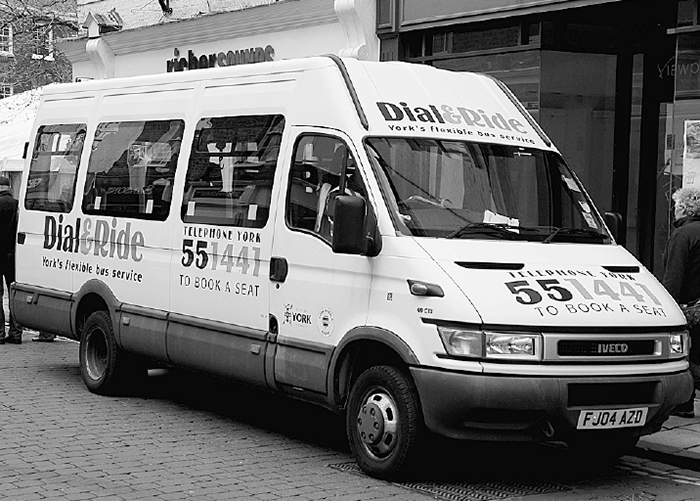
A Dial-a-Ride van between runs in the city of York in the United Kingdom in April 2012. While private companies run some commercial services, such as airport and casino shuttles, most Dial-a-Ride routes are community not-for-profit enterprises.
DRT systems have been instituted in many rural areas in order to provide transport services. DRT systems are also used in areas where regular bus service is not profitable because of low demand. Funding for DRT systems may come from a local transit authority as a subsidized socially necessary transportation system. In cases where DRT is subsidized, operators may be chosen by auction or by submitting sealed bids for the right to be the transport provider. Regardless of the selection mechanism used, the transport operator is given a monopoly for DRT services it provides.
A DRT system gives people access to transportation that gets them to places and events in the community. It provides a means for people to get to appointments, activities, and social events. Trips to health care providers, places of employment, shopping centers, senior centers, education centers, or recreational places are available in a timely manner. The system is designed for people whose access to transportation or whose physical mobility is limited due to health problems. Such physical challenges may make it difficult for people to use a regular fixed-route bus service even if it is available. What a DRT system offers is a special transportation service that is much better suited to those with a disability, providing, for example wheelchair-equipped vehicles.
Many DRT systems are funded by the local transit authority. Some are self-funded. Most are a community service that is a not-for-profit enterprise. Other DRT systems are funded by private companies for commercial reasons, such as providing customers a ride to their businesses. This may be similar to casinos providing gamblers with a ride to and from home. Some bus companies have set up DRT programs that service airports. In some cases the DRT program may compete with private for-hire shuttle bus companies.
...
- Administration, Operations, and Evaluation
- Adopt-a-Highway Program
- Air Traffic Flow Management
- Aircraft Maintenance
- Airline Flight Reservations and Ticketing Systems
- Airline Flight Scheduling
- Airline Marketing
- Airline Passengers
- Airline Service Quality Modeling
- Airport Administration
- Airport Gate Assignment Problems
- Airport Operations and Marketing
- Bridge Maintenance, Repair, and Replacement
- Bus Capacity
- Bus Routes
- Bus Scheduling
- Carpooling
- Construction Management
- Construction Management, Public Relations and
- Freight Handling
- Harbors and Ports, Administration and Operations of
- High Occupancy Toll Lanes
- High Occupancy Vehicle Lanes
- Inland Waterways, Traffic Management and
- International Customs and Duties
- Just-in-Time Systems
- Parking Planning and Management
- Parking Regulation and Enforcement
- Parking Revenue and Collection
- Pavement Management Systems
- Planning, Programming, and Budgeting Systems
- Port Inspections
- Rail Corridor Congestion
- Risk Analysis/Assessment
- Spatial Equity Analysis
- Supply-Chain Management
- Taxicab Licensing and Regulation
- Telematics
- Traffic Demand Management
- Traffic Impact Assessments
- Traffic Information and Control Systems
- Traffic Management Systems
- Traffic Mitigation Programs
- Traffic Monitoring
- Traffic Signal Priority
- Traffic Signals
- Transit Cost Allocation Models
- Transit Fares, Media and Collection Systems and
- Transit Information Systems
- Transit Management and Operations
- Transit Performance Monitoring and Evaluation
- Transit Priority Measures
- Transit Systems Analysis
- Transit Systems, Marketing Research and Public Relations for
- Transit Systems, Service Quality of
- Transit Vehicle Capacities, Loading Criteria and
- Transportation Control Measures
- Transportation Impact Analysis
- Trucking Industry
- Trucking, Computer Monitoring Systems and
- Trucking, Owner-Operators and
- Air Transportation Systems
- Economics of Transportation
- Airline Fares
- Automobile Industry, Economics of
- Automobile Insurance
- Automobile Operating Costs
- Benefit–Cost Analysis of Transportation
- Economic Development
- Economics of Air Travel
- Economics of On-Street Parking
- Fiscal Politics
- Freight Rates/Tariffs
- Privatization of Public Transit
- Railroad Industry, Economics of
- Transit Industry, Economics of
- Transportation, Economics of
- Travel Pricing
- Trucking Industry, Economics of
- Value Pricing
- Energy, Environmental, and Health Impacts
- Air Pollution, Automobiles
- Air Pollution/Air Quality
- Aircraft Engine Emissions
- Airports, Environmental Issues and
- Alternative Automotive Fuels
- Alternative Fuels
- Automobile Emissions Controls
- Bicycling, Health and Recreational Aspects of
- Biodiesel
- Biofuels
- Carbon Dioxide Emissions
- Carbon Monoxide Emissions
- Climate Change, Transportation Impacts From
- Diesel Fuel Vehicles
- Dredging
- Emissions Modeling
- Emissions Trading Schemes
- Energy Costs
- Environmental Impacts
- Ethanol
- Gasoline, Reformulated
- Green Fuels
- Green Transportation
- Greenhouse Gases
- Harbors, Environmental Issues
- Health Issues
- Hydrogen Fuel
- Lead Pollution
- Light Pollution
- Liquefied and Compressed Natural Gas
- Mobile Emissions
- National Ambient Air Quality Standards
- Nitrogen Oxides
- Noise Pollution and Airplanes
- Noise Pollution and Cars
- Particulate Matter
- Road Ecology
- Smog
- Sulfur Dioxide
- Vehicle Emissions Standards
- Vehicle Fleet Emissions
- Visual Pollution
- Volatile Organic Compounds
- Water Pollution
- Facilities and Infrastructure
- Access Roads
- Airport Hubs
- Airport Parking and Ground
- Airport Passenger Terminals
- Bicycle Facilities
- Bikeways/Bike Lanes, Road Design Issues of
- Bridges, Condition of
- Bus Stops/Shelters
- Busways and Reversible Bus Lanes
- Canals and Locks
- Collector Streets
- Freight Terminals
- Greenways
- Harbors and Ports, Administration and Operations of
- High Speed Highways
- Highway Construction and Maintenance
- Highway Landscaping
- Highway/Road Capacity
- Highways, Rural and Low-Volume
- Historic Transportation Facilities
- Interchanges, Modal
- Intersections
- Interstate Highway System
- Maritime Industry
- Parking Lots
- Parking Structures
- Pedestrian Malls and Skywalks
- Road Signage
- Roundabouts and Traffic Circles
- Scenic Roads and Parkways
- Sidewalks
- State Highway Planning and Finance
- Traffic Congestion
- Traffic Signals
- Train Stations, Economic of
- Transit Centers
- Transit Lines/Networks
- Transit Tunnels, Design and Construction of
- Transitways
- Upstream Signalized Crossovers
- Urban Trail Systems
- Urban Walkways
- Wildlife Crossings and Barriers
- World Container Ports
- Intermodal Transportation Systems
- International Transportation and Policy
- International Air Passenger Transport
- International Customs and Duties
- International Rail Transit
- International Travel
- International Waters
- Transportation Policies, African
- Transportation Policies, Asian
- Transportation Policies, European
- Transportation Policies, North American
- Transportation Policies, South and Central American
- Labor Issues/Employee Relations
- Planning and Policy
- 3-C Planning Process
- Airport Planning
- Automobile Access Programs
- Bicycle Sharing
- Carpool Programs, Ride-Sharing and
- Complete Streets
- Congestion Mitigation and Air Quality Program
- Deregulation
- Evacuation Planning
- Federal Transportation Policy
- FreedomCAR and Vehicle Technologies Program
- Geographic Information Systems in Transportation
- Harbor and Port Planning
- High Speed Rail, Policy and Planning of
- Highway Aesthetics
- Highway Planning
- Highway Removal
- Hypersonic Flight
- Inland Waterways, Planning and
- Interstate Highway System
- Job Access and Reverse Commuting Program
- Livable Streets
- Metropolitan Planning Organizations
- Neotraditional Neighborhoods and Transportation Impacts
- Next Generation Airports, Federal
- Park-and-Ride/Kiss-and-Ride Lots
- Parking Generation Rates
- Parking Planning and Management
- Partnership for a New Generation of Vehicles
- Pedestrian-Friendly Design
- Planning, Programming, and Budgeting Systems
- Public Participation in Transportation Planning
- Rails-to-Trails Programs
- Regional Transit Agencies
- Regional Transportation Planning
- Regional Transportation Planning Organizations
- Regional Transportation Plans
- Road Inventory
- Smart Growth
- State Implementation Plans
- State Transportation Planning
- Surface Transportation Program
- Traffic Noise Abatement
- Traffic Studies and Surveys
- Transit Corridor Planning
- Transit-Oriented Development
- Transportation Impacts on Land Use
- Transportation Improvement Programs
- Transportation Plan Implementation, Monitoring, and Evaluation
- Transportation Planning
- Transportation Planning and Politics
- Transportation Statistics and Databases
- Trip Reduction Programs
- Safety and Security
- Air Traffic Control
- Air Travel Regulations, History of
- Aircraft Maintenance Training Programs
- Airplane Disasters
- Airplane Pilot Licensing
- Airplane Pilot Training
- Airport Security
- Automated Traffic Enforcement
- Automobile Accidents and Prevention
- Automobile Safety Inspections and Registration
- Automobile Safety Systems
- Aviation Safety, Dangerous Goods Transport and
- Bicycle Safety
- Collision Avoidance Systems, Airplanes
- Collision Avoidance Systems, Automobile
- Distracted Driving
- Driver Licensing
- Driver Licensing, Commercial
- Elderly Driver Safety Issues
- Emergency Response Systems
- Emergency Transportation Planning and Operations
- Emergency Vehicles
- Federal Automobile Safety Standards
- GPS
- Harbors and Port Security
- Hazardous Materials Transport
- Helicopters, Emergency Response and Law Enforcement
- High Speed Rail, Safety Issues of
- Highway Safety Barriers and Traffic Barriers
- Impaired Driving
- Incident Detection Systems, Airplanes
- Incident Detection Systems, Automobiles
- Motorcycle Safety
- Nonmotorized Vehicles, Safety Issues of
- Passenger Van Safety
- Pedestrian Safety
- Pedestrian Safety, Blind and Elderly
- Railroad Grade Crossings
- Road Diets
- Road Rage
- Road Surface Marking and Markers
- Roadside Assistance Programs
- School Bus Safety
- Security, Transportation
- Speed Laws and Enforcement
- Terrorism, Transportation Systems as Targets of
- Tire Safety
- Traffic Calming
- Traffic Incident Management
- Traffic Laws and Enforcement
- Traffic Safety and Risk Assessment
- Transit Safety
- Truck Inspections and Vehicle Licensing
- Trucks, Safety Issues and
- Tunnels, Safety and Security Issues in
- Unmanned Aircraft
- Unsignalized Intersections
- Work Zone Traffic Control
- Social Issues in Transportation
- Accessibility and Mobility
- Automobile Culture
- Automobile Drivers, Disabled
- Automobile Drivers, Elderly
- Civil Rights and Transportation
- Elderly and Disabled Travelers
- Environmental Justice
- Ethical Issues
- Globalization
- Handicapped Access
- Jobs–Housing Balance/Spatial Mismatch
- Neighborhood Disruption From Highway and Transit Construction and Operation
- Rural Transportation Mobility
- Social Equity and Discrimination in Transportation
- Student Transport
- Telecommuting and Telecommunications
- Tourism
- Traffic Congestion
- Transportation and the Disadvantaged
- Urban Sprawl Versus Compact Development
- Welfare Reform
- Women in Transportation
- Women's Issues/Gender Issues
- Surface Transportation Systems
- Automobile Financing
- Automobile Manufacturing and Sales
- Bus Priority Lanes, Exclusive Right of Way
- Bus Rapid Transit, Design and Engineering of
- Bus Systems, Interurban
- Bus Systems, Local and Express
- Bus Systems, Rural
- Commuter Buses
- Commuter Rail
- Consolidated Rail Corporation
- Demand-Responsive Transit, Evaluation Studies of
- Dial-a-Ride
- Funicular Railways
- High Speed Rail, Policy and Planning of
- Hitchhiking
- Jitneys
- National Railroad Passenger Corporation/Amtrak
- Nonmotorized Transportation
- Paratransit in Developing Countries
- Personal Rapid Transit
- Personal Transportation Systems
- Rail Transit Planning, U.S.
- Rail Transit Planning, Worldwide
- Railroads, Freight
- Railroads, Passenger
- School Transportation
- Shared Taxis
- Subway Systems
- Taxicabs
- Tramways
- Transit Systems
- University Transportation Centers
- Technology, Design, and Engineering
- Advanced Traveler Information Systems
- Aeronautical Decision Making
- Aeronautics
- Aircraft Design
- Aircraft Propulsion, New Technologies of
- Aircraft, New Large
- Aircraft, Regional Jet
- Aircraft, Very Light Jet
- Airplane Navigation Systems
- Automated Guideway Transit
- Automated Landing Systems, Airplane
- Automated Passenger Counters
- Automated Road-Pricing and Toll-Collection Systems
- Automated Traffic Control Systems
- Automated Transit Systems
- Automated Vehicle Guidance Systems
- Automated Vehicle Location Systems
- Automated Vehicle Monitoring Systems
- Automatic Terminal Information Systems
- Automobile Design
- Automobile Driver Warning Systems
- Automobile Emissions Controls
- Automobile Engines
- Automobile Tires, Nitrogen Inflation and
- Automobile Travel Patterns
- Bridge Design
- Bus Design
- Bus Design for Accessibility
- Bus Engines
- Bus Information Systems
- Collision Avoidance Systems, Airplane
- Collision Avoidance Systems, Automobile
- Diesel Engines
- Disabled Driving and Vehicle Modifications
- Electric Diesel Locomotive
- Electric Vehicle Recharging Stations
- Electronic Route Guidance Systems
- Emerging Technologies
- Gasoline Engines
- GPS, Automobile
- Harbors, Design and Engineering of
- High Speed Rail, Design and Technology of
- Highway Design and Engineering
- Highway Interchanges
- Highway/Road Capacity
- Hybrid Automobiles/Hybrid Electric Vehicles
- Hydrogen Fuel Cells
- Hypersonic Flight
- In-Vehicle Computers
- Incident Detection Systems, Automobile
- Information Technologies and Transportation
- Inland Waterways, Operations and Management
- Intelligent Transportation Systems
- Intelligent Vehicle Highway Systems
- Low-Emission Vehicles
- Maglev Systems
- Neighborhood Electric Vehicles
- Pneumatic Tube Transportation
- Railroad Automation Technology
- Smart Cars
- Smart Highways
- Street Design/Patterns
- Traffic Detection Systems
- Traffic Engineering
- Traffic Flow
- Transit System Analysis
- Transit System Technology
- Transit Systems Analysis
- Transit Tunnels, Design and Construction of
- Transit Vehicle Capacities, Loading Criteria and
- Transportation Financing
- Congestion Mitigation and Air Quality Program
- Highway Finance
- Highway Trust Fund
- Motor Fuel Taxes
- Parking Cash-Out Systems
- Parking Finance
- Road Pricing Schemes, U.S. and International
- Tax Increment Financing Districts
- Toll Roads, Private
- Transit Fares
- Transit Fares, Elasticity of Demand of
- Transit Finance
- Value Increment Tax
- Vehicle Miles Taxation and Fees
- Transportation Legislation
- Airline Deregulation Act of 1978
- Alternative Motor Fuels Act of 1988
- Americans with Disabilities Act of 1990
- Bureau of Budget Circular A-95
- Clean Air Act and Amendments
- Department of Transportation Act of 1966
- Energy Policy Act of 1992
- Energy Policy and Conservation Act of 1975
- Environmental Quality Improvement Act of 1970
- Executive Order 12898
- Federal Aid Highway Program
- Federal Aid Road Act of 1916
- Federal Aviation Administration Reauthorization Act of 2009
- Federal Highway Act of 1921
- High-Speed Rail Investment Act of 2001
- Intermodal Surface Transportation Efficiency Act
- Motor Carrier Act (MCA) of 1980
- Moving Ahead for Progress in the 21st Century Act
- National Energy Act of 1978
- National Environmental Policy Act
- National Highway System Design Act of 1995
- National Mass Transportation Assistance Legislation
- Safe, Accountable, Flexible, Efficient Transportation Equity Act: A Legacy for Users
- Section 504 Regulations on Accessibility
- Surface Transportation Assistance Act of 1978 and 1982
- Transportation Equity Act for the Twenty-First Century
- Urban Mass Transit Act of 1964
- Transportation Modeling
- Activity-Based Models
- Destination Choice Models
- Equilibrium Modeling
- Freight Transport Models
- Full-Feedback Modeling
- Gravity Models
- Integrated Transportation and Urban Land Use Planning Models
- Microsimulation Models
- Mode Choice Models
- Network Modeling
- Origin–Destination Models
- Residential Location Models
- Route Assignment Models
- Supernetworks
- Traffic Forecasts
- Traffic Simulation
- Traffic Variables
- Transit Systems Analysis
- Transportation Modeling and Planning Software
- Travel Demand Forecasting
- Travel Model Calibration and Validation
- Travel Model Improvement Program
- Travel Modeling
- Travel Speed Models
- Trip Distribution Models
- Trip Generation Rates and Models
- Urban Transportation Modeling System
- Vehicle Ownership Models
- Transportation Modes
- Aerial Tramways
- Automobiles, Passenger
- Bicycles
- Bicycles, Electric
- Buses
- Commuter Rail
- Electric Vehicles
- Ferries
- Heavy Rail Transit
- Helicopters
- Light Electric Vehicles
- Light Rail Transit
- Light-Duty and Pickup Trucks
- Monorails
- Motorcycles
- Recreational Vehicles
- School Buses
- Ships
- Sport Utility Vehicles
- Streetcars/Trolleys
- Subways/Elevated Trains
- Taxicabs
- Trains
- Trolleybuses
- Trucks
- Vans
- Walking
- Transportation Organizations and Agencies
- American Association of State Highway and Transportation Officials
- American Public Transportation Association
- Bureau of Public Roads
- Environmental Protection Agency
- Federal Aviation Administration
- Federal Highway Administration
- Federal Motor Carrier Safety Administration
- Federal Railroad Administration
- Federal Transit Administration
- Institute of Traffic Engineers
- Interstate Commerce Commission
- Maritime Administration
- National Highway Traffic Safety Administration
- National Transportation Safety Board
- Pipeline and Hazardous Materials Safety Administration
- Surface Transportation Board
- Surface Transportation Policy Project
- Transportation Cooperative Research Program
- Transportation Research Board
- U.S. Department of Transportation
- Travel Behavior and Research
- Air Travel
- Automobile Trips
- Bicycle Commuting
- Business Travel
- Car Sharing
- Carpooling
- Carpooling, Casual
- Chicago Area Transportation Study
- Commuter Paradox
- Commuting
- Cordon Travel
- Derived Demand
- Driver Licensing Rates
- E-Shopping
- Employment Location
- Induced Travel
- Latent Travel Demand
- Mode Choice Models
- Multiple Criteria Decision Making/Aiding
- National Household Travel Survey
- Noncommuter Travel
- Ocean Cruise Industry
- Parking Demand
- Pedestrian Travel
- Privately Owned Vehicles
- Queuing and Shockwaves Measurement
- Recreational Travel
- Reverse Commuting
- Single-Occupant Vehicle Trips
- Traffic Psychology
- Transit Demographics
- Transit Dependence
- Transit Ridership
- Transportation Studies
- Transportation Surveys
- Travel by Households
- Travel by Mode
- Travel by Persons
- Travel Choice
- Travel Demand
- Travel Destinations
- Travel Diaries
- Travel Patterns by Income
- Travel Patterns by Race/Ethnicity
- Travel Patterns of the Elderly
- Travel Patterns of Women
- Trip Chaining
- Triple Convergence
- Vehicle Miles Traveled
- Water Transportation Systems
- Loading...
Get a 30 day FREE TRIAL
-
 Watch videos from a variety of sources bringing classroom topics to life
 -
Read modern, diverse business cases
-
Explore hundreds of books and reference titles

Read next

More like this
Sage Recommends
We found other relevant content for you on other Sage platforms.
Have you created a personal profile? Login or create a profile so that you can save clips, playlists and searches