
Entry
Reader's guide
Entries A-Z
Subject index
McCollough Effect
All of us have experienced visual adaptation in some form or another. Stare at a bright red light for half a minute, look away and you will see a green spot on your retina before it fades away quickly. You just adapted to the (red) light and, as a result, saw a (green) color that is opposite or complementary to the original. In general, persistent exposure to a stimulus causes the neural circuitry responsive to the stimulus to adapt. The adaptation results in afterimages or aftereffects, namely, percepts that are dissimilar from the actual stimulus. Aftereffects are generally negative insofar as the feature value perceived following the adaptation is opposite that of the adapter (the stimulus that causes the adaptation), as in the preceding example.
Celeste McCollough's discovery of an aftereffect that was contingent on a feature of the adapting pattern radically altered the study of adaptation. The aftereffect, known as the McCollough effect, has since been extensively replicated in other laboratories. It arises from the alternating presentation of stripes (gratings) of perpendicular (orthogonal) orientations of complementary colors for a modest time period (5–10 minutes). Figure 1 illustrates the adapting stimuli, which consist of red, horizontal and green, vertical gratings. Subsequent to the adaptation, achromatic (i.e., black and white) horizontal gratings appear greenish and achromatic vertical gratings pinkish, opposite to the colors shown during adaptation. Thus, similar to the overwhelming majority of aftereffects, the McCollough effect is a negative aftereffect.
Figure 1 McCollough effect
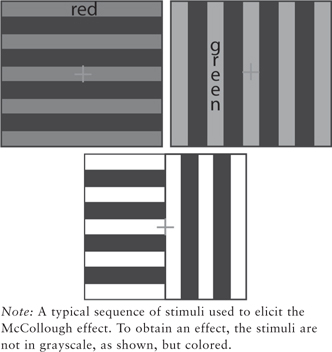
The McCollough effect is a dramatic departure from other negative aftereffects, however. In contrast to simple aftereffects that do not require a test stimulus for the misperception to be evident, the McCollough effect is a contingent aftereffect that is created by relatively brief experimentally induced correlations between stimuli that are usually uncorrelated in the real world. The aftereffect is different depending on whether the test stimulus is horizontal or vertical in the previous example. Also, in contrast to simple aftereffects that last a few seconds, the McCollough effect is stable for weeks, or even months.
There are at least two other fascinating aspects of the McCollough effect. The observer does not have to maintain fixation on a point on the adapter; in fact, the observer can let the eyes wander over the pattern, and the resulting aftereffect will be largely unaffected. Second, the effect does not transfer interocularly: If adaptation is limited to one eye, no discernible negative aftereffect is observed in the non-adapted eye. Given that the McCollough effect is contingent on adapter orientation, that orientation selectivity does not emerge before primary visual cortex (or V1), and that orientation-tuned cells in V1 typically have binocular responses, one would expect the McCollough effect to transfer to the non-adapted eye. That it does not is surprising, and suggests a subcortical locus, where information from the two eyes is segregated.
Stemming from the McCollough effect, research has expanded into investigations into mechanisms or theories to explain the McCollough effect, explorations of aftereffects on other visual dimensions, and discoveries of positive contingent aftereffects.
Mechanisms and Models
It has been proposed that the McCollough effect be thought of as an instantiation of classical or Pavlovian conditioning. Others have proposed a neuroecological interpretation: The visual system is always calibrating its neutral point, and a strong correlation between a specific color and specific orientation is unusual enough to warrant a new neutral point, that is, the negative aftereffect. These studies, although critically placing the McCollough effect within a wider scientific milieu, do not claim to offer a biologically plausible model. In this regard, McCollough originally proposed that cells that were sensitive to both color and orientation, which lie in visual cortex, adapted. A more recent and influential neural network model by Stephen Grossberg and colleagues accounts for the spectrum of empirical findings related to the McCollough effect and is based on known mechanisms in biological vision.
...
- Action and Motor Control
- Action and Bodily Movement
- Analogical Reasoning, Models of Development
- Anomalous Monism
- Anomalous Monism
- Anti-Individualism About Cognition
- Anti-Individualism About Cognition
- Attention and Emotions, Computational Perspectives
- Belief and Judgment
- Case-Based Reasoning, Computational Perspectives
- Causal Theories of Intentionality
- Causal Theories of Memory
- Computational Models of Emotion
- Computational Perspectives
- Conscious Thinking
- Conscious Thinking
- Consciousness and Embodiment
- Consciousness and Embodiment
- Consciousness and the Unconscious
- Deductive Reasoning
- Descriptive Thought
- Development
- Disorders and Pathology
- Disorders and Pathology
- Distributed Cognition
- Electrophysiological Studies of Mind
- Eliminative Materialism
- Eliminative Materialism
- Emergence
- Emergence
- Emotion and Moral Judgment
- Evolutionary Perspectives
- Experimental Philosophy
- Explanatory Gap
- Explanatory Gap
- Extended Mind
- Face Recognition in Humans and Computers
- Facial Expressions, Computational Perspectives
- Facial Expressions, Computational Perspectives
- Freedom of Action
- Idealism
- Idealism
- Intelligence, Neural Basis
- Intentionality of Bodily Sensation
- Intentionality of Emotion
- Introspection
- Know-How, Philosophical Perspectives
- Know-How, Philosophical Perspectives
- Knowledge by Acquaintance
- Machine Speech Recognition
- Memory and Knowledge
- Mental Action
- Mental Causation
- Mental Causation
- Mind-Body Problem
- Modeling Causal Learning
- Moral Development
- Multimodal Conversational Systems
- Naïve Realism
- Natural Language Generation
- Neural Basis
- Object-Dependent Thought
- Personal Identity
- Personal Identity, Development of
- Philosophical Perspectives
- Philosophy of Action
- Physicalism
- Physicalism
- Psychological Research
- Realism and Instrumentalism
- Realism and Instrumentalism
- Reductive Physicalism
- Reductive Physicalism
- Relationships, Development of
- Representational Theory of Mind
- Self-Knowledge
- Semantic Memory, Computational Perspectives
- Sequential Memory, Computational Perspectives
- Serial Order Memory, Computational Perspectives
- Smell, Philosophical Perspectives
- Taste, Philosophical Perspectives
- Teleology
- Teleology
- Theory of Appearing
- Attention
- Aging, Memory, and Information Processing Speed
- Audition, Neural Basis
- Bilingual Language Processing
- Bilingualism, Cognitive Benefits of
- Black English Vernacular (Ebonics)
- Blindsight
- Borderline Personality Disorder
- Capgras Delusion
- Character and Personality, Philosophical Perspectives
- Collective Action
- Common Coding
- Computational Perspectives
- Distributed Cognition
- Emotion and Moral Judgment
- Emotion, Cultural Perspectives
- Emotional Recognition, Neuropsychology of
- Event Memory, Development
- Evolutionary Perspectives
- Experimental Philosophy
- Flynn Effect: Rising Intelligence Scores
- Gender Differences in Language and Language Use
- Gesture and Language Processing
- Attention and Action
- Attention and Emotion
- Attention, Resource Models
- Attentional Blink Effect
- Automaticity
- Change Blindness
- Divided Attention and Memory
- Inattentional Blindness
- Inhibition of Return
- Mental Effort
- Multitasking and Human Performance
- Neurodynamics of Visual Search
- Perceptual Consciousness and Attention
- Psychological Refractory Period
- Stroop Effect
- Visual Search
- Heritability
- Heritage Language and Second Language Learning
- Intelligence and Working Memory
- Joint or Collective Intention
- Joint or Collective Intention
- Knowledge Acquisition in Development
- Mirror Neurons
- Attention and Action
- Attention and Emotion
- Attention, Resource Models
- Attentional Blink Effect
- Automaticity
- Change Blindness
- Divided Attention and Memory
- Inattentional Blindness
- Inhibition of Return
- Mental Effort
- Multitasking and Human Performance
- Neurodynamics of Visual Search
- Perceptual Consciousness and Attention
- Psychological Refractory Period
- Stroop Effect
- Visual Search
- Multiple Intelligences Theory
- Narcissistic Personality Disorder
- Neural Basis
- Philosophical Perspectives
- Philosophy of Action
- Psychological Research
- Attention and Action
- Attention and Emotion
- Attention, Resource Models
- Attentional Blink Effect
- Automaticity
- Change Blindness
- Divided Attention and Memory
- Inattentional Blindness
- Inhibition of Return
- Mental Effort
- Multitasking and Human Performance
- Neurodynamics of Visual Search
- Perceptual Consciousness and Attention
- Psychological Refractory Period
- Stroop Effect
- Visual Search
- Self-Knowledge
- Synesthesia
- Visual Imagery
- Word Learning
- Concepts and Categories
- Amnesia
- Analogical Reasoning, Models of Development
- Anxiety Disorders
- Character and Personality, Philosophical Perspectives
- Computational Perspectives
- Confabulation
- Desire
- Development
- Disjunctive Theory of Perception
- Disorders and Pathology
- Dissent, Effects on Group Decisions
- Distributed Cognition
- Dyslexia, Developmental
- Dyslexia, Phonological Processing in
- Emotion and Moral Judgment
- Evolutionary Perspectives
- Exercise and the Brain
- Folk Psychology
- Group Decision Making
- Guilt
- Hearing, Philosophical Perspectives
- Heritage Language and Second Language Learning
- Human Classification Learning
- Innateness and Parameter Setting
- Intergroup Conflict
- Intergroup Conflict, Models of
- Knowledge Acquisition in Development
- Language Development
- Language Development, Overregulation in
- Moral Development
- Naïve Realism
- Neural Basis
- Philosophical Perspectives
- Political Psychology
- Prediction, Clinical Versus Actuarial
- Psychological Research
- Religion and Psychiatry
- Semantic Dementia
- Smell, Philosophical Perspectives
- Spatial Cognition, Development of
- Taste, Philosophical Perspectives
- Word Learning
- Consciousness
- Aphasia
- Attitude Change
- Attitude Change
- Attitudes and Behavior
- Attraction
- Attribution Theory
- Auditory Masking
- Behavioral Therapy
- Borderline Personality Disorder
- Cognitive Dissonance
- Anesthesia and Awareness
- Attention and Consciousness
- Consciousness and the Unconscious
- Metacognition and Education
- Perceptual Consciousness and Attention
- Self-Consciousness
- Self-Knowledge
- Subliminal Perception
- Unconscious Emotions, Psychological Perspectives
- Unconscious Perception
- Voluntary Action, Illusion of
- Common Coding
- Conduction Aphasia
- Consciousness, Comparative Perspectives
- Deductive Reasoning
- Depth Perception
- Desirable Difficulties Perspective on Learning
- Discrimination Learning, Training Methods
- Disorders and Pathology
- Dyslexia, Acquired
- Dyslexia, Developmental
- Dyslexia, Phonological Processing in
- Anesthesia and Awareness
- Attention and Consciousness
- Consciousness and the Unconscious
- Metacognition and Education
- Perceptual Consciousness and Attention
- Self-Consciousness
- Self-Knowledge
- Subliminal Perception
- Unconscious Emotions, Psychological Perspectives
- Unconscious Perception
- Voluntary Action, Illusion of
- Evolutionary Perspectives
- Exercise and the Brain
- Face Perception
- Facial Expressions, Emotional
- Anesthesia and Awareness
- Attention and Consciousness
- Consciousness and the Unconscious
- Metacognition and Education
- Perceptual Consciousness and Attention
- Self-Consciousness
- Self-Knowledge
- Subliminal Perception
- Unconscious Emotions, Psychological Perspectives
- Unconscious Perception
- Voluntary Action, Illusion of
- Group Decision Making
- Hearing
- Heritability
- Intergroup Conflict
- Intergroup Conflict, Models of
- Learning Styles
- Anesthesia and Awareness
- Attention and Consciousness
- Consciousness and the Unconscious
- Metacognition and Education
- Perceptual Consciousness and Attention
- Self-Consciousness
- Self-Knowledge
- Subliminal Perception
- Unconscious Emotions, Psychological Perspectives
- Unconscious Perception
- Voluntary Action, Illusion of
- Love
- McCollough Effect
- Meta-Analysis
- Metacognition and Education
- Motor Learning, Practical Aspects
- Multinomial Modeling
- Music Perception
- Neural Basis
- Optic Flow
- Perceptual Consciousness and Attention
- Perceptual Constancy
- Personal Identity, Development of
- Personality: Individual Versus Situation Debate
- Personality: Individual Versus Situation Debate
- Persuasion
- Philosophical Perspectives
- Placebo Effect
- Political Psychology
- Anesthesia and Awareness
- Attention and Consciousness
- Consciousness and the Unconscious
- Metacognition and Education
- Perceptual Consciousness and Attention
- Self-Consciousness
- Self-Knowledge
- Subliminal Perception
- Unconscious Emotions, Psychological Perspectives
- Unconscious Perception
- Voluntary Action, Illusion of
- Political Psychology
- Psychological Research
- Anesthesia and Awareness
- Attention and Consciousness
- Consciousness and the Unconscious
- Metacognition and Education
- Perceptual Consciousness and Attention
- Self-Consciousness
- Self-Knowledge
- Subliminal Perception
- Unconscious Emotions, Psychological Perspectives
- Unconscious Perception
- Voluntary Action, Illusion of
- Reaction Time
- Retrieval Practice (Testing) Effect
- Semantic Dementia
- Skill Learning, Enhancement of
- Social Cognition
- Social Loafing
- Spacing Effect, Practical Applications
- Speech Perception
- Stereopsis
- Subliminal Perception
- Synesthesia
- Time Perception
- Unconscious Perception
- Visual Imagery
- Visual Masking
- Visual Search
- Visuospatial Reasoning
- Wisdom of Crowds Effect
- Word Recognition, Auditory
- Word Recognition, Visual
- Working Memory, Evolution of
- Decision Making
- Amnesia
- Argument Mapping
- Behavioral Therapy
- Behaviorism
- Case-Based Reasoning, Computational Perspectives
- Computational Perspectives
- Desirable Difficulties Perspective on Learning
- Desire
- Desire
- Emotion and Psychopathology
- Emotion, Cerebral Lateralization
- Emotion, Psychophysiology of
- Emotional Recognition, Neuropsychology of
- Event Memory, Development
- Genes and Linguistic Tone
- Human Classification Learning
- Implicit Memory
- Learning Styles
- Memory, Neural Basis
- Metacognition and Education
- Music and the Evolution of Language
- Neural Basis
- Philosophical Perspectives
- Placebo Effect
- Practical Applications
- Psychological Research
- Reinforcement Learning, Psychological Perspectives
- Retrieval Practice (Testing) Effect
- Skill Learning, Enhancement of
- Spacing Effect
- Word Learning
- Disorders and Pathology
- Addiction
- Amnesia
- Analogical Mapping and Reasoning
- Anchoring
- Anosognosia
- Anxiety Disorders
- Aphasia
- Aphasia
- Apraxia
- Autism
- Automatic Behavior
- Autoscopic Phenomena
- Availability Heuristic
- Behavioral Therapy
- Borderline Personality Disorder
- Capgras Delusion
- Causal Theories of Memory
- Conduction Aphasia
- Conduction Aphasia
- Confabulation
- Delusions
- Desire
- Distributed Cognition
- Dyslexia, Acquired
- Dyslexia, Developmental
- Dyslexia, Phonological Processing in
- Emotion and Moral Judgment
- Emotion and Psychopathology
- Emotions and Consciousness
- Fregoli Delusion
- Hypochondria
- Intentionality of Emotion
- Legal Reasoning, Psychological Perspectives
- Memory and Knowledge
- Motivated Thinking
- Narcissistic Personality Disorder
- Objects of Memory
- Rationality of Emotion
- Religion and Psychiatry
- Representativeness Heuristic
- Schizophrenia
- Scientific Reasoning
- Semantic Dementia
- Spatial Cognition, Development of
- Thinking
- Two System Models of Reasoning
- Visual Imagery
- Visuospatial Reasoning
- Williams Syndrome
- Computational Perspectives
- Action and Bodily Movement
- Analogical Reasoning, Models of Development
- Anomalous Monism
- Anomalous Monism
- Anti-Individualism About Cognition
- Anti-Individualism About Cognition
- Attention and Emotions, Computational Perspectives
- Belief and Judgment
- Case-Based Reasoning, Computational Perspectives
- Causal Theories of Intentionality
- Causal Theories of Memory
- Computational Models of Emotion
- Computational Perspectives
- Conscious Thinking
- Conscious Thinking
- Consciousness and Embodiment
- Consciousness and Embodiment
- Consciousness and the Unconscious
- Deductive Reasoning
- Descriptive Thought
- Development
- Disorders and Pathology
- Disorders and Pathology
- Distributed Cognition
- Electrophysiological Studies of Mind
- Eliminative Materialism
- Eliminative Materialism
- Emergence
- Emergence
- Emotion and Moral Judgment
- Evolutionary Perspectives
- Experimental Philosophy
- Explanatory Gap
- Explanatory Gap
- Extended Mind
- Face Recognition in Humans and Computers
- Facial Expressions, Computational Perspectives
- Facial Expressions, Computational Perspectives
- Freedom of Action
- Idealism
- Idealism
- Intelligence, Neural Basis
- Intentionality of Bodily Sensation
- Intentionality of Emotion
- Introspection
- Know-How, Philosophical Perspectives
- Know-How, Philosophical Perspectives
- Knowledge by Acquaintance
- Machine Speech Recognition
- Memory and Knowledge
- Mental Action
- Mental Causation
- Mental Causation
- Mind-Body Problem
- Modeling Causal Learning
- Moral Development
- Multimodal Conversational Systems
- Naïve Realism
- Natural Language Generation
- Neural Basis
- Object-Dependent Thought
- Personal Identity
- Personal Identity, Development of
- Philosophical Perspectives
- Philosophy of Action
- Physicalism
- Physicalism
- Psychological Research
- Realism and Instrumentalism
- Realism and Instrumentalism
- Reductive Physicalism
- Reductive Physicalism
- Relationships, Development of
- Representational Theory of Mind
- Self-Knowledge
- Semantic Memory, Computational Perspectives
- Sequential Memory, Computational Perspectives
- Serial Order Memory, Computational Perspectives
- Smell, Philosophical Perspectives
- Taste, Philosophical Perspectives
- Teleology
- Teleology
- Theory of Appearing
- Cultural Perspectives
- Aging, Memory, and Information Processing Speed
- Audition, Neural Basis
- Bilingual Language Processing
- Bilingualism, Cognitive Benefits of
- Black English Vernacular (Ebonics)
- Blindsight
- Borderline Personality Disorder
- Capgras Delusion
- Character and Personality, Philosophical Perspectives
- Collective Action
- Common Coding
- Computational Perspectives
- Distributed Cognition
- Emotion and Moral Judgment
- Emotion, Cultural Perspectives
- Emotional Recognition, Neuropsychology of
- Event Memory, Development
- Evolutionary Perspectives
- Experimental Philosophy
- Flynn Effect: Rising Intelligence Scores
- Gender Differences in Language and Language Use
- Gesture and Language Processing
- Attention and Action
- Attention and Emotion
- Attention, Resource Models
- Attentional Blink Effect
- Automaticity
- Change Blindness
- Divided Attention and Memory
- Inattentional Blindness
- Inhibition of Return
- Mental Effort
- Multitasking and Human Performance
- Neurodynamics of Visual Search
- Perceptual Consciousness and Attention
- Psychological Refractory Period
- Stroop Effect
- Visual Search
- Heritability
- Heritage Language and Second Language Learning
- Intelligence and Working Memory
- Joint or Collective Intention
- Joint or Collective Intention
- Knowledge Acquisition in Development
- Mirror Neurons
- Attention and Action
- Attention and Emotion
- Attention, Resource Models
- Attentional Blink Effect
- Automaticity
- Change Blindness
- Divided Attention and Memory
- Inattentional Blindness
- Inhibition of Return
- Mental Effort
- Multitasking and Human Performance
- Neurodynamics of Visual Search
- Perceptual Consciousness and Attention
- Psychological Refractory Period
- Stroop Effect
- Visual Search
- Multiple Intelligences Theory
- Narcissistic Personality Disorder
- Neural Basis
- Philosophical Perspectives
- Philosophy of Action
- Psychological Research
- Attention and Action
- Attention and Emotion
- Attention, Resource Models
- Attentional Blink Effect
- Automaticity
- Change Blindness
- Divided Attention and Memory
- Inattentional Blindness
- Inhibition of Return
- Mental Effort
- Multitasking and Human Performance
- Neurodynamics of Visual Search
- Perceptual Consciousness and Attention
- Psychological Refractory Period
- Stroop Effect
- Visual Search
- Self-Knowledge
- Synesthesia
- Visual Imagery
- Word Learning
- Disorders and Pathology
- Amnesia
- Analogical Reasoning, Models of Development
- Anxiety Disorders
- Character and Personality, Philosophical Perspectives
- Computational Perspectives
- Confabulation
- Desire
- Development
- Disjunctive Theory of Perception
- Disorders and Pathology
- Dissent, Effects on Group Decisions
- Distributed Cognition
- Dyslexia, Developmental
- Dyslexia, Phonological Processing in
- Emotion and Moral Judgment
- Evolutionary Perspectives
- Exercise and the Brain
- Folk Psychology
- Group Decision Making
- Guilt
- Hearing, Philosophical Perspectives
- Heritage Language and Second Language Learning
- Human Classification Learning
- Innateness and Parameter Setting
- Intergroup Conflict
- Intergroup Conflict, Models of
- Knowledge Acquisition in Development
- Language Development
- Language Development, Overregulation in
- Moral Development
- Naïve Realism
- Neural Basis
- Philosophical Perspectives
- Political Psychology
- Prediction, Clinical Versus Actuarial
- Psychological Research
- Religion and Psychiatry
- Semantic Dementia
- Smell, Philosophical Perspectives
- Spatial Cognition, Development of
- Taste, Philosophical Perspectives
- Word Learning
- Evolutionary Perspectives
- Aphasia
- Attitude Change
- Attitude Change
- Attitudes and Behavior
- Attraction
- Attribution Theory
- Auditory Masking
- Behavioral Therapy
- Borderline Personality Disorder
- Cognitive Dissonance
- Anesthesia and Awareness
- Attention and Consciousness
- Consciousness and the Unconscious
- Metacognition and Education
- Perceptual Consciousness and Attention
- Self-Consciousness
- Self-Knowledge
- Subliminal Perception
- Unconscious Emotions, Psychological Perspectives
- Unconscious Perception
- Voluntary Action, Illusion of
- Common Coding
- Conduction Aphasia
- Consciousness, Comparative Perspectives
- Deductive Reasoning
- Depth Perception
- Desirable Difficulties Perspective on Learning
- Discrimination Learning, Training Methods
- Disorders and Pathology
- Dyslexia, Acquired
- Dyslexia, Developmental
- Dyslexia, Phonological Processing in
- Anesthesia and Awareness
- Attention and Consciousness
- Consciousness and the Unconscious
- Metacognition and Education
- Perceptual Consciousness and Attention
- Self-Consciousness
- Self-Knowledge
- Subliminal Perception
- Unconscious Emotions, Psychological Perspectives
- Unconscious Perception
- Voluntary Action, Illusion of
- Evolutionary Perspectives
- Exercise and the Brain
- Face Perception
- Facial Expressions, Emotional
- Anesthesia and Awareness
- Attention and Consciousness
- Consciousness and the Unconscious
- Metacognition and Education
- Perceptual Consciousness and Attention
- Self-Consciousness
- Self-Knowledge
- Subliminal Perception
- Unconscious Emotions, Psychological Perspectives
- Unconscious Perception
- Voluntary Action, Illusion of
- Group Decision Making
- Hearing
- Heritability
- Intergroup Conflict
- Intergroup Conflict, Models of
- Learning Styles
- Anesthesia and Awareness
- Attention and Consciousness
- Consciousness and the Unconscious
- Metacognition and Education
- Perceptual Consciousness and Attention
- Self-Consciousness
- Self-Knowledge
- Subliminal Perception
- Unconscious Emotions, Psychological Perspectives
- Unconscious Perception
- Voluntary Action, Illusion of
- Love
- McCollough Effect
- Meta-Analysis
- Metacognition and Education
- Motor Learning, Practical Aspects
- Multinomial Modeling
- Music Perception
- Neural Basis
- Optic Flow
- Perceptual Consciousness and Attention
- Perceptual Constancy
- Personal Identity, Development of
- Personality: Individual Versus Situation Debate
- Personality: Individual Versus Situation Debate
- Persuasion
- Philosophical Perspectives
- Placebo Effect
- Political Psychology
- Anesthesia and Awareness
- Attention and Consciousness
- Consciousness and the Unconscious
- Metacognition and Education
- Perceptual Consciousness and Attention
- Self-Consciousness
- Self-Knowledge
- Subliminal Perception
- Unconscious Emotions, Psychological Perspectives
- Unconscious Perception
- Voluntary Action, Illusion of
- Political Psychology
- Psychological Research
- Anesthesia and Awareness
- Attention and Consciousness
- Consciousness and the Unconscious
- Metacognition and Education
- Perceptual Consciousness and Attention
- Self-Consciousness
- Self-Knowledge
- Subliminal Perception
- Unconscious Emotions, Psychological Perspectives
- Unconscious Perception
- Voluntary Action, Illusion of
- Reaction Time
- Retrieval Practice (Testing) Effect
- Semantic Dementia
- Skill Learning, Enhancement of
- Social Cognition
- Social Loafing
- Spacing Effect, Practical Applications
- Speech Perception
- Stereopsis
- Subliminal Perception
- Synesthesia
- Time Perception
- Unconscious Perception
- Visual Imagery
- Visual Masking
- Visual Search
- Visuospatial Reasoning
- Wisdom of Crowds Effect
- Word Recognition, Auditory
- Word Recognition, Visual
- Working Memory, Evolution of
- Neural Basis
- Amnesia
- Argument Mapping
- Behavioral Therapy
- Behaviorism
- Case-Based Reasoning, Computational Perspectives
- Computational Perspectives
- Desirable Difficulties Perspective on Learning
- Desire
- Desire
- Emotion and Psychopathology
- Emotion, Cerebral Lateralization
- Emotion, Psychophysiology of
- Emotional Recognition, Neuropsychology of
- Event Memory, Development
- Genes and Linguistic Tone
- Human Classification Learning
- Implicit Memory
- Learning Styles
- Memory, Neural Basis
- Metacognition and Education
- Music and the Evolution of Language
- Neural Basis
- Philosophical Perspectives
- Placebo Effect
- Practical Applications
- Psychological Research
- Reinforcement Learning, Psychological Perspectives
- Retrieval Practice (Testing) Effect
- Skill Learning, Enhancement of
- Spacing Effect
- Word Learning
- Philosophical Perspectives
- Addiction
- Amnesia
- Analogical Mapping and Reasoning
- Anchoring
- Anosognosia
- Anxiety Disorders
- Aphasia
- Aphasia
- Apraxia
- Autism
- Automatic Behavior
- Autoscopic Phenomena
- Availability Heuristic
- Behavioral Therapy
- Borderline Personality Disorder
- Capgras Delusion
- Causal Theories of Memory
- Conduction Aphasia
- Conduction Aphasia
- Confabulation
- Delusions
- Desire
- Distributed Cognition
- Dyslexia, Acquired
- Dyslexia, Developmental
- Dyslexia, Phonological Processing in
- Emotion and Moral Judgment
- Emotion and Psychopathology
- Emotions and Consciousness
- Fregoli Delusion
- Hypochondria
- Intentionality of Emotion
- Legal Reasoning, Psychological Perspectives
- Memory and Knowledge
- Motivated Thinking
- Narcissistic Personality Disorder
- Objects of Memory
- Rationality of Emotion
- Religion and Psychiatry
- Representativeness Heuristic
- Schizophrenia
- Scientific Reasoning
- Semantic Dementia
- Spatial Cognition, Development of
- Thinking
- Two System Models of Reasoning
- Visual Imagery
- Visuospatial Reasoning
- Williams Syndrome
- Psychological Research
- Affective Forecasting
- Anxiety Disorders
- Attention and Emotion
- Cognitive Dissonance
- Descriptions
- Descriptive Thought
- Disgust
- Embarrassment
- Emotion and Moral Judgment
- Emotion and Working Memory
- Emotion Regulation
- Emotion, Psychophysiology of
- Emotion, Structural Approaches
- Envy
- Exercise and the Brain
- Facial Expressions, Emotional
- Guilt
- Happiness
- Indexical Thought
- Intension and Extension
- Jealousy
- Love
- Metaphor
- Mnemonic Strategies
- Object-Dependent Thought
- Regret
- Religion and Psychiatry
- Resentment
- Retrieval Practice (Testing) Effect
- Spacing Effect, Practical Applications
- Unconscious Emotions, Psychological Perspectives
- Philosophical Perspectives
- Action and Bodily Movement
- Analogical Reasoning, Models of Development
- Anomalous Monism
- Anomalous Monism
- Anti-Individualism About Cognition
- Anti-Individualism About Cognition
- Attention and Emotions, Computational Perspectives
- Belief and Judgment
- Case-Based Reasoning, Computational Perspectives
- Causal Theories of Intentionality
- Causal Theories of Memory
- Computational Models of Emotion
- Computational Perspectives
- Conscious Thinking
- Conscious Thinking
- Consciousness and Embodiment
- Consciousness and Embodiment
- Consciousness and the Unconscious
- Deductive Reasoning
- Descriptive Thought
- Development
- Disorders and Pathology
- Disorders and Pathology
- Distributed Cognition
- Electrophysiological Studies of Mind
- Eliminative Materialism
- Eliminative Materialism
- Emergence
- Emergence
- Emotion and Moral Judgment
- Evolutionary Perspectives
- Experimental Philosophy
- Explanatory Gap
- Explanatory Gap
- Extended Mind
- Face Recognition in Humans and Computers
- Facial Expressions, Computational Perspectives
- Facial Expressions, Computational Perspectives
- Freedom of Action
- Idealism
- Idealism
- Intelligence, Neural Basis
- Intentionality of Bodily Sensation
- Intentionality of Emotion
- Introspection
- Know-How, Philosophical Perspectives
- Know-How, Philosophical Perspectives
- Knowledge by Acquaintance
- Machine Speech Recognition
- Memory and Knowledge
- Mental Action
- Mental Causation
- Mental Causation
- Mind-Body Problem
- Modeling Causal Learning
- Moral Development
- Multimodal Conversational Systems
- Naïve Realism
- Natural Language Generation
- Neural Basis
- Object-Dependent Thought
- Personal Identity
- Personal Identity, Development of
- Philosophical Perspectives
- Philosophy of Action
- Physicalism
- Physicalism
- Psychological Research
- Realism and Instrumentalism
- Realism and Instrumentalism
- Reductive Physicalism
- Reductive Physicalism
- Relationships, Development of
- Representational Theory of Mind
- Self-Knowledge
- Semantic Memory, Computational Perspectives
- Sequential Memory, Computational Perspectives
- Serial Order Memory, Computational Perspectives
- Smell, Philosophical Perspectives
- Taste, Philosophical Perspectives
- Teleology
- Teleology
- Theory of Appearing
- Psychological Research
- Aging, Memory, and Information Processing Speed
- Audition, Neural Basis
- Bilingual Language Processing
- Bilingualism, Cognitive Benefits of
- Black English Vernacular (Ebonics)
- Blindsight
- Borderline Personality Disorder
- Capgras Delusion
- Character and Personality, Philosophical Perspectives
- Collective Action
- Common Coding
- Computational Perspectives
- Distributed Cognition
- Emotion and Moral Judgment
- Emotion, Cultural Perspectives
- Emotional Recognition, Neuropsychology of
- Event Memory, Development
- Evolutionary Perspectives
- Experimental Philosophy
- Flynn Effect: Rising Intelligence Scores
- Gender Differences in Language and Language Use
- Gesture and Language Processing
- Attention and Action
- Attention and Emotion
- Attention, Resource Models
- Attentional Blink Effect
- Automaticity
- Change Blindness
- Divided Attention and Memory
- Inattentional Blindness
- Inhibition of Return
- Mental Effort
- Multitasking and Human Performance
- Neurodynamics of Visual Search
- Perceptual Consciousness and Attention
- Psychological Refractory Period
- Stroop Effect
- Visual Search
- Heritability
- Heritage Language and Second Language Learning
- Intelligence and Working Memory
- Joint or Collective Intention
- Joint or Collective Intention
- Knowledge Acquisition in Development
- Mirror Neurons
- Attention and Action
- Attention and Emotion
- Attention, Resource Models
- Attentional Blink Effect
- Automaticity
- Change Blindness
- Divided Attention and Memory
- Inattentional Blindness
- Inhibition of Return
- Mental Effort
- Multitasking and Human Performance
- Neurodynamics of Visual Search
- Perceptual Consciousness and Attention
- Psychological Refractory Period
- Stroop Effect
- Visual Search
- Multiple Intelligences Theory
- Narcissistic Personality Disorder
- Neural Basis
- Philosophical Perspectives
- Philosophy of Action
- Psychological Research
- Attention and Action
- Attention and Emotion
- Attention, Resource Models
- Attentional Blink Effect
- Automaticity
- Change Blindness
- Divided Attention and Memory
- Inattentional Blindness
- Inhibition of Return
- Mental Effort
- Multitasking and Human Performance
- Neurodynamics of Visual Search
- Perceptual Consciousness and Attention
- Psychological Refractory Period
- Stroop Effect
- Visual Search
- Self-Knowledge
- Synesthesia
- Visual Imagery
- Word Learning
- Heritability
- Action and Bodily Movement
- Analogical Reasoning, Models of Development
- Anomalous Monism
- Anomalous Monism
- Anti-Individualism About Cognition
- Anti-Individualism About Cognition
- Attention and Emotions, Computational Perspectives
- Belief and Judgment
- Case-Based Reasoning, Computational Perspectives
- Causal Theories of Intentionality
- Causal Theories of Memory
- Computational Models of Emotion
- Computational Perspectives
- Conscious Thinking
- Conscious Thinking
- Consciousness and Embodiment
- Consciousness and Embodiment
- Consciousness and the Unconscious
- Deductive Reasoning
- Descriptive Thought
- Development
- Disorders and Pathology
- Disorders and Pathology
- Distributed Cognition
- Electrophysiological Studies of Mind
- Eliminative Materialism
- Eliminative Materialism
- Emergence
- Emergence
- Emotion and Moral Judgment
- Evolutionary Perspectives
- Experimental Philosophy
- Explanatory Gap
- Explanatory Gap
- Extended Mind
- Face Recognition in Humans and Computers
- Facial Expressions, Computational Perspectives
- Facial Expressions, Computational Perspectives
- Freedom of Action
- Idealism
- Idealism
- Intelligence, Neural Basis
- Intentionality of Bodily Sensation
- Intentionality of Emotion
- Introspection
- Know-How, Philosophical Perspectives
- Know-How, Philosophical Perspectives
- Knowledge by Acquaintance
- Machine Speech Recognition
- Memory and Knowledge
- Mental Action
- Mental Causation
- Mental Causation
- Mind-Body Problem
- Modeling Causal Learning
- Moral Development
- Multimodal Conversational Systems
- Naïve Realism
- Natural Language Generation
- Neural Basis
- Object-Dependent Thought
- Personal Identity
- Personal Identity, Development of
- Philosophical Perspectives
- Philosophy of Action
- Physicalism
- Physicalism
- Psychological Research
- Realism and Instrumentalism
- Realism and Instrumentalism
- Reductive Physicalism
- Reductive Physicalism
- Relationships, Development of
- Representational Theory of Mind
- Self-Knowledge
- Semantic Memory, Computational Perspectives
- Sequential Memory, Computational Perspectives
- Serial Order Memory, Computational Perspectives
- Smell, Philosophical Perspectives
- Taste, Philosophical Perspectives
- Teleology
- Teleology
- Theory of Appearing
- Cultural Perspectives
- Action and Bodily Movement
- Analogical Reasoning, Models of Development
- Anomalous Monism
- Anomalous Monism
- Anti-Individualism About Cognition
- Anti-Individualism About Cognition
- Attention and Emotions, Computational Perspectives
- Belief and Judgment
- Case-Based Reasoning, Computational Perspectives
- Causal Theories of Intentionality
- Causal Theories of Memory
- Computational Models of Emotion
- Computational Perspectives
- Conscious Thinking
- Conscious Thinking
- Consciousness and Embodiment
- Consciousness and Embodiment
- Consciousness and the Unconscious
- Deductive Reasoning
- Descriptive Thought
- Development
- Disorders and Pathology
- Disorders and Pathology
- Distributed Cognition
- Electrophysiological Studies of Mind
- Eliminative Materialism
- Eliminative Materialism
- Emergence
- Emergence
- Emotion and Moral Judgment
- Evolutionary Perspectives
- Experimental Philosophy
- Explanatory Gap
- Explanatory Gap
- Extended Mind
- Face Recognition in Humans and Computers
- Facial Expressions, Computational Perspectives
- Facial Expressions, Computational Perspectives
- Freedom of Action
- Idealism
- Idealism
- Intelligence, Neural Basis
- Intentionality of Bodily Sensation
- Intentionality of Emotion
- Introspection
- Know-How, Philosophical Perspectives
- Know-How, Philosophical Perspectives
- Knowledge by Acquaintance
- Machine Speech Recognition
- Memory and Knowledge
- Mental Action
- Mental Causation
- Mental Causation
- Mind-Body Problem
- Modeling Causal Learning
- Moral Development
- Multimodal Conversational Systems
- Naïve Realism
- Natural Language Generation
- Neural Basis
- Object-Dependent Thought
- Personal Identity
- Personal Identity, Development of
- Philosophical Perspectives
- Philosophy of Action
- Physicalism
- Physicalism
- Psychological Research
- Realism and Instrumentalism
- Realism and Instrumentalism
- Reductive Physicalism
- Reductive Physicalism
- Relationships, Development of
- Representational Theory of Mind
- Self-Knowledge
- Semantic Memory, Computational Perspectives
- Sequential Memory, Computational Perspectives
- Serial Order Memory, Computational Perspectives
- Smell, Philosophical Perspectives
- Taste, Philosophical Perspectives
- Teleology
- Teleology
- Theory of Appearing
- Philosophical Perspectives
- Aging, Memory, and Information Processing Speed
- Audition, Neural Basis
- Bilingual Language Processing
- Bilingualism, Cognitive Benefits of
- Black English Vernacular (Ebonics)
- Blindsight
- Borderline Personality Disorder
- Capgras Delusion
- Character and Personality, Philosophical Perspectives
- Collective Action
- Common Coding
- Computational Perspectives
- Distributed Cognition
- Emotion and Moral Judgment
- Emotion, Cultural Perspectives
- Emotional Recognition, Neuropsychology of
- Event Memory, Development
- Evolutionary Perspectives
- Experimental Philosophy
- Flynn Effect: Rising Intelligence Scores
- Gender Differences in Language and Language Use
- Gesture and Language Processing
- Attention and Action
- Attention and Emotion
- Attention, Resource Models
- Attentional Blink Effect
- Automaticity
- Change Blindness
- Divided Attention and Memory
- Inattentional Blindness
- Inhibition of Return
- Mental Effort
- Multitasking and Human Performance
- Neurodynamics of Visual Search
- Perceptual Consciousness and Attention
- Psychological Refractory Period
- Stroop Effect
- Visual Search
- Heritability
- Heritage Language and Second Language Learning
- Intelligence and Working Memory
- Joint or Collective Intention
- Joint or Collective Intention
- Knowledge Acquisition in Development
- Mirror Neurons
- Attention and Action
- Attention and Emotion
- Attention, Resource Models
- Attentional Blink Effect
- Automaticity
- Change Blindness
- Divided Attention and Memory
- Inattentional Blindness
- Inhibition of Return
- Mental Effort
- Multitasking and Human Performance
- Neurodynamics of Visual Search
- Perceptual Consciousness and Attention
- Psychological Refractory Period
- Stroop Effect
- Visual Search
- Multiple Intelligences Theory
- Narcissistic Personality Disorder
- Neural Basis
- Philosophical Perspectives
- Philosophy of Action
- Psychological Research
- Attention and Action
- Attention and Emotion
- Attention, Resource Models
- Attentional Blink Effect
- Automaticity
- Change Blindness
- Divided Attention and Memory
- Inattentional Blindness
- Inhibition of Return
- Mental Effort
- Multitasking and Human Performance
- Neurodynamics of Visual Search
- Perceptual Consciousness and Attention
- Psychological Refractory Period
- Stroop Effect
- Visual Search
- Self-Knowledge
- Synesthesia
- Visual Imagery
- Word Learning
- Psychological Research
- Amnesia
- Analogical Reasoning, Models of Development
- Anxiety Disorders
- Character and Personality, Philosophical Perspectives
- Computational Perspectives
- Confabulation
- Desire
- Development
- Disjunctive Theory of Perception
- Disorders and Pathology
- Dissent, Effects on Group Decisions
- Distributed Cognition
- Dyslexia, Developmental
- Dyslexia, Phonological Processing in
- Emotion and Moral Judgment
- Evolutionary Perspectives
- Exercise and the Brain
- Folk Psychology
- Group Decision Making
- Guilt
- Hearing, Philosophical Perspectives
- Heritage Language and Second Language Learning
- Human Classification Learning
- Innateness and Parameter Setting
- Intergroup Conflict
- Intergroup Conflict, Models of
- Knowledge Acquisition in Development
- Language Development
- Language Development, Overregulation in
- Moral Development
- Naïve Realism
- Neural Basis
- Philosophical Perspectives
- Political Psychology
- Prediction, Clinical Versus Actuarial
- Psychological Research
- Religion and Psychiatry
- Semantic Dementia
- Smell, Philosophical Perspectives
- Spatial Cognition, Development of
- Taste, Philosophical Perspectives
- Word Learning
- Neural Basis
- Action and Bodily Movement
- Analogical Reasoning, Models of Development
- Anomalous Monism
- Anomalous Monism
- Anti-Individualism About Cognition
- Anti-Individualism About Cognition
- Attention and Emotions, Computational Perspectives
- Belief and Judgment
- Case-Based Reasoning, Computational Perspectives
- Causal Theories of Intentionality
- Causal Theories of Memory
- Computational Models of Emotion
- Computational Perspectives
- Conscious Thinking
- Conscious Thinking
- Consciousness and Embodiment
- Consciousness and Embodiment
- Consciousness and the Unconscious
- Deductive Reasoning
- Descriptive Thought
- Development
- Disorders and Pathology
- Disorders and Pathology
- Distributed Cognition
- Electrophysiological Studies of Mind
- Eliminative Materialism
- Eliminative Materialism
- Emergence
- Emergence
- Emotion and Moral Judgment
- Evolutionary Perspectives
- Experimental Philosophy
- Explanatory Gap
- Explanatory Gap
- Extended Mind
- Face Recognition in Humans and Computers
- Facial Expressions, Computational Perspectives
- Facial Expressions, Computational Perspectives
- Freedom of Action
- Idealism
- Idealism
- Intelligence, Neural Basis
- Intentionality of Bodily Sensation
- Intentionality of Emotion
- Introspection
- Know-How, Philosophical Perspectives
- Know-How, Philosophical Perspectives
- Knowledge by Acquaintance
- Machine Speech Recognition
- Memory and Knowledge
- Mental Action
- Mental Causation
- Mental Causation
- Mind-Body Problem
- Modeling Causal Learning
- Moral Development
- Multimodal Conversational Systems
- Naïve Realism
- Natural Language Generation
- Neural Basis
- Object-Dependent Thought
- Personal Identity
- Personal Identity, Development of
- Philosophical Perspectives
- Philosophy of Action
- Physicalism
- Physicalism
- Psychological Research
- Realism and Instrumentalism
- Realism and Instrumentalism
- Reductive Physicalism
- Reductive Physicalism
- Relationships, Development of
- Representational Theory of Mind
- Self-Knowledge
- Semantic Memory, Computational Perspectives
- Sequential Memory, Computational Perspectives
- Serial Order Memory, Computational Perspectives
- Smell, Philosophical Perspectives
- Taste, Philosophical Perspectives
- Teleology
- Teleology
- Theory of Appearing
- Psychological Research
- Aging, Memory, and Information Processing Speed
- Audition, Neural Basis
- Bilingual Language Processing
- Bilingualism, Cognitive Benefits of
- Black English Vernacular (Ebonics)
- Blindsight
- Borderline Personality Disorder
- Capgras Delusion
- Character and Personality, Philosophical Perspectives
- Collective Action
- Common Coding
- Computational Perspectives
- Distributed Cognition
- Emotion and Moral Judgment
- Emotion, Cultural Perspectives
- Emotional Recognition, Neuropsychology of
- Event Memory, Development
- Evolutionary Perspectives
- Experimental Philosophy
- Flynn Effect: Rising Intelligence Scores
- Gender Differences in Language and Language Use
- Gesture and Language Processing
- Attention and Action
- Attention and Emotion
- Attention, Resource Models
- Attentional Blink Effect
- Automaticity
- Change Blindness
- Divided Attention and Memory
- Inattentional Blindness
- Inhibition of Return
- Mental Effort
- Multitasking and Human Performance
- Neurodynamics of Visual Search
- Perceptual Consciousness and Attention
- Psychological Refractory Period
- Stroop Effect
- Visual Search
- Heritability
- Heritage Language and Second Language Learning
- Intelligence and Working Memory
- Joint or Collective Intention
- Joint or Collective Intention
- Knowledge Acquisition in Development
- Mirror Neurons
- Attention and Action
- Attention and Emotion
- Attention, Resource Models
- Attentional Blink Effect
- Automaticity
- Change Blindness
- Divided Attention and Memory
- Inattentional Blindness
- Inhibition of Return
- Mental Effort
- Multitasking and Human Performance
- Neurodynamics of Visual Search
- Perceptual Consciousness and Attention
- Psychological Refractory Period
- Stroop Effect
- Visual Search
- Multiple Intelligences Theory
- Narcissistic Personality Disorder
- Neural Basis
- Philosophical Perspectives
- Philosophy of Action
- Psychological Research
- Attention and Action
- Attention and Emotion
- Attention, Resource Models
- Attentional Blink Effect
- Automaticity
- Change Blindness
- Divided Attention and Memory
- Inattentional Blindness
- Inhibition of Return
- Mental Effort
- Multitasking and Human Performance
- Neurodynamics of Visual Search
- Perceptual Consciousness and Attention
- Psychological Refractory Period
- Stroop Effect
- Visual Search
- Self-Knowledge
- Synesthesia
- Visual Imagery
- Word Learning
- Computational Perspectives
- Action and Bodily Movement
- Analogical Reasoning, Models of Development
- Anomalous Monism
- Anomalous Monism
- Anti-Individualism About Cognition
- Anti-Individualism About Cognition
- Attention and Emotions, Computational Perspectives
- Belief and Judgment
- Case-Based Reasoning, Computational Perspectives
- Causal Theories of Intentionality
- Causal Theories of Memory
- Computational Models of Emotion
- Computational Perspectives
- Conscious Thinking
- Conscious Thinking
- Consciousness and Embodiment
- Consciousness and Embodiment
- Consciousness and the Unconscious
- Deductive Reasoning
- Descriptive Thought
- Development
- Disorders and Pathology
- Disorders and Pathology
- Distributed Cognition
- Electrophysiological Studies of Mind
- Eliminative Materialism
- Eliminative Materialism
- Emergence
- Emergence
- Emotion and Moral Judgment
- Evolutionary Perspectives
- Experimental Philosophy
- Explanatory Gap
- Explanatory Gap
- Extended Mind
- Face Recognition in Humans and Computers
- Facial Expressions, Computational Perspectives
- Facial Expressions, Computational Perspectives
- Freedom of Action
- Idealism
- Idealism
- Intelligence, Neural Basis
- Intentionality of Bodily Sensation
- Intentionality of Emotion
- Introspection
- Know-How, Philosophical Perspectives
- Know-How, Philosophical Perspectives
- Knowledge by Acquaintance
- Machine Speech Recognition
- Memory and Knowledge
- Mental Action
- Mental Causation
- Mental Causation
- Mind-Body Problem
- Modeling Causal Learning
- Moral Development
- Multimodal Conversational Systems
- Naïve Realism
- Natural Language Generation
- Neural Basis
- Object-Dependent Thought
- Personal Identity
- Personal Identity, Development of
- Philosophical Perspectives
- Philosophy of Action
- Physicalism
- Physicalism
- Psychological Research
- Realism and Instrumentalism
- Realism and Instrumentalism
- Reductive Physicalism
- Reductive Physicalism
- Relationships, Development of
- Representational Theory of Mind
- Self-Knowledge
- Semantic Memory, Computational Perspectives
- Sequential Memory, Computational Perspectives
- Serial Order Memory, Computational Perspectives
- Smell, Philosophical Perspectives
- Taste, Philosophical Perspectives
- Teleology
- Teleology
- Theory of Appearing
- Cultural Perspectives
- Aging, Memory, and Information Processing Speed
- Audition, Neural Basis
- Bilingual Language Processing
- Bilingualism, Cognitive Benefits of
- Black English Vernacular (Ebonics)
- Blindsight
- Borderline Personality Disorder
- Capgras Delusion
- Character and Personality, Philosophical Perspectives
- Collective Action
- Common Coding
- Computational Perspectives
- Distributed Cognition
- Emotion and Moral Judgment
- Emotion, Cultural Perspectives
- Emotional Recognition, Neuropsychology of
- Event Memory, Development
- Evolutionary Perspectives
- Experimental Philosophy
- Flynn Effect: Rising Intelligence Scores
- Gender Differences in Language and Language Use
- Gesture and Language Processing
- Attention and Action
- Attention and Emotion
- Attention, Resource Models
- Attentional Blink Effect
- Automaticity
- Change Blindness
- Divided Attention and Memory
- Inattentional Blindness
- Inhibition of Return
- Mental Effort
- Multitasking and Human Performance
- Neurodynamics of Visual Search
- Perceptual Consciousness and Attention
- Psychological Refractory Period
- Stroop Effect
- Visual Search
- Heritability
- Heritage Language and Second Language Learning
- Intelligence and Working Memory
- Joint or Collective Intention
- Joint or Collective Intention
- Knowledge Acquisition in Development
- Mirror Neurons
- Attention and Action
- Attention and Emotion
- Attention, Resource Models
- Attentional Blink Effect
- Automaticity
- Change Blindness
- Divided Attention and Memory
- Inattentional Blindness
- Inhibition of Return
- Mental Effort
- Multitasking and Human Performance
- Neurodynamics of Visual Search
- Perceptual Consciousness and Attention
- Psychological Refractory Period
- Stroop Effect
- Visual Search
- Multiple Intelligences Theory
- Narcissistic Personality Disorder
- Neural Basis
- Philosophical Perspectives
- Philosophy of Action
- Psychological Research
- Attention and Action
- Attention and Emotion
- Attention, Resource Models
- Attentional Blink Effect
- Automaticity
- Change Blindness
- Divided Attention and Memory
- Inattentional Blindness
- Inhibition of Return
- Mental Effort
- Multitasking and Human Performance
- Neurodynamics of Visual Search
- Perceptual Consciousness and Attention
- Psychological Refractory Period
- Stroop Effect
- Visual Search
- Self-Knowledge
- Synesthesia
- Visual Imagery
- Word Learning
- Development
- Amnesia
- Analogical Reasoning, Models of Development
- Anxiety Disorders
- Character and Personality, Philosophical Perspectives
- Computational Perspectives
- Confabulation
- Desire
- Development
- Disjunctive Theory of Perception
- Disorders and Pathology
- Dissent, Effects on Group Decisions
- Distributed Cognition
- Dyslexia, Developmental
- Dyslexia, Phonological Processing in
- Emotion and Moral Judgment
- Evolutionary Perspectives
- Exercise and the Brain
- Folk Psychology
- Group Decision Making
- Guilt
- Hearing, Philosophical Perspectives
- Heritage Language and Second Language Learning
- Human Classification Learning
- Innateness and Parameter Setting
- Intergroup Conflict
- Intergroup Conflict, Models of
- Knowledge Acquisition in Development
- Language Development
- Language Development, Overregulation in
- Moral Development
- Naïve Realism
- Neural Basis
- Philosophical Perspectives
- Political Psychology
- Prediction, Clinical Versus Actuarial
- Psychological Research
- Religion and Psychiatry
- Semantic Dementia
- Smell, Philosophical Perspectives
- Spatial Cognition, Development of
- Taste, Philosophical Perspectives
- Word Learning
- Disorders and Pathology
- Aphasia
- Attitude Change
- Attitude Change
- Attitudes and Behavior
- Attraction
- Attribution Theory
- Auditory Masking
- Behavioral Therapy
- Borderline Personality Disorder
- Cognitive Dissonance
- Anesthesia and Awareness
- Attention and Consciousness
- Consciousness and the Unconscious
- Metacognition and Education
- Perceptual Consciousness and Attention
- Self-Consciousness
- Self-Knowledge
- Subliminal Perception
- Unconscious Emotions, Psychological Perspectives
- Unconscious Perception
- Voluntary Action, Illusion of
- Common Coding
- Conduction Aphasia
- Consciousness, Comparative Perspectives
- Deductive Reasoning
- Depth Perception
- Desirable Difficulties Perspective on Learning
- Discrimination Learning, Training Methods
- Disorders and Pathology
- Dyslexia, Acquired
- Dyslexia, Developmental
- Dyslexia, Phonological Processing in
- Anesthesia and Awareness
- Attention and Consciousness
- Consciousness and the Unconscious
- Metacognition and Education
- Perceptual Consciousness and Attention
- Self-Consciousness
- Self-Knowledge
- Subliminal Perception
- Unconscious Emotions, Psychological Perspectives
- Unconscious Perception
- Voluntary Action, Illusion of
- Evolutionary Perspectives
- Exercise and the Brain
- Face Perception
- Facial Expressions, Emotional
- Anesthesia and Awareness
- Attention and Consciousness
- Consciousness and the Unconscious
- Metacognition and Education
- Perceptual Consciousness and Attention
- Self-Consciousness
- Self-Knowledge
- Subliminal Perception
- Unconscious Emotions, Psychological Perspectives
- Unconscious Perception
- Voluntary Action, Illusion of
- Group Decision Making
- Hearing
- Heritability
- Intergroup Conflict
- Intergroup Conflict, Models of
- Learning Styles
- Anesthesia and Awareness
- Attention and Consciousness
- Consciousness and the Unconscious
- Metacognition and Education
- Perceptual Consciousness and Attention
- Self-Consciousness
- Self-Knowledge
- Subliminal Perception
- Unconscious Emotions, Psychological Perspectives
- Unconscious Perception
- Voluntary Action, Illusion of
- Love
- McCollough Effect
- Meta-Analysis
- Metacognition and Education
- Motor Learning, Practical Aspects
- Multinomial Modeling
- Music Perception
- Neural Basis
- Optic Flow
- Perceptual Consciousness and Attention
- Perceptual Constancy
- Personal Identity, Development of
- Personality: Individual Versus Situation Debate
- Personality: Individual Versus Situation Debate
- Persuasion
- Philosophical Perspectives
- Placebo Effect
- Political Psychology
- Anesthesia and Awareness
- Attention and Consciousness
- Consciousness and the Unconscious
- Metacognition and Education
- Perceptual Consciousness and Attention
- Self-Consciousness
- Self-Knowledge
- Subliminal Perception
- Unconscious Emotions, Psychological Perspectives
- Unconscious Perception
- Voluntary Action, Illusion of
- Political Psychology
- Psychological Research
- Anesthesia and Awareness
- Attention and Consciousness
- Consciousness and the Unconscious
- Metacognition and Education
- Perceptual Consciousness and Attention
- Self-Consciousness
- Self-Knowledge
- Subliminal Perception
- Unconscious Emotions, Psychological Perspectives
- Unconscious Perception
- Voluntary Action, Illusion of
- Reaction Time
- Retrieval Practice (Testing) Effect
- Semantic Dementia
- Skill Learning, Enhancement of
- Social Cognition
- Social Loafing
- Spacing Effect, Practical Applications
- Speech Perception
- Stereopsis
- Subliminal Perception
- Synesthesia
- Time Perception
- Unconscious Perception
- Visual Imagery
- Visual Masking
- Visual Search
- Visuospatial Reasoning
- Wisdom of Crowds Effect
- Word Recognition, Auditory
- Word Recognition, Visual
- Working Memory, Evolution of
- Evolutionary Perspectives
- Amnesia
- Argument Mapping
- Behavioral Therapy
- Behaviorism
- Case-Based Reasoning, Computational Perspectives
- Computational Perspectives
- Desirable Difficulties Perspective on Learning
- Desire
- Desire
- Emotion and Psychopathology
- Emotion, Cerebral Lateralization
- Emotion, Psychophysiology of
- Emotional Recognition, Neuropsychology of
- Event Memory, Development
- Genes and Linguistic Tone
- Human Classification Learning
- Implicit Memory
- Learning Styles
- Memory, Neural Basis
- Metacognition and Education
- Music and the Evolution of Language
- Neural Basis
- Philosophical Perspectives
- Placebo Effect
- Practical Applications
- Psychological Research
- Reinforcement Learning, Psychological Perspectives
- Retrieval Practice (Testing) Effect
- Skill Learning, Enhancement of
- Spacing Effect
- Word Learning
- Neural Basis
- Addiction
- Amnesia
- Analogical Mapping and Reasoning
- Anchoring
- Anosognosia
- Anxiety Disorders
- Aphasia
- Aphasia
- Apraxia
- Autism
- Automatic Behavior
- Autoscopic Phenomena
- Availability Heuristic
- Behavioral Therapy
- Borderline Personality Disorder
- Capgras Delusion
- Causal Theories of Memory
- Conduction Aphasia
- Conduction Aphasia
- Confabulation
- Delusions
- Desire
- Distributed Cognition
- Dyslexia, Acquired
- Dyslexia, Developmental
- Dyslexia, Phonological Processing in
- Emotion and Moral Judgment
- Emotion and Psychopathology
- Emotions and Consciousness
- Fregoli Delusion
- Hypochondria
- Intentionality of Emotion
- Legal Reasoning, Psychological Perspectives
- Memory and Knowledge
- Motivated Thinking
- Narcissistic Personality Disorder
- Objects of Memory
- Rationality of Emotion
- Religion and Psychiatry
- Representativeness Heuristic
- Schizophrenia
- Scientific Reasoning
- Semantic Dementia
- Spatial Cognition, Development of
- Thinking
- Two System Models of Reasoning
- Visual Imagery
- Visuospatial Reasoning
- Williams Syndrome
- Philosophical Perspectives
- Affective Forecasting
- Anxiety Disorders
- Attention and Emotion
- Cognitive Dissonance
- Descriptions
- Descriptive Thought
- Disgust
- Embarrassment
- Emotion and Moral Judgment
- Emotion and Working Memory
- Emotion Regulation
- Emotion, Psychophysiology of
- Emotion, Structural Approaches
- Envy
- Exercise and the Brain
- Facial Expressions, Emotional
- Guilt
- Happiness
- Indexical Thought
- Intension and Extension
- Jealousy
- Love
- Metaphor
- Mnemonic Strategies
- Object-Dependent Thought
- Regret
- Religion and Psychiatry
- Resentment
- Retrieval Practice (Testing) Effect
- Spacing Effect, Practical Applications
- Unconscious Emotions, Psychological Perspectives
- Practical Applications
- Aging, Memory, and Information Processing Speed
- Deception, Linguistic Cues to
- Divided Attention and Memory
- Emotion and Working Memory
- Event Memory, Development
- Exercise and the Brain
- Eyewitness Memory
- Implicit Memory
- Intelligence and Working Memory
- Lie Detection
- Memory Recall, Dynamics
- Memory, Interference With
- Rehearsal and Memory
- Retrieval Practice (Testing) Effect
- Semantic Memory
- Spacing Effect
- Visual Working Memory
- Working Memory
- Working Memory in Language Processing
- Psychological Research
- Bilingual Language Processing
- Bilingualism, Cognitive Benefits of
- Cohort Model of Auditory Word Recognition
- Compound Words, Processing of
- Concepts and Language
- Conceptual Combination
- Conversation and Dialogue
- Declarative/Procedural Model of Language
- Discourse Processing, Models of
- Disfluencies: Comprehension Processes
- Eye Movements During Reading
- Frequency Effects in Word Recognition
- Gesture and Language Processing
- Inferences in Language Comprehension
- Inner Speech
- Language Development
- Language Production, Agreement in
- Language Production, Incremental Processing in
- Lie Detection
- Metaphor
- Perspective Taking in Language Processing
- Planning in Language Production
- Production of Language
- Prosody in Production
- Speech Perception
- Syntactic Production, Agreement in
- Word Learning
- Word Recognition, Auditory
- Word Recognition, Visual
- Working Memory in Language Processing
- Computational Perspectives
- Action and Bodily Movement
- Analogical Reasoning, Models of Development
- Anomalous Monism
- Anomalous Monism
- Anti-Individualism About Cognition
- Anti-Individualism About Cognition
- Attention and Emotions, Computational Perspectives
- Belief and Judgment
- Case-Based Reasoning, Computational Perspectives
- Causal Theories of Intentionality
- Causal Theories of Memory
- Computational Models of Emotion
- Computational Perspectives
- Conscious Thinking
- Conscious Thinking
- Consciousness and Embodiment
- Consciousness and Embodiment
- Consciousness and the Unconscious
- Deductive Reasoning
- Descriptive Thought
- Development
- Disorders and Pathology
- Disorders and Pathology
- Distributed Cognition
- Electrophysiological Studies of Mind
- Eliminative Materialism
- Eliminative Materialism
- Emergence
- Emergence
- Emotion and Moral Judgment
- Evolutionary Perspectives
- Experimental Philosophy
- Explanatory Gap
- Explanatory Gap
- Extended Mind
- Face Recognition in Humans and Computers
- Facial Expressions, Computational Perspectives
- Facial Expressions, Computational Perspectives
- Freedom of Action
- Idealism
- Idealism
- Intelligence, Neural Basis
- Intentionality of Bodily Sensation
- Intentionality of Emotion
- Introspection
- Know-How, Philosophical Perspectives
- Know-How, Philosophical Perspectives
- Knowledge by Acquaintance
- Machine Speech Recognition
- Memory and Knowledge
- Mental Action
- Mental Causation
- Mental Causation
- Mind-Body Problem
- Modeling Causal Learning
- Moral Development
- Multimodal Conversational Systems
- Naïve Realism
- Natural Language Generation
- Neural Basis
- Object-Dependent Thought
- Personal Identity
- Personal Identity, Development of
- Philosophical Perspectives
- Philosophy of Action
- Physicalism
- Physicalism
- Psychological Research
- Realism and Instrumentalism
- Realism and Instrumentalism
- Reductive Physicalism
- Reductive Physicalism
- Relationships, Development of
- Representational Theory of Mind
- Self-Knowledge
- Semantic Memory, Computational Perspectives
- Sequential Memory, Computational Perspectives
- Serial Order Memory, Computational Perspectives
- Smell, Philosophical Perspectives
- Taste, Philosophical Perspectives
- Teleology
- Teleology
- Theory of Appearing
- Development
- Aging, Memory, and Information Processing Speed
- Audition, Neural Basis
- Bilingual Language Processing
- Bilingualism, Cognitive Benefits of
- Black English Vernacular (Ebonics)
- Blindsight
- Borderline Personality Disorder
- Capgras Delusion
- Character and Personality, Philosophical Perspectives
- Collective Action
- Common Coding
- Computational Perspectives
- Distributed Cognition
- Emotion and Moral Judgment
- Emotion, Cultural Perspectives
- Emotional Recognition, Neuropsychology of
- Event Memory, Development
- Evolutionary Perspectives
- Experimental Philosophy
- Flynn Effect: Rising Intelligence Scores
- Gender Differences in Language and Language Use
- Gesture and Language Processing
- Attention and Action
- Attention and Emotion
- Attention, Resource Models
- Attentional Blink Effect
- Automaticity
- Change Blindness
- Divided Attention and Memory
- Inattentional Blindness
- Inhibition of Return
- Mental Effort
- Multitasking and Human Performance
- Neurodynamics of Visual Search
- Perceptual Consciousness and Attention
- Psychological Refractory Period
- Stroop Effect
- Visual Search
- Heritability
- Heritage Language and Second Language Learning
- Intelligence and Working Memory
- Joint or Collective Intention
- Joint or Collective Intention
- Knowledge Acquisition in Development
- Mirror Neurons
- Attention and Action
- Attention and Emotion
- Attention, Resource Models
- Attentional Blink Effect
- Automaticity
- Change Blindness
- Divided Attention and Memory
- Inattentional Blindness
- Inhibition of Return
- Mental Effort
- Multitasking and Human Performance
- Neurodynamics of Visual Search
- Perceptual Consciousness and Attention
- Psychological Refractory Period
- Stroop Effect
- Visual Search
- Multiple Intelligences Theory
- Narcissistic Personality Disorder
- Neural Basis
- Philosophical Perspectives
- Philosophy of Action
- Psychological Research
- Attention and Action
- Attention and Emotion
- Attention, Resource Models
- Attentional Blink Effect
- Automaticity
- Change Blindness
- Divided Attention and Memory
- Inattentional Blindness
- Inhibition of Return
- Mental Effort
- Multitasking and Human Performance
- Neurodynamics of Visual Search
- Perceptual Consciousness and Attention
- Psychological Refractory Period
- Stroop Effect
- Visual Search
- Self-Knowledge
- Synesthesia
- Visual Imagery
- Word Learning
- Neural Basis
- Amnesia
- Analogical Reasoning, Models of Development
- Anxiety Disorders
- Character and Personality, Philosophical Perspectives
- Computational Perspectives
- Confabulation
- Desire
- Development
- Disjunctive Theory of Perception
- Disorders and Pathology
- Dissent, Effects on Group Decisions
- Distributed Cognition
- Dyslexia, Developmental
- Dyslexia, Phonological Processing in
- Emotion and Moral Judgment
- Evolutionary Perspectives
- Exercise and the Brain
- Folk Psychology
- Group Decision Making
- Guilt
- Hearing, Philosophical Perspectives
- Heritage Language and Second Language Learning
- Human Classification Learning
- Innateness and Parameter Setting
- Intergroup Conflict
- Intergroup Conflict, Models of
- Knowledge Acquisition in Development
- Language Development
- Language Development, Overregulation in
- Moral Development
- Naïve Realism
- Neural Basis
- Philosophical Perspectives
- Political Psychology
- Prediction, Clinical Versus Actuarial
- Psychological Research
- Religion and Psychiatry
- Semantic Dementia
- Smell, Philosophical Perspectives
- Spatial Cognition, Development of
- Taste, Philosophical Perspectives
- Word Learning
- Practical Applications
- Aphasia
- Attitude Change
- Attitude Change
- Attitudes and Behavior
- Attraction
- Attribution Theory
- Auditory Masking
- Behavioral Therapy
- Borderline Personality Disorder
- Cognitive Dissonance
- Anesthesia and Awareness
- Attention and Consciousness
- Consciousness and the Unconscious
- Metacognition and Education
- Perceptual Consciousness and Attention
- Self-Consciousness
- Self-Knowledge
- Subliminal Perception
- Unconscious Emotions, Psychological Perspectives
- Unconscious Perception
- Voluntary Action, Illusion of
- Common Coding
- Conduction Aphasia
- Consciousness, Comparative Perspectives
- Deductive Reasoning
- Depth Perception
- Desirable Difficulties Perspective on Learning
- Discrimination Learning, Training Methods
- Disorders and Pathology
- Dyslexia, Acquired
- Dyslexia, Developmental
- Dyslexia, Phonological Processing in
- Anesthesia and Awareness
- Attention and Consciousness
- Consciousness and the Unconscious
- Metacognition and Education
- Perceptual Consciousness and Attention
- Self-Consciousness
- Self-Knowledge
- Subliminal Perception
- Unconscious Emotions, Psychological Perspectives
- Unconscious Perception
- Voluntary Action, Illusion of
- Evolutionary Perspectives
- Exercise and the Brain
- Face Perception
- Facial Expressions, Emotional
- Anesthesia and Awareness
- Attention and Consciousness
- Consciousness and the Unconscious
- Metacognition and Education
- Perceptual Consciousness and Attention
- Self-Consciousness
- Self-Knowledge
- Subliminal Perception
- Unconscious Emotions, Psychological Perspectives
- Unconscious Perception
- Voluntary Action, Illusion of
- Group Decision Making
- Hearing
- Heritability
- Intergroup Conflict
- Intergroup Conflict, Models of
- Learning Styles
- Anesthesia and Awareness
- Attention and Consciousness
- Consciousness and the Unconscious
- Metacognition and Education
- Perceptual Consciousness and Attention
- Self-Consciousness
- Self-Knowledge
- Subliminal Perception
- Unconscious Emotions, Psychological Perspectives
- Unconscious Perception
- Voluntary Action, Illusion of
- Love
- McCollough Effect
- Meta-Analysis
- Metacognition and Education
- Motor Learning, Practical Aspects
- Multinomial Modeling
- Music Perception
- Neural Basis
- Optic Flow
- Perceptual Consciousness and Attention
- Perceptual Constancy
- Personal Identity, Development of
- Personality: Individual Versus Situation Debate
- Personality: Individual Versus Situation Debate
- Persuasion
- Philosophical Perspectives
- Placebo Effect
- Political Psychology
- Anesthesia and Awareness
- Attention and Consciousness
- Consciousness and the Unconscious
- Metacognition and Education
- Perceptual Consciousness and Attention
- Self-Consciousness
- Self-Knowledge
- Subliminal Perception
- Unconscious Emotions, Psychological Perspectives
- Unconscious Perception
- Voluntary Action, Illusion of
- Political Psychology
- Psychological Research
- Anesthesia and Awareness
- Attention and Consciousness
- Consciousness and the Unconscious
- Metacognition and Education
- Perceptual Consciousness and Attention
- Self-Consciousness
- Self-Knowledge
- Subliminal Perception
- Unconscious Emotions, Psychological Perspectives
- Unconscious Perception
- Voluntary Action, Illusion of
- Reaction Time
- Retrieval Practice (Testing) Effect
- Semantic Dementia
- Skill Learning, Enhancement of
- Social Cognition
- Social Loafing
- Spacing Effect, Practical Applications
- Speech Perception
- Stereopsis
- Subliminal Perception
- Synesthesia
- Time Perception
- Unconscious Perception
- Visual Imagery
- Visual Masking
- Visual Search
- Visuospatial Reasoning
- Wisdom of Crowds Effect
- Word Recognition, Auditory
- Word Recognition, Visual
- Working Memory, Evolution of
- Psychological Research
- Amnesia
- Argument Mapping
- Behavioral Therapy
- Behaviorism
- Case-Based Reasoning, Computational Perspectives
- Computational Perspectives
- Desirable Difficulties Perspective on Learning
- Desire
- Desire
- Emotion and Psychopathology
- Emotion, Cerebral Lateralization
- Emotion, Psychophysiology of
- Emotional Recognition, Neuropsychology of
- Event Memory, Development
- Genes and Linguistic Tone
- Human Classification Learning
- Implicit Memory
- Learning Styles
- Memory, Neural Basis
- Metacognition and Education
- Music and the Evolution of Language
- Neural Basis
- Philosophical Perspectives
- Placebo Effect
- Practical Applications
- Psychological Research
- Reinforcement Learning, Psychological Perspectives
- Retrieval Practice (Testing) Effect
- Skill Learning, Enhancement of
- Spacing Effect
- Word Learning
- Computational Perspectives
- Action and Bodily Movement
- Analogical Reasoning, Models of Development
- Anomalous Monism
- Anomalous Monism
- Anti-Individualism About Cognition
- Anti-Individualism About Cognition
- Attention and Emotions, Computational Perspectives
- Belief and Judgment
- Case-Based Reasoning, Computational Perspectives
- Causal Theories of Intentionality
- Causal Theories of Memory
- Computational Models of Emotion
- Computational Perspectives
- Conscious Thinking
- Conscious Thinking
- Consciousness and Embodiment
- Consciousness and Embodiment
- Consciousness and the Unconscious
- Deductive Reasoning
- Descriptive Thought
- Development
- Disorders and Pathology
- Disorders and Pathology
- Distributed Cognition
- Electrophysiological Studies of Mind
- Eliminative Materialism
- Eliminative Materialism
- Emergence
- Emergence
- Emotion and Moral Judgment
- Evolutionary Perspectives
- Experimental Philosophy
- Explanatory Gap
- Explanatory Gap
- Extended Mind
- Face Recognition in Humans and Computers
- Facial Expressions, Computational Perspectives
- Facial Expressions, Computational Perspectives
- Freedom of Action
- Idealism
- Idealism
- Intelligence, Neural Basis
- Intentionality of Bodily Sensation
- Intentionality of Emotion
- Introspection
- Know-How, Philosophical Perspectives
- Know-How, Philosophical Perspectives
- Knowledge by Acquaintance
- Machine Speech Recognition
- Memory and Knowledge
- Mental Action
- Mental Causation
- Mental Causation
- Mind-Body Problem
- Modeling Causal Learning
- Moral Development
- Multimodal Conversational Systems
- Naïve Realism
- Natural Language Generation
- Neural Basis
- Object-Dependent Thought
- Personal Identity
- Personal Identity, Development of
- Philosophical Perspectives
- Philosophy of Action
- Physicalism
- Physicalism
- Psychological Research
- Realism and Instrumentalism
- Realism and Instrumentalism
- Reductive Physicalism
- Reductive Physicalism
- Relationships, Development of
- Representational Theory of Mind
- Self-Knowledge
- Semantic Memory, Computational Perspectives
- Sequential Memory, Computational Perspectives
- Serial Order Memory, Computational Perspectives
- Smell, Philosophical Perspectives
- Taste, Philosophical Perspectives
- Teleology
- Teleology
- Theory of Appearing
- Development
- Aging, Memory, and Information Processing Speed
- Audition, Neural Basis
- Bilingual Language Processing
- Bilingualism, Cognitive Benefits of
- Black English Vernacular (Ebonics)
- Blindsight
- Borderline Personality Disorder
- Capgras Delusion
- Character and Personality, Philosophical Perspectives
- Collective Action
- Common Coding
- Computational Perspectives
- Distributed Cognition
- Emotion and Moral Judgment
- Emotion, Cultural Perspectives
- Emotional Recognition, Neuropsychology of
- Event Memory, Development
- Evolutionary Perspectives
- Experimental Philosophy
- Flynn Effect: Rising Intelligence Scores
- Gender Differences in Language and Language Use
- Gesture and Language Processing
- Attention and Action
- Attention and Emotion
- Attention, Resource Models
- Attentional Blink Effect
- Automaticity
- Change Blindness
- Divided Attention and Memory
- Inattentional Blindness
- Inhibition of Return
- Mental Effort
- Multitasking and Human Performance
- Neurodynamics of Visual Search
- Perceptual Consciousness and Attention
- Psychological Refractory Period
- Stroop Effect
- Visual Search
- Heritability
- Heritage Language and Second Language Learning
- Intelligence and Working Memory
- Joint or Collective Intention
- Joint or Collective Intention
- Knowledge Acquisition in Development
- Mirror Neurons
- Attention and Action
- Attention and Emotion
- Attention, Resource Models
- Attentional Blink Effect
- Automaticity
- Change Blindness
- Divided Attention and Memory
- Inattentional Blindness
- Inhibition of Return
- Mental Effort
- Multitasking and Human Performance
- Neurodynamics of Visual Search
- Perceptual Consciousness and Attention
- Psychological Refractory Period
- Stroop Effect
- Visual Search
- Multiple Intelligences Theory
- Narcissistic Personality Disorder
- Neural Basis
- Philosophical Perspectives
- Philosophy of Action
- Psychological Research
- Attention and Action
- Attention and Emotion
- Attention, Resource Models
- Attentional Blink Effect
- Automaticity
- Change Blindness
- Divided Attention and Memory
- Inattentional Blindness
- Inhibition of Return
- Mental Effort
- Multitasking and Human Performance
- Neurodynamics of Visual Search
- Perceptual Consciousness and Attention
- Psychological Refractory Period
- Stroop Effect
- Visual Search
- Self-Knowledge
- Synesthesia
- Visual Imagery
- Word Learning
- Disorders and Pathology
- Amnesia
- Analogical Reasoning, Models of Development
- Anxiety Disorders
- Character and Personality, Philosophical Perspectives
- Computational Perspectives
- Confabulation
- Desire
- Development
- Disjunctive Theory of Perception
- Disorders and Pathology
- Dissent, Effects on Group Decisions
- Distributed Cognition
- Dyslexia, Developmental
- Dyslexia, Phonological Processing in
- Emotion and Moral Judgment
- Evolutionary Perspectives
- Exercise and the Brain
- Folk Psychology
- Group Decision Making
- Guilt
- Hearing, Philosophical Perspectives
- Heritage Language and Second Language Learning
- Human Classification Learning
- Innateness and Parameter Setting
- Intergroup Conflict
- Intergroup Conflict, Models of
- Knowledge Acquisition in Development
- Language Development
- Language Development, Overregulation in
- Moral Development
- Naïve Realism
- Neural Basis
- Philosophical Perspectives
- Political Psychology
- Prediction, Clinical Versus Actuarial
- Psychological Research
- Religion and Psychiatry
- Semantic Dementia
- Smell, Philosophical Perspectives
- Spatial Cognition, Development of
- Taste, Philosophical Perspectives
- Word Learning
- Evolutionary Perspectives
- Aphasia
- Attitude Change
- Attitude Change
- Attitudes and Behavior
- Attraction
- Attribution Theory
- Auditory Masking
- Behavioral Therapy
- Borderline Personality Disorder
- Cognitive Dissonance
- Anesthesia and Awareness
- Attention and Consciousness
- Consciousness and the Unconscious
- Metacognition and Education
- Perceptual Consciousness and Attention
- Self-Consciousness
- Self-Knowledge
- Subliminal Perception
- Unconscious Emotions, Psychological Perspectives
- Unconscious Perception
- Voluntary Action, Illusion of
- Common Coding
- Conduction Aphasia
- Consciousness, Comparative Perspectives
- Deductive Reasoning
- Depth Perception
- Desirable Difficulties Perspective on Learning
- Discrimination Learning, Training Methods
- Disorders and Pathology
- Dyslexia, Acquired
- Dyslexia, Developmental
- Dyslexia, Phonological Processing in
- Anesthesia and Awareness
- Attention and Consciousness
- Consciousness and the Unconscious
- Metacognition and Education
- Perceptual Consciousness and Attention
- Self-Consciousness
- Self-Knowledge
- Subliminal Perception
- Unconscious Emotions, Psychological Perspectives
- Unconscious Perception
- Voluntary Action, Illusion of
- Evolutionary Perspectives
- Exercise and the Brain
- Face Perception
- Facial Expressions, Emotional
- Anesthesia and Awareness
- Attention and Consciousness
- Consciousness and the Unconscious
- Metacognition and Education
- Perceptual Consciousness and Attention
- Self-Consciousness
- Self-Knowledge
- Subliminal Perception
- Unconscious Emotions, Psychological Perspectives
- Unconscious Perception
- Voluntary Action, Illusion of
- Group Decision Making
- Hearing
- Heritability
- Intergroup Conflict
- Intergroup Conflict, Models of
- Learning Styles
- Anesthesia and Awareness
- Attention and Consciousness
- Consciousness and the Unconscious
- Metacognition and Education
- Perceptual Consciousness and Attention
- Self-Consciousness
- Self-Knowledge
- Subliminal Perception
- Unconscious Emotions, Psychological Perspectives
- Unconscious Perception
- Voluntary Action, Illusion of
- Love
- McCollough Effect
- Meta-Analysis
- Metacognition and Education
- Motor Learning, Practical Aspects
- Multinomial Modeling
- Music Perception
- Neural Basis
- Optic Flow
- Perceptual Consciousness and Attention
- Perceptual Constancy
- Personal Identity, Development of
- Personality: Individual Versus Situation Debate
- Personality: Individual Versus Situation Debate
- Persuasion
- Philosophical Perspectives
- Placebo Effect
- Political Psychology
- Anesthesia and Awareness
- Attention and Consciousness
- Consciousness and the Unconscious
- Metacognition and Education
- Perceptual Consciousness and Attention
- Self-Consciousness
- Self-Knowledge
- Subliminal Perception
- Unconscious Emotions, Psychological Perspectives
- Unconscious Perception
- Voluntary Action, Illusion of
- Political Psychology
- Psychological Research
- Anesthesia and Awareness
- Attention and Consciousness
- Consciousness and the Unconscious
- Metacognition and Education
- Perceptual Consciousness and Attention
- Self-Consciousness
- Self-Knowledge
- Subliminal Perception
- Unconscious Emotions, Psychological Perspectives
- Unconscious Perception
- Voluntary Action, Illusion of
- Reaction Time
- Retrieval Practice (Testing) Effect
- Semantic Dementia
- Skill Learning, Enhancement of
- Social Cognition
- Social Loafing
- Spacing Effect, Practical Applications
- Speech Perception
- Stereopsis
- Subliminal Perception
- Synesthesia
- Time Perception
- Unconscious Perception
- Visual Imagery
- Visual Masking
- Visual Search
- Visuospatial Reasoning
- Wisdom of Crowds Effect
- Word Recognition, Auditory
- Word Recognition, Visual
- Working Memory, Evolution of
- Neural Basis
- Amnesia
- Argument Mapping
- Behavioral Therapy
- Behaviorism
- Case-Based Reasoning, Computational Perspectives
- Computational Perspectives
- Desirable Difficulties Perspective on Learning
- Desire
- Desire
- Emotion and Psychopathology
- Emotion, Cerebral Lateralization
- Emotion, Psychophysiology of
- Emotional Recognition, Neuropsychology of
- Event Memory, Development
- Genes and Linguistic Tone
- Human Classification Learning
- Implicit Memory
- Learning Styles
- Memory, Neural Basis
- Metacognition and Education
- Music and the Evolution of Language
- Neural Basis
- Philosophical Perspectives
- Placebo Effect
- Practical Applications
- Psychological Research
- Reinforcement Learning, Psychological Perspectives
- Retrieval Practice (Testing) Effect
- Skill Learning, Enhancement of
- Spacing Effect
- Word Learning
- Philosophical Perspectives
- Addiction
- Amnesia
- Analogical Mapping and Reasoning
- Anchoring
- Anosognosia
- Anxiety Disorders
- Aphasia
- Aphasia
- Apraxia
- Autism
- Automatic Behavior
- Autoscopic Phenomena
- Availability Heuristic
- Behavioral Therapy
- Borderline Personality Disorder
- Capgras Delusion
- Causal Theories of Memory
- Conduction Aphasia
- Conduction Aphasia
- Confabulation
- Delusions
- Desire
- Distributed Cognition
- Dyslexia, Acquired
- Dyslexia, Developmental
- Dyslexia, Phonological Processing in
- Emotion and Moral Judgment
- Emotion and Psychopathology
- Emotions and Consciousness
- Fregoli Delusion
- Hypochondria
- Intentionality of Emotion
- Legal Reasoning, Psychological Perspectives
- Memory and Knowledge
- Motivated Thinking
- Narcissistic Personality Disorder
- Objects of Memory
- Rationality of Emotion
- Religion and Psychiatry
- Representativeness Heuristic
- Schizophrenia
- Scientific Reasoning
- Semantic Dementia
- Spatial Cognition, Development of
- Thinking
- Two System Models of Reasoning
- Visual Imagery
- Visuospatial Reasoning
- Williams Syndrome
- Practical Applications
- Affective Forecasting
- Anxiety Disorders
- Attention and Emotion
- Cognitive Dissonance
- Descriptions
- Descriptive Thought
- Disgust
- Embarrassment
- Emotion and Moral Judgment
- Emotion and Working Memory
- Emotion Regulation
- Emotion, Psychophysiology of
- Emotion, Structural Approaches
- Envy
- Exercise and the Brain
- Facial Expressions, Emotional
- Guilt
- Happiness
- Indexical Thought
- Intension and Extension
- Jealousy
- Love
- Metaphor
- Mnemonic Strategies
- Object-Dependent Thought
- Regret
- Religion and Psychiatry
- Resentment
- Retrieval Practice (Testing) Effect
- Spacing Effect, Practical Applications
- Unconscious Emotions, Psychological Perspectives
- Psychological Research
- Aging, Memory, and Information Processing Speed
- Deception, Linguistic Cues to
- Divided Attention and Memory
- Emotion and Working Memory
- Event Memory, Development
- Exercise and the Brain
- Eyewitness Memory
- Implicit Memory
- Intelligence and Working Memory
- Lie Detection
- Memory Recall, Dynamics
- Memory, Interference With
- Rehearsal and Memory
- Retrieval Practice (Testing) Effect
- Semantic Memory
- Spacing Effect
- Visual Working Memory
- Working Memory
- Working Memory in Language Processing
- Philosophical Perspectives
- Action and Bodily Movement
- Analogical Reasoning, Models of Development
- Anomalous Monism
- Anomalous Monism
- Anti-Individualism About Cognition
- Anti-Individualism About Cognition
- Attention and Emotions, Computational Perspectives
- Belief and Judgment
- Case-Based Reasoning, Computational Perspectives
- Causal Theories of Intentionality
- Causal Theories of Memory
- Computational Models of Emotion
- Computational Perspectives
- Conscious Thinking
- Conscious Thinking
- Consciousness and Embodiment
- Consciousness and Embodiment
- Consciousness and the Unconscious
- Deductive Reasoning
- Descriptive Thought
- Development
- Disorders and Pathology
- Disorders and Pathology
- Distributed Cognition
- Electrophysiological Studies of Mind
- Eliminative Materialism
- Eliminative Materialism
- Emergence
- Emergence
- Emotion and Moral Judgment
- Evolutionary Perspectives
- Experimental Philosophy
- Explanatory Gap
- Explanatory Gap
- Extended Mind
- Face Recognition in Humans and Computers
- Facial Expressions, Computational Perspectives
- Facial Expressions, Computational Perspectives
- Freedom of Action
- Idealism
- Idealism
- Intelligence, Neural Basis
- Intentionality of Bodily Sensation
- Intentionality of Emotion
- Introspection
- Know-How, Philosophical Perspectives
- Know-How, Philosophical Perspectives
- Knowledge by Acquaintance
- Machine Speech Recognition
- Memory and Knowledge
- Mental Action
- Mental Causation
- Mental Causation
- Mind-Body Problem
- Modeling Causal Learning
- Moral Development
- Multimodal Conversational Systems
- Naïve Realism
- Natural Language Generation
- Neural Basis
- Object-Dependent Thought
- Personal Identity
- Personal Identity, Development of
- Philosophical Perspectives
- Philosophy of Action
- Physicalism
- Physicalism
- Psychological Research
- Realism and Instrumentalism
- Realism and Instrumentalism
- Reductive Physicalism
- Reductive Physicalism
- Relationships, Development of
- Representational Theory of Mind
- Self-Knowledge
- Semantic Memory, Computational Perspectives
- Sequential Memory, Computational Perspectives
- Serial Order Memory, Computational Perspectives
- Smell, Philosophical Perspectives
- Taste, Philosophical Perspectives
- Teleology
- Teleology
- Theory of Appearing
- Neural Basis
- Action and Bodily Movement
- Analogical Reasoning, Models of Development
- Anomalous Monism
- Anomalous Monism
- Anti-Individualism About Cognition
- Anti-Individualism About Cognition
- Attention and Emotions, Computational Perspectives
- Belief and Judgment
- Case-Based Reasoning, Computational Perspectives
- Causal Theories of Intentionality
- Causal Theories of Memory
- Computational Models of Emotion
- Computational Perspectives
- Conscious Thinking
- Conscious Thinking
- Consciousness and Embodiment
- Consciousness and Embodiment
- Consciousness and the Unconscious
- Deductive Reasoning
- Descriptive Thought
- Development
- Disorders and Pathology
- Disorders and Pathology
- Distributed Cognition
- Electrophysiological Studies of Mind
- Eliminative Materialism
- Eliminative Materialism
- Emergence
- Emergence
- Emotion and Moral Judgment
- Evolutionary Perspectives
- Experimental Philosophy
- Explanatory Gap
- Explanatory Gap
- Extended Mind
- Face Recognition in Humans and Computers
- Facial Expressions, Computational Perspectives
- Facial Expressions, Computational Perspectives
- Freedom of Action
- Idealism
- Idealism
- Intelligence, Neural Basis
- Intentionality of Bodily Sensation
- Intentionality of Emotion
- Introspection
- Know-How, Philosophical Perspectives
- Know-How, Philosophical Perspectives
- Knowledge by Acquaintance
- Machine Speech Recognition
- Memory and Knowledge
- Mental Action
- Mental Causation
- Mental Causation
- Mind-Body Problem
- Modeling Causal Learning
- Moral Development
- Multimodal Conversational Systems
- Naïve Realism
- Natural Language Generation
- Neural Basis
- Object-Dependent Thought
- Personal Identity
- Personal Identity, Development of
- Philosophical Perspectives
- Philosophy of Action
- Physicalism
- Physicalism
- Psychological Research
- Realism and Instrumentalism
- Realism and Instrumentalism
- Reductive Physicalism
- Reductive Physicalism
- Relationships, Development of
- Representational Theory of Mind
- Self-Knowledge
- Semantic Memory, Computational Perspectives
- Sequential Memory, Computational Perspectives
- Serial Order Memory, Computational Perspectives
- Smell, Philosophical Perspectives
- Taste, Philosophical Perspectives
- Teleology
- Teleology
- Theory of Appearing
- Philosophical Perspectives
- Aging, Memory, and Information Processing Speed
- Audition, Neural Basis
- Bilingual Language Processing
- Bilingualism, Cognitive Benefits of
- Black English Vernacular (Ebonics)
- Blindsight
- Borderline Personality Disorder
- Capgras Delusion
- Character and Personality, Philosophical Perspectives
- Collective Action
- Common Coding
- Computational Perspectives
- Distributed Cognition
- Emotion and Moral Judgment
- Emotion, Cultural Perspectives
- Emotional Recognition, Neuropsychology of
- Event Memory, Development
- Evolutionary Perspectives
- Experimental Philosophy
- Flynn Effect: Rising Intelligence Scores
- Gender Differences in Language and Language Use
- Gesture and Language Processing
- Attention and Action
- Attention and Emotion
- Attention, Resource Models
- Attentional Blink Effect
- Automaticity
- Change Blindness
- Divided Attention and Memory
- Inattentional Blindness
- Inhibition of Return
- Mental Effort
- Multitasking and Human Performance
- Neurodynamics of Visual Search
- Perceptual Consciousness and Attention
- Psychological Refractory Period
- Stroop Effect
- Visual Search
- Heritability
- Heritage Language and Second Language Learning
- Intelligence and Working Memory
- Joint or Collective Intention
- Joint or Collective Intention
- Knowledge Acquisition in Development
- Mirror Neurons
- Attention and Action
- Attention and Emotion
- Attention, Resource Models
- Attentional Blink Effect
- Automaticity
- Change Blindness
- Divided Attention and Memory
- Inattentional Blindness
- Inhibition of Return
- Mental Effort
- Multitasking and Human Performance
- Neurodynamics of Visual Search
- Perceptual Consciousness and Attention
- Psychological Refractory Period
- Stroop Effect
- Visual Search
- Multiple Intelligences Theory
- Narcissistic Personality Disorder
- Neural Basis
- Philosophical Perspectives
- Philosophy of Action
- Psychological Research
- Attention and Action
- Attention and Emotion
- Attention, Resource Models
- Attentional Blink Effect
- Automaticity
- Change Blindness
- Divided Attention and Memory
- Inattentional Blindness
- Inhibition of Return
- Mental Effort
- Multitasking and Human Performance
- Neurodynamics of Visual Search
- Perceptual Consciousness and Attention
- Psychological Refractory Period
- Stroop Effect
- Visual Search
- Self-Knowledge
- Synesthesia
- Visual Imagery
- Word Learning
- Practical Applications
- Amnesia
- Analogical Reasoning, Models of Development
- Anxiety Disorders
- Character and Personality, Philosophical Perspectives
- Computational Perspectives
- Confabulation
- Desire
- Development
- Disjunctive Theory of Perception
- Disorders and Pathology
- Dissent, Effects on Group Decisions
- Distributed Cognition
- Dyslexia, Developmental
- Dyslexia, Phonological Processing in
- Emotion and Moral Judgment
- Evolutionary Perspectives
- Exercise and the Brain
- Folk Psychology
- Group Decision Making
- Guilt
- Hearing, Philosophical Perspectives
- Heritage Language and Second Language Learning
- Human Classification Learning
- Innateness and Parameter Setting
- Intergroup Conflict
- Intergroup Conflict, Models of
- Knowledge Acquisition in Development
- Language Development
- Language Development, Overregulation in
- Moral Development
- Naïve Realism
- Neural Basis
- Philosophical Perspectives
- Political Psychology
- Prediction, Clinical Versus Actuarial
- Psychological Research
- Religion and Psychiatry
- Semantic Dementia
- Smell, Philosophical Perspectives
- Spatial Cognition, Development of
- Taste, Philosophical Perspectives
- Word Learning
- Psychological Research
- Aphasia
- Attitude Change
- Attitude Change
- Attitudes and Behavior
- Attraction
- Attribution Theory
- Auditory Masking
- Behavioral Therapy
- Borderline Personality Disorder
- Cognitive Dissonance
- Anesthesia and Awareness
- Attention and Consciousness
- Consciousness and the Unconscious
- Metacognition and Education
- Perceptual Consciousness and Attention
- Self-Consciousness
- Self-Knowledge
- Subliminal Perception
- Unconscious Emotions, Psychological Perspectives
- Unconscious Perception
- Voluntary Action, Illusion of
- Common Coding
- Conduction Aphasia
- Consciousness, Comparative Perspectives
- Deductive Reasoning
- Depth Perception
- Desirable Difficulties Perspective on Learning
- Discrimination Learning, Training Methods
- Disorders and Pathology
- Dyslexia, Acquired
- Dyslexia, Developmental
- Dyslexia, Phonological Processing in
- Anesthesia and Awareness
- Attention and Consciousness
- Consciousness and the Unconscious
- Metacognition and Education
- Perceptual Consciousness and Attention
- Self-Consciousness
- Self-Knowledge
- Subliminal Perception
- Unconscious Emotions, Psychological Perspectives
- Unconscious Perception
- Voluntary Action, Illusion of
- Evolutionary Perspectives
- Exercise and the Brain
- Face Perception
- Facial Expressions, Emotional
- Anesthesia and Awareness
- Attention and Consciousness
- Consciousness and the Unconscious
- Metacognition and Education
- Perceptual Consciousness and Attention
- Self-Consciousness
- Self-Knowledge
- Subliminal Perception
- Unconscious Emotions, Psychological Perspectives
- Unconscious Perception
- Voluntary Action, Illusion of
- Group Decision Making
- Hearing
- Heritability
- Intergroup Conflict
- Intergroup Conflict, Models of
- Learning Styles
- Anesthesia and Awareness
- Attention and Consciousness
- Consciousness and the Unconscious
- Metacognition and Education
- Perceptual Consciousness and Attention
- Self-Consciousness
- Self-Knowledge
- Subliminal Perception
- Unconscious Emotions, Psychological Perspectives
- Unconscious Perception
- Voluntary Action, Illusion of
- Love
- McCollough Effect
- Meta-Analysis
- Metacognition and Education
- Motor Learning, Practical Aspects
- Multinomial Modeling
- Music Perception
- Neural Basis
- Optic Flow
- Perceptual Consciousness and Attention
- Perceptual Constancy
- Personal Identity, Development of
- Personality: Individual Versus Situation Debate
- Personality: Individual Versus Situation Debate
- Persuasion
- Philosophical Perspectives
- Placebo Effect
- Political Psychology
- Anesthesia and Awareness
- Attention and Consciousness
- Consciousness and the Unconscious
- Metacognition and Education
- Perceptual Consciousness and Attention
- Self-Consciousness
- Self-Knowledge
- Subliminal Perception
- Unconscious Emotions, Psychological Perspectives
- Unconscious Perception
- Voluntary Action, Illusion of
- Political Psychology
- Psychological Research
- Anesthesia and Awareness
- Attention and Consciousness
- Consciousness and the Unconscious
- Metacognition and Education
- Perceptual Consciousness and Attention
- Self-Consciousness
- Self-Knowledge
- Subliminal Perception
- Unconscious Emotions, Psychological Perspectives
- Unconscious Perception
- Voluntary Action, Illusion of
- Reaction Time
- Retrieval Practice (Testing) Effect
- Semantic Dementia
- Skill Learning, Enhancement of
- Social Cognition
- Social Loafing
- Spacing Effect, Practical Applications
- Speech Perception
- Stereopsis
- Subliminal Perception
- Synesthesia
- Time Perception
- Unconscious Perception
- Visual Imagery
- Visual Masking
- Visual Search
- Visuospatial Reasoning
- Wisdom of Crowds Effect
- Word Recognition, Auditory
- Word Recognition, Visual
- Working Memory, Evolution of
- Philosophical Perspectives
- Action and Bodily Movement
- Analogical Reasoning, Models of Development
- Anomalous Monism
- Anomalous Monism
- Anti-Individualism About Cognition
- Anti-Individualism About Cognition
- Attention and Emotions, Computational Perspectives
- Belief and Judgment
- Case-Based Reasoning, Computational Perspectives
- Causal Theories of Intentionality
- Causal Theories of Memory
- Computational Models of Emotion
- Computational Perspectives
- Conscious Thinking
- Conscious Thinking
- Consciousness and Embodiment
- Consciousness and Embodiment
- Consciousness and the Unconscious
- Deductive Reasoning
- Descriptive Thought
- Development
- Disorders and Pathology
- Disorders and Pathology
- Distributed Cognition
- Electrophysiological Studies of Mind
- Eliminative Materialism
- Eliminative Materialism
- Emergence
- Emergence
- Emotion and Moral Judgment
- Evolutionary Perspectives
- Experimental Philosophy
- Explanatory Gap
- Explanatory Gap
- Extended Mind
- Face Recognition in Humans and Computers
- Facial Expressions, Computational Perspectives
- Facial Expressions, Computational Perspectives
- Freedom of Action
- Idealism
- Idealism
- Intelligence, Neural Basis
- Intentionality of Bodily Sensation
- Intentionality of Emotion
- Introspection
- Know-How, Philosophical Perspectives
- Know-How, Philosophical Perspectives
- Knowledge by Acquaintance
- Machine Speech Recognition
- Memory and Knowledge
- Mental Action
- Mental Causation
- Mental Causation
- Mind-Body Problem
- Modeling Causal Learning
- Moral Development
- Multimodal Conversational Systems
- Naïve Realism
- Natural Language Generation
- Neural Basis
- Object-Dependent Thought
- Personal Identity
- Personal Identity, Development of
- Philosophical Perspectives
- Philosophy of Action
- Physicalism
- Physicalism
- Psychological Research
- Realism and Instrumentalism
- Realism and Instrumentalism
- Reductive Physicalism
- Reductive Physicalism
- Relationships, Development of
- Representational Theory of Mind
- Self-Knowledge
- Semantic Memory, Computational Perspectives
- Sequential Memory, Computational Perspectives
- Serial Order Memory, Computational Perspectives
- Smell, Philosophical Perspectives
- Taste, Philosophical Perspectives
- Teleology
- Teleology
- Theory of Appearing
- Development
- Action and Bodily Movement
- Analogical Reasoning, Models of Development
- Anomalous Monism
- Anomalous Monism
- Anti-Individualism About Cognition
- Anti-Individualism About Cognition
- Attention and Emotions, Computational Perspectives
- Belief and Judgment
- Case-Based Reasoning, Computational Perspectives
- Causal Theories of Intentionality
- Causal Theories of Memory
- Computational Models of Emotion
- Computational Perspectives
- Conscious Thinking
- Conscious Thinking
- Consciousness and Embodiment
- Consciousness and Embodiment
- Consciousness and the Unconscious
- Deductive Reasoning
- Descriptive Thought
- Development
- Disorders and Pathology
- Disorders and Pathology
- Distributed Cognition
- Electrophysiological Studies of Mind
- Eliminative Materialism
- Eliminative Materialism
- Emergence
- Emergence
- Emotion and Moral Judgment
- Evolutionary Perspectives
- Experimental Philosophy
- Explanatory Gap
- Explanatory Gap
- Extended Mind
- Face Recognition in Humans and Computers
- Facial Expressions, Computational Perspectives
- Facial Expressions, Computational Perspectives
- Freedom of Action
- Idealism
- Idealism
- Intelligence, Neural Basis
- Intentionality of Bodily Sensation
- Intentionality of Emotion
- Introspection
- Know-How, Philosophical Perspectives
- Know-How, Philosophical Perspectives
- Knowledge by Acquaintance
- Machine Speech Recognition
- Memory and Knowledge
- Mental Action
- Mental Causation
- Mental Causation
- Mind-Body Problem
- Modeling Causal Learning
- Moral Development
- Multimodal Conversational Systems
- Naïve Realism
- Natural Language Generation
- Neural Basis
- Object-Dependent Thought
- Personal Identity
- Personal Identity, Development of
- Philosophical Perspectives
- Philosophy of Action
- Physicalism
- Physicalism
- Psychological Research
- Realism and Instrumentalism
- Realism and Instrumentalism
- Reductive Physicalism
- Reductive Physicalism
- Relationships, Development of
- Representational Theory of Mind
- Self-Knowledge
- Semantic Memory, Computational Perspectives
- Sequential Memory, Computational Perspectives
- Serial Order Memory, Computational Perspectives
- Smell, Philosophical Perspectives
- Taste, Philosophical Perspectives
- Teleology
- Teleology
- Theory of Appearing
- Philosophical Perspectives
- Aging, Memory, and Information Processing Speed
- Audition, Neural Basis
- Bilingual Language Processing
- Bilingualism, Cognitive Benefits of
- Black English Vernacular (Ebonics)
- Blindsight
- Borderline Personality Disorder
- Capgras Delusion
- Character and Personality, Philosophical Perspectives
- Collective Action
- Common Coding
- Computational Perspectives
- Distributed Cognition
- Emotion and Moral Judgment
- Emotion, Cultural Perspectives
- Emotional Recognition, Neuropsychology of
- Event Memory, Development
- Evolutionary Perspectives
- Experimental Philosophy
- Flynn Effect: Rising Intelligence Scores
- Gender Differences in Language and Language Use
- Gesture and Language Processing
- Attention and Action
- Attention and Emotion
- Attention, Resource Models
- Attentional Blink Effect
- Automaticity
- Change Blindness
- Divided Attention and Memory
- Inattentional Blindness
- Inhibition of Return
- Mental Effort
- Multitasking and Human Performance
- Neurodynamics of Visual Search
- Perceptual Consciousness and Attention
- Psychological Refractory Period
- Stroop Effect
- Visual Search
- Heritability
- Heritage Language and Second Language Learning
- Intelligence and Working Memory
- Joint or Collective Intention
- Joint or Collective Intention
- Knowledge Acquisition in Development
- Mirror Neurons
- Attention and Action
- Attention and Emotion
- Attention, Resource Models
- Attentional Blink Effect
- Automaticity
- Change Blindness
- Divided Attention and Memory
- Inattentional Blindness
- Inhibition of Return
- Mental Effort
- Multitasking and Human Performance
- Neurodynamics of Visual Search
- Perceptual Consciousness and Attention
- Psychological Refractory Period
- Stroop Effect
- Visual Search
- Multiple Intelligences Theory
- Narcissistic Personality Disorder
- Neural Basis
- Philosophical Perspectives
- Philosophy of Action
- Psychological Research
- Attention and Action
- Attention and Emotion
- Attention, Resource Models
- Attentional Blink Effect
- Automaticity
- Change Blindness
- Divided Attention and Memory
- Inattentional Blindness
- Inhibition of Return
- Mental Effort
- Multitasking and Human Performance
- Neurodynamics of Visual Search
- Perceptual Consciousness and Attention
- Psychological Refractory Period
- Stroop Effect
- Visual Search
- Self-Knowledge
- Synesthesia
- Visual Imagery
- Word Learning
- Psychological Research
- Amnesia
- Analogical Reasoning, Models of Development
- Anxiety Disorders
- Character and Personality, Philosophical Perspectives
- Computational Perspectives
- Confabulation
- Desire
- Development
- Disjunctive Theory of Perception
- Disorders and Pathology
- Dissent, Effects on Group Decisions
- Distributed Cognition
- Dyslexia, Developmental
- Dyslexia, Phonological Processing in
- Emotion and Moral Judgment
- Evolutionary Perspectives
- Exercise and the Brain
- Folk Psychology
- Group Decision Making
- Guilt
- Hearing, Philosophical Perspectives
- Heritage Language and Second Language Learning
- Human Classification Learning
- Innateness and Parameter Setting
- Intergroup Conflict
- Intergroup Conflict, Models of
- Knowledge Acquisition in Development
- Language Development
- Language Development, Overregulation in
- Moral Development
- Naïve Realism
- Neural Basis
- Philosophical Perspectives
- Political Psychology
- Prediction, Clinical Versus Actuarial
- Psychological Research
- Religion and Psychiatry
- Semantic Dementia
- Smell, Philosophical Perspectives
- Spatial Cognition, Development of
- Taste, Philosophical Perspectives
- Word Learning
- Computational Perspectives
- Action and Bodily Movement
- Analogical Reasoning, Models of Development
- Anomalous Monism
- Anomalous Monism
- Anti-Individualism About Cognition
- Anti-Individualism About Cognition
- Attention and Emotions, Computational Perspectives
- Belief and Judgment
- Case-Based Reasoning, Computational Perspectives
- Causal Theories of Intentionality
- Causal Theories of Memory
- Computational Models of Emotion
- Computational Perspectives
- Conscious Thinking
- Conscious Thinking
- Consciousness and Embodiment
- Consciousness and Embodiment
- Consciousness and the Unconscious
- Deductive Reasoning
- Descriptive Thought
- Development
- Disorders and Pathology
- Disorders and Pathology
- Distributed Cognition
- Electrophysiological Studies of Mind
- Eliminative Materialism
- Eliminative Materialism
- Emergence
- Emergence
- Emotion and Moral Judgment
- Evolutionary Perspectives
- Experimental Philosophy
- Explanatory Gap
- Explanatory Gap
- Extended Mind
- Face Recognition in Humans and Computers
- Facial Expressions, Computational Perspectives
- Facial Expressions, Computational Perspectives
- Freedom of Action
- Idealism
- Idealism
- Intelligence, Neural Basis
- Intentionality of Bodily Sensation
- Intentionality of Emotion
- Introspection
- Know-How, Philosophical Perspectives
- Know-How, Philosophical Perspectives
- Knowledge by Acquaintance
- Machine Speech Recognition
- Memory and Knowledge
- Mental Action
- Mental Causation
- Mental Causation
- Mind-Body Problem
- Modeling Causal Learning
- Moral Development
- Multimodal Conversational Systems
- Naïve Realism
- Natural Language Generation
- Neural Basis
- Object-Dependent Thought
- Personal Identity
- Personal Identity, Development of
- Philosophical Perspectives
- Philosophy of Action
- Physicalism
- Physicalism
- Psychological Research
- Realism and Instrumentalism
- Realism and Instrumentalism
- Reductive Physicalism
- Reductive Physicalism
- Relationships, Development of
- Representational Theory of Mind
- Self-Knowledge
- Semantic Memory, Computational Perspectives
- Sequential Memory, Computational Perspectives
- Serial Order Memory, Computational Perspectives
- Smell, Philosophical Perspectives
- Taste, Philosophical Perspectives
- Teleology
- Teleology
- Theory of Appearing
- Neural Basis
- Aging, Memory, and Information Processing Speed
- Audition, Neural Basis
- Bilingual Language Processing
- Bilingualism, Cognitive Benefits of
- Black English Vernacular (Ebonics)
- Blindsight
- Borderline Personality Disorder
- Capgras Delusion
- Character and Personality, Philosophical Perspectives
- Collective Action
- Common Coding
- Computational Perspectives
- Distributed Cognition
- Emotion and Moral Judgment
- Emotion, Cultural Perspectives
- Emotional Recognition, Neuropsychology of
- Event Memory, Development
- Evolutionary Perspectives
- Experimental Philosophy
- Flynn Effect: Rising Intelligence Scores
- Gender Differences in Language and Language Use
- Gesture and Language Processing
- Attention and Action
- Attention and Emotion
- Attention, Resource Models
- Attentional Blink Effect
- Automaticity
- Change Blindness
- Divided Attention and Memory
- Inattentional Blindness
- Inhibition of Return
- Mental Effort
- Multitasking and Human Performance
- Neurodynamics of Visual Search
- Perceptual Consciousness and Attention
- Psychological Refractory Period
- Stroop Effect
- Visual Search
- Heritability
- Heritage Language and Second Language Learning
- Intelligence and Working Memory
- Joint or Collective Intention
- Joint or Collective Intention
- Knowledge Acquisition in Development
- Mirror Neurons
- Attention and Action
- Attention and Emotion
- Attention, Resource Models
- Attentional Blink Effect
- Automaticity
- Change Blindness
- Divided Attention and Memory
- Inattentional Blindness
- Inhibition of Return
- Mental Effort
- Multitasking and Human Performance
- Neurodynamics of Visual Search
- Perceptual Consciousness and Attention
- Psychological Refractory Period
- Stroop Effect
- Visual Search
- Multiple Intelligences Theory
- Narcissistic Personality Disorder
- Neural Basis
- Philosophical Perspectives
- Philosophy of Action
- Psychological Research
- Attention and Action
- Attention and Emotion
- Attention, Resource Models
- Attentional Blink Effect
- Automaticity
- Change Blindness
- Divided Attention and Memory
- Inattentional Blindness
- Inhibition of Return
- Mental Effort
- Multitasking and Human Performance
- Neurodynamics of Visual Search
- Perceptual Consciousness and Attention
- Psychological Refractory Period
- Stroop Effect
- Visual Search
- Self-Knowledge
- Synesthesia
- Visual Imagery
- Word Learning
- Philosophical Perspectives
- Amnesia
- Analogical Reasoning, Models of Development
- Anxiety Disorders
- Character and Personality, Philosophical Perspectives
- Computational Perspectives
- Confabulation
- Desire
- Development
- Disjunctive Theory of Perception
- Disorders and Pathology
- Dissent, Effects on Group Decisions
- Distributed Cognition
- Dyslexia, Developmental
- Dyslexia, Phonological Processing in
- Emotion and Moral Judgment
- Evolutionary Perspectives
- Exercise and the Brain
- Folk Psychology
- Group Decision Making
- Guilt
- Hearing, Philosophical Perspectives
- Heritage Language and Second Language Learning
- Human Classification Learning
- Innateness and Parameter Setting
- Intergroup Conflict
- Intergroup Conflict, Models of
- Knowledge Acquisition in Development
- Language Development
- Language Development, Overregulation in
- Moral Development
- Naïve Realism
- Neural Basis
- Philosophical Perspectives
- Political Psychology
- Prediction, Clinical Versus Actuarial
- Psychological Research
- Religion and Psychiatry
- Semantic Dementia
- Smell, Philosophical Perspectives
- Spatial Cognition, Development of
- Taste, Philosophical Perspectives
- Word Learning
- Psychological Research
- Aphasia
- Attitude Change
- Attitude Change
- Attitudes and Behavior
- Attraction
- Attribution Theory
- Auditory Masking
- Behavioral Therapy
- Borderline Personality Disorder
- Cognitive Dissonance
- Anesthesia and Awareness
- Attention and Consciousness
- Consciousness and the Unconscious
- Metacognition and Education
- Perceptual Consciousness and Attention
- Self-Consciousness
- Self-Knowledge
- Subliminal Perception
- Unconscious Emotions, Psychological Perspectives
- Unconscious Perception
- Voluntary Action, Illusion of
- Common Coding
- Conduction Aphasia
- Consciousness, Comparative Perspectives
- Deductive Reasoning
- Depth Perception
- Desirable Difficulties Perspective on Learning
- Discrimination Learning, Training Methods
- Disorders and Pathology
- Dyslexia, Acquired
- Dyslexia, Developmental
- Dyslexia, Phonological Processing in
- Anesthesia and Awareness
- Attention and Consciousness
- Consciousness and the Unconscious
- Metacognition and Education
- Perceptual Consciousness and Attention
- Self-Consciousness
- Self-Knowledge
- Subliminal Perception
- Unconscious Emotions, Psychological Perspectives
- Unconscious Perception
- Voluntary Action, Illusion of
- Evolutionary Perspectives
- Exercise and the Brain
- Face Perception
- Facial Expressions, Emotional
- Anesthesia and Awareness
- Attention and Consciousness
- Consciousness and the Unconscious
- Metacognition and Education
- Perceptual Consciousness and Attention
- Self-Consciousness
- Self-Knowledge
- Subliminal Perception
- Unconscious Emotions, Psychological Perspectives
- Unconscious Perception
- Voluntary Action, Illusion of
- Group Decision Making
- Hearing
- Heritability
- Intergroup Conflict
- Intergroup Conflict, Models of
- Learning Styles
- Anesthesia and Awareness
- Attention and Consciousness
- Consciousness and the Unconscious
- Metacognition and Education
- Perceptual Consciousness and Attention
- Self-Consciousness
- Self-Knowledge
- Subliminal Perception
- Unconscious Emotions, Psychological Perspectives
- Unconscious Perception
- Voluntary Action, Illusion of
- Love
- McCollough Effect
- Meta-Analysis
- Metacognition and Education
- Motor Learning, Practical Aspects
- Multinomial Modeling
- Music Perception
- Neural Basis
- Optic Flow
- Perceptual Consciousness and Attention
- Perceptual Constancy
- Personal Identity, Development of
- Personality: Individual Versus Situation Debate
- Personality: Individual Versus Situation Debate
- Persuasion
- Philosophical Perspectives
- Placebo Effect
- Political Psychology
- Anesthesia and Awareness
- Attention and Consciousness
- Consciousness and the Unconscious
- Metacognition and Education
- Perceptual Consciousness and Attention
- Self-Consciousness
- Self-Knowledge
- Subliminal Perception
- Unconscious Emotions, Psychological Perspectives
- Unconscious Perception
- Voluntary Action, Illusion of
- Political Psychology
- Psychological Research
- Anesthesia and Awareness
- Attention and Consciousness
- Consciousness and the Unconscious
- Metacognition and Education
- Perceptual Consciousness and Attention
- Self-Consciousness
- Self-Knowledge
- Subliminal Perception
- Unconscious Emotions, Psychological Perspectives
- Unconscious Perception
- Voluntary Action, Illusion of
- Reaction Time
- Retrieval Practice (Testing) Effect
- Semantic Dementia
- Skill Learning, Enhancement of
- Social Cognition
- Social Loafing
- Spacing Effect, Practical Applications
- Speech Perception
- Stereopsis
- Subliminal Perception
- Synesthesia
- Time Perception
- Unconscious Perception
- Visual Imagery
- Visual Masking
- Visual Search
- Visuospatial Reasoning
- Wisdom of Crowds Effect
- Word Recognition, Auditory
- Word Recognition, Visual
- Working Memory, Evolution of
- Development
- Action and Bodily Movement
- Analogical Reasoning, Models of Development
- Anomalous Monism
- Anomalous Monism
- Anti-Individualism About Cognition
- Anti-Individualism About Cognition
- Attention and Emotions, Computational Perspectives
- Belief and Judgment
- Case-Based Reasoning, Computational Perspectives
- Causal Theories of Intentionality
- Causal Theories of Memory
- Computational Models of Emotion
- Computational Perspectives
- Conscious Thinking
- Conscious Thinking
- Consciousness and Embodiment
- Consciousness and Embodiment
- Consciousness and the Unconscious
- Deductive Reasoning
- Descriptive Thought
- Development
- Disorders and Pathology
- Disorders and Pathology
- Distributed Cognition
- Electrophysiological Studies of Mind
- Eliminative Materialism
- Eliminative Materialism
- Emergence
- Emergence
- Emotion and Moral Judgment
- Evolutionary Perspectives
- Experimental Philosophy
- Explanatory Gap
- Explanatory Gap
- Extended Mind
- Face Recognition in Humans and Computers
- Facial Expressions, Computational Perspectives
- Facial Expressions, Computational Perspectives
- Freedom of Action
- Idealism
- Idealism
- Intelligence, Neural Basis
- Intentionality of Bodily Sensation
- Intentionality of Emotion
- Introspection
- Know-How, Philosophical Perspectives
- Know-How, Philosophical Perspectives
- Knowledge by Acquaintance
- Machine Speech Recognition
- Memory and Knowledge
- Mental Action
- Mental Causation
- Mental Causation
- Mind-Body Problem
- Modeling Causal Learning
- Moral Development
- Multimodal Conversational Systems
- Naïve Realism
- Natural Language Generation
- Neural Basis
- Object-Dependent Thought
- Personal Identity
- Personal Identity, Development of
- Philosophical Perspectives
- Philosophy of Action
- Physicalism
- Physicalism
- Psychological Research
- Realism and Instrumentalism
- Realism and Instrumentalism
- Reductive Physicalism
- Reductive Physicalism
- Relationships, Development of
- Representational Theory of Mind
- Self-Knowledge
- Semantic Memory, Computational Perspectives
- Sequential Memory, Computational Perspectives
- Serial Order Memory, Computational Perspectives
- Smell, Philosophical Perspectives
- Taste, Philosophical Perspectives
- Teleology
- Teleology
- Theory of Appearing
- Disorders and Pathology
- Aging, Memory, and Information Processing Speed
- Audition, Neural Basis
- Bilingual Language Processing
- Bilingualism, Cognitive Benefits of
- Black English Vernacular (Ebonics)
- Blindsight
- Borderline Personality Disorder
- Capgras Delusion
- Character and Personality, Philosophical Perspectives
- Collective Action
- Common Coding
- Computational Perspectives
- Distributed Cognition
- Emotion and Moral Judgment
- Emotion, Cultural Perspectives
- Emotional Recognition, Neuropsychology of
- Event Memory, Development
- Evolutionary Perspectives
- Experimental Philosophy
- Flynn Effect: Rising Intelligence Scores
- Gender Differences in Language and Language Use
- Gesture and Language Processing
- Attention and Action
- Attention and Emotion
- Attention, Resource Models
- Attentional Blink Effect
- Automaticity
- Change Blindness
- Divided Attention and Memory
- Inattentional Blindness
- Inhibition of Return
- Mental Effort
- Multitasking and Human Performance
- Neurodynamics of Visual Search
- Perceptual Consciousness and Attention
- Psychological Refractory Period
- Stroop Effect
- Visual Search
- Heritability
- Heritage Language and Second Language Learning
- Intelligence and Working Memory
- Joint or Collective Intention
- Joint or Collective Intention
- Knowledge Acquisition in Development
- Mirror Neurons
- Attention and Action
- Attention and Emotion
- Attention, Resource Models
- Attentional Blink Effect
- Automaticity
- Change Blindness
- Divided Attention and Memory
- Inattentional Blindness
- Inhibition of Return
- Mental Effort
- Multitasking and Human Performance
- Neurodynamics of Visual Search
- Perceptual Consciousness and Attention
- Psychological Refractory Period
- Stroop Effect
- Visual Search
- Multiple Intelligences Theory
- Narcissistic Personality Disorder
- Neural Basis
- Philosophical Perspectives
- Philosophy of Action
- Psychological Research
- Attention and Action
- Attention and Emotion
- Attention, Resource Models
- Attentional Blink Effect
- Automaticity
- Change Blindness
- Divided Attention and Memory
- Inattentional Blindness
- Inhibition of Return
- Mental Effort
- Multitasking and Human Performance
- Neurodynamics of Visual Search
- Perceptual Consciousness and Attention
- Psychological Refractory Period
- Stroop Effect
- Visual Search
- Self-Knowledge
- Synesthesia
- Visual Imagery
- Word Learning
- Philosophical Perspectives
- Amnesia
- Analogical Reasoning, Models of Development
- Anxiety Disorders
- Character and Personality, Philosophical Perspectives
- Computational Perspectives
- Confabulation
- Desire
- Development
- Disjunctive Theory of Perception
- Disorders and Pathology
- Dissent, Effects on Group Decisions
- Distributed Cognition
- Dyslexia, Developmental
- Dyslexia, Phonological Processing in
- Emotion and Moral Judgment
- Evolutionary Perspectives
- Exercise and the Brain
- Folk Psychology
- Group Decision Making
- Guilt
- Hearing, Philosophical Perspectives
- Heritage Language and Second Language Learning
- Human Classification Learning
- Innateness and Parameter Setting
- Intergroup Conflict
- Intergroup Conflict, Models of
- Knowledge Acquisition in Development
- Language Development
- Language Development, Overregulation in
- Moral Development
- Naïve Realism
- Neural Basis
- Philosophical Perspectives
- Political Psychology
- Prediction, Clinical Versus Actuarial
- Psychological Research
- Religion and Psychiatry
- Semantic Dementia
- Smell, Philosophical Perspectives
- Spatial Cognition, Development of
- Taste, Philosophical Perspectives
- Word Learning
- Psychological Research
- Aphasia
- Attitude Change
- Attitude Change
- Attitudes and Behavior
- Attraction
- Attribution Theory
- Auditory Masking
- Behavioral Therapy
- Borderline Personality Disorder
- Cognitive Dissonance
- Anesthesia and Awareness
- Attention and Consciousness
- Consciousness and the Unconscious
- Metacognition and Education
- Perceptual Consciousness and Attention
- Self-Consciousness
- Self-Knowledge
- Subliminal Perception
- Unconscious Emotions, Psychological Perspectives
- Unconscious Perception
- Voluntary Action, Illusion of
- Common Coding
- Conduction Aphasia
- Consciousness, Comparative Perspectives
- Deductive Reasoning
- Depth Perception
- Desirable Difficulties Perspective on Learning
- Discrimination Learning, Training Methods
- Disorders and Pathology
- Dyslexia, Acquired
- Dyslexia, Developmental
- Dyslexia, Phonological Processing in
- Anesthesia and Awareness
- Attention and Consciousness
- Consciousness and the Unconscious
- Metacognition and Education
- Perceptual Consciousness and Attention
- Self-Consciousness
- Self-Knowledge
- Subliminal Perception
- Unconscious Emotions, Psychological Perspectives
- Unconscious Perception
- Voluntary Action, Illusion of
- Evolutionary Perspectives
- Exercise and the Brain
- Face Perception
- Facial Expressions, Emotional
- Anesthesia and Awareness
- Attention and Consciousness
- Consciousness and the Unconscious
- Metacognition and Education
- Perceptual Consciousness and Attention
- Self-Consciousness
- Self-Knowledge
- Subliminal Perception
- Unconscious Emotions, Psychological Perspectives
- Unconscious Perception
- Voluntary Action, Illusion of
- Group Decision Making
- Hearing
- Heritability
- Intergroup Conflict
- Intergroup Conflict, Models of
- Learning Styles
- Anesthesia and Awareness
- Attention and Consciousness
- Consciousness and the Unconscious
- Metacognition and Education
- Perceptual Consciousness and Attention
- Self-Consciousness
- Self-Knowledge
- Subliminal Perception
- Unconscious Emotions, Psychological Perspectives
- Unconscious Perception
- Voluntary Action, Illusion of
- Love
- McCollough Effect
- Meta-Analysis
- Metacognition and Education
- Motor Learning, Practical Aspects
- Multinomial Modeling
- Music Perception
- Neural Basis
- Optic Flow
- Perceptual Consciousness and Attention
- Perceptual Constancy
- Personal Identity, Development of
- Personality: Individual Versus Situation Debate
- Personality: Individual Versus Situation Debate
- Persuasion
- Philosophical Perspectives
- Placebo Effect
- Political Psychology
- Anesthesia and Awareness
- Attention and Consciousness
- Consciousness and the Unconscious
- Metacognition and Education
- Perceptual Consciousness and Attention
- Self-Consciousness
- Self-Knowledge
- Subliminal Perception
- Unconscious Emotions, Psychological Perspectives
- Unconscious Perception
- Voluntary Action, Illusion of
- Political Psychology
- Psychological Research
- Anesthesia and Awareness
- Attention and Consciousness
- Consciousness and the Unconscious
- Metacognition and Education
- Perceptual Consciousness and Attention
- Self-Consciousness
- Self-Knowledge
- Subliminal Perception
- Unconscious Emotions, Psychological Perspectives
- Unconscious Perception
- Voluntary Action, Illusion of
- Reaction Time
- Retrieval Practice (Testing) Effect
- Semantic Dementia
- Skill Learning, Enhancement of
- Social Cognition
- Social Loafing
- Spacing Effect, Practical Applications
- Speech Perception
- Stereopsis
- Subliminal Perception
- Synesthesia
- Time Perception
- Unconscious Perception
- Visual Imagery
- Visual Masking
- Visual Search
- Visuospatial Reasoning
- Wisdom of Crowds Effect
- Word Recognition, Auditory
- Word Recognition, Visual
- Working Memory, Evolution of
- Development
- Action and Bodily Movement
- Analogical Reasoning, Models of Development
- Anomalous Monism
- Anomalous Monism
- Anti-Individualism About Cognition
- Anti-Individualism About Cognition
- Attention and Emotions, Computational Perspectives
- Belief and Judgment
- Case-Based Reasoning, Computational Perspectives
- Causal Theories of Intentionality
- Causal Theories of Memory
- Computational Models of Emotion
- Computational Perspectives
- Conscious Thinking
- Conscious Thinking
- Consciousness and Embodiment
- Consciousness and Embodiment
- Consciousness and the Unconscious
- Deductive Reasoning
- Descriptive Thought
- Development
- Disorders and Pathology
- Disorders and Pathology
- Distributed Cognition
- Electrophysiological Studies of Mind
- Eliminative Materialism
- Eliminative Materialism
- Emergence
- Emergence
- Emotion and Moral Judgment
- Evolutionary Perspectives
- Experimental Philosophy
- Explanatory Gap
- Explanatory Gap
- Extended Mind
- Face Recognition in Humans and Computers
- Facial Expressions, Computational Perspectives
- Facial Expressions, Computational Perspectives
- Freedom of Action
- Idealism
- Idealism
- Intelligence, Neural Basis
- Intentionality of Bodily Sensation
- Intentionality of Emotion
- Introspection
- Know-How, Philosophical Perspectives
- Know-How, Philosophical Perspectives
- Knowledge by Acquaintance
- Machine Speech Recognition
- Memory and Knowledge
- Mental Action
- Mental Causation
- Mental Causation
- Mind-Body Problem
- Modeling Causal Learning
- Moral Development
- Multimodal Conversational Systems
- Naïve Realism
- Natural Language Generation
- Neural Basis
- Object-Dependent Thought
- Personal Identity
- Personal Identity, Development of
- Philosophical Perspectives
- Philosophy of Action
- Physicalism
- Physicalism
- Psychological Research
- Realism and Instrumentalism
- Realism and Instrumentalism
- Reductive Physicalism
- Reductive Physicalism
- Relationships, Development of
- Representational Theory of Mind
- Self-Knowledge
- Semantic Memory, Computational Perspectives
- Sequential Memory, Computational Perspectives
- Serial Order Memory, Computational Perspectives
- Smell, Philosophical Perspectives
- Taste, Philosophical Perspectives
- Teleology
- Teleology
- Theory of Appearing
- Disorders and Pathology
- Aging, Memory, and Information Processing Speed
- Audition, Neural Basis
- Bilingual Language Processing
- Bilingualism, Cognitive Benefits of
- Black English Vernacular (Ebonics)
- Blindsight
- Borderline Personality Disorder
- Capgras Delusion
- Character and Personality, Philosophical Perspectives
- Collective Action
- Common Coding
- Computational Perspectives
- Distributed Cognition
- Emotion and Moral Judgment
- Emotion, Cultural Perspectives
- Emotional Recognition, Neuropsychology of
- Event Memory, Development
- Evolutionary Perspectives
- Experimental Philosophy
- Flynn Effect: Rising Intelligence Scores
- Gender Differences in Language and Language Use
- Gesture and Language Processing
- Attention and Action
- Attention and Emotion
- Attention, Resource Models
- Attentional Blink Effect
- Automaticity
- Change Blindness
- Divided Attention and Memory
- Inattentional Blindness
- Inhibition of Return
- Mental Effort
- Multitasking and Human Performance
- Neurodynamics of Visual Search
- Perceptual Consciousness and Attention
- Psychological Refractory Period
- Stroop Effect
- Visual Search
- Heritability
- Heritage Language and Second Language Learning
- Intelligence and Working Memory
- Joint or Collective Intention
- Joint or Collective Intention
- Knowledge Acquisition in Development
- Mirror Neurons
- Attention and Action
- Attention and Emotion
- Attention, Resource Models
- Attentional Blink Effect
- Automaticity
- Change Blindness
- Divided Attention and Memory
- Inattentional Blindness
- Inhibition of Return
- Mental Effort
- Multitasking and Human Performance
- Neurodynamics of Visual Search
- Perceptual Consciousness and Attention
- Psychological Refractory Period
- Stroop Effect
- Visual Search
- Multiple Intelligences Theory
- Narcissistic Personality Disorder
- Neural Basis
- Philosophical Perspectives
- Philosophy of Action
- Psychological Research
- Attention and Action
- Attention and Emotion
- Attention, Resource Models
- Attentional Blink Effect
- Automaticity
- Change Blindness
- Divided Attention and Memory
- Inattentional Blindness
- Inhibition of Return
- Mental Effort
- Multitasking and Human Performance
- Neurodynamics of Visual Search
- Perceptual Consciousness and Attention
- Psychological Refractory Period
- Stroop Effect
- Visual Search
- Self-Knowledge
- Synesthesia
- Visual Imagery
- Word Learning
- Philosophical Perspectives
- Amnesia
- Analogical Reasoning, Models of Development
- Anxiety Disorders
- Character and Personality, Philosophical Perspectives
- Computational Perspectives
- Confabulation
- Desire
- Development
- Disjunctive Theory of Perception
- Disorders and Pathology
- Dissent, Effects on Group Decisions
- Distributed Cognition
- Dyslexia, Developmental
- Dyslexia, Phonological Processing in
- Emotion and Moral Judgment
- Evolutionary Perspectives
- Exercise and the Brain
- Folk Psychology
- Group Decision Making
- Guilt
- Hearing, Philosophical Perspectives
- Heritage Language and Second Language Learning
- Human Classification Learning
- Innateness and Parameter Setting
- Intergroup Conflict
- Intergroup Conflict, Models of
- Knowledge Acquisition in Development
- Language Development
- Language Development, Overregulation in
- Moral Development
- Naïve Realism
- Neural Basis
- Philosophical Perspectives
- Political Psychology
- Prediction, Clinical Versus Actuarial
- Psychological Research
- Religion and Psychiatry
- Semantic Dementia
- Smell, Philosophical Perspectives
- Spatial Cognition, Development of
- Taste, Philosophical Perspectives
- Word Learning
- Psychological Research
- Aphasia
- Attitude Change
- Attitude Change
- Attitudes and Behavior
- Attraction
- Attribution Theory
- Auditory Masking
- Behavioral Therapy
- Borderline Personality Disorder
- Cognitive Dissonance
- Anesthesia and Awareness
- Attention and Consciousness
- Consciousness and the Unconscious
- Metacognition and Education
- Perceptual Consciousness and Attention
- Self-Consciousness
- Self-Knowledge
- Subliminal Perception
- Unconscious Emotions, Psychological Perspectives
- Unconscious Perception
- Voluntary Action, Illusion of
- Common Coding
- Conduction Aphasia
- Consciousness, Comparative Perspectives
- Deductive Reasoning
- Depth Perception
- Desirable Difficulties Perspective on Learning
- Discrimination Learning, Training Methods
- Disorders and Pathology
- Dyslexia, Acquired
- Dyslexia, Developmental
- Dyslexia, Phonological Processing in
- Anesthesia and Awareness
- Attention and Consciousness
- Consciousness and the Unconscious
- Metacognition and Education
- Perceptual Consciousness and Attention
- Self-Consciousness
- Self-Knowledge
- Subliminal Perception
- Unconscious Emotions, Psychological Perspectives
- Unconscious Perception
- Voluntary Action, Illusion of
- Evolutionary Perspectives
- Exercise and the Brain
- Face Perception
- Facial Expressions, Emotional
- Anesthesia and Awareness
- Attention and Consciousness
- Consciousness and the Unconscious
- Metacognition and Education
- Perceptual Consciousness and Attention
- Self-Consciousness
- Self-Knowledge
- Subliminal Perception
- Unconscious Emotions, Psychological Perspectives
- Unconscious Perception
- Voluntary Action, Illusion of
- Group Decision Making
- Hearing
- Heritability
- Intergroup Conflict
- Intergroup Conflict, Models of
- Learning Styles
- Anesthesia and Awareness
- Attention and Consciousness
- Consciousness and the Unconscious
- Metacognition and Education
- Perceptual Consciousness and Attention
- Self-Consciousness
- Self-Knowledge
- Subliminal Perception
- Unconscious Emotions, Psychological Perspectives
- Unconscious Perception
- Voluntary Action, Illusion of
- Love
- McCollough Effect
- Meta-Analysis
- Metacognition and Education
- Motor Learning, Practical Aspects
- Multinomial Modeling
- Music Perception
- Neural Basis
- Optic Flow
- Perceptual Consciousness and Attention
- Perceptual Constancy
- Personal Identity, Development of
- Personality: Individual Versus Situation Debate
- Personality: Individual Versus Situation Debate
- Persuasion
- Philosophical Perspectives
- Placebo Effect
- Political Psychology
- Anesthesia and Awareness
- Attention and Consciousness
- Consciousness and the Unconscious
- Metacognition and Education
- Perceptual Consciousness and Attention
- Self-Consciousness
- Self-Knowledge
- Subliminal Perception
- Unconscious Emotions, Psychological Perspectives
- Unconscious Perception
- Voluntary Action, Illusion of
- Political Psychology
- Psychological Research
- Anesthesia and Awareness
- Attention and Consciousness
- Consciousness and the Unconscious
- Metacognition and Education
- Perceptual Consciousness and Attention
- Self-Consciousness
- Self-Knowledge
- Subliminal Perception
- Unconscious Emotions, Psychological Perspectives
- Unconscious Perception
- Voluntary Action, Illusion of
- Reaction Time
- Retrieval Practice (Testing) Effect
- Semantic Dementia
- Skill Learning, Enhancement of
- Social Cognition
- Social Loafing
- Spacing Effect, Practical Applications
- Speech Perception
- Stereopsis
- Subliminal Perception
- Synesthesia
- Time Perception
- Unconscious Perception
- Visual Imagery
- Visual Masking
- Visual Search
- Visuospatial Reasoning
- Wisdom of Crowds Effect
- Word Recognition, Auditory
- Word Recognition, Visual
- Working Memory, Evolution of
- Computational Perspectives
- Action and Bodily Movement
- Analogical Reasoning, Models of Development
- Anomalous Monism
- Anomalous Monism
- Anti-Individualism About Cognition
- Anti-Individualism About Cognition
- Attention and Emotions, Computational Perspectives
- Belief and Judgment
- Case-Based Reasoning, Computational Perspectives
- Causal Theories of Intentionality
- Causal Theories of Memory
- Computational Models of Emotion
- Computational Perspectives
- Conscious Thinking
- Conscious Thinking
- Consciousness and Embodiment
- Consciousness and Embodiment
- Consciousness and the Unconscious
- Deductive Reasoning
- Descriptive Thought
- Development
- Disorders and Pathology
- Disorders and Pathology
- Distributed Cognition
- Electrophysiological Studies of Mind
- Eliminative Materialism
- Eliminative Materialism
- Emergence
- Emergence
- Emotion and Moral Judgment
- Evolutionary Perspectives
- Experimental Philosophy
- Explanatory Gap
- Explanatory Gap
- Extended Mind
- Face Recognition in Humans and Computers
- Facial Expressions, Computational Perspectives
- Facial Expressions, Computational Perspectives
- Freedom of Action
- Idealism
- Idealism
- Intelligence, Neural Basis
- Intentionality of Bodily Sensation
- Intentionality of Emotion
- Introspection
- Know-How, Philosophical Perspectives
- Know-How, Philosophical Perspectives
- Knowledge by Acquaintance
- Machine Speech Recognition
- Memory and Knowledge
- Mental Action
- Mental Causation
- Mental Causation
- Mind-Body Problem
- Modeling Causal Learning
- Moral Development
- Multimodal Conversational Systems
- Naïve Realism
- Natural Language Generation
- Neural Basis
- Object-Dependent Thought
- Personal Identity
- Personal Identity, Development of
- Philosophical Perspectives
- Philosophy of Action
- Physicalism
- Physicalism
- Psychological Research
- Realism and Instrumentalism
- Realism and Instrumentalism
- Reductive Physicalism
- Reductive Physicalism
- Relationships, Development of
- Representational Theory of Mind
- Self-Knowledge
- Semantic Memory, Computational Perspectives
- Sequential Memory, Computational Perspectives
- Serial Order Memory, Computational Perspectives
- Smell, Philosophical Perspectives
- Taste, Philosophical Perspectives
- Teleology
- Teleology
- Theory of Appearing
- Cultural Perspectives
- Aging, Memory, and Information Processing Speed
- Audition, Neural Basis
- Bilingual Language Processing
- Bilingualism, Cognitive Benefits of
- Black English Vernacular (Ebonics)
- Blindsight
- Borderline Personality Disorder
- Capgras Delusion
- Character and Personality, Philosophical Perspectives
- Collective Action
- Common Coding
- Computational Perspectives
- Distributed Cognition
- Emotion and Moral Judgment
- Emotion, Cultural Perspectives
- Emotional Recognition, Neuropsychology of
- Event Memory, Development
- Evolutionary Perspectives
- Experimental Philosophy
- Flynn Effect: Rising Intelligence Scores
- Gender Differences in Language and Language Use
- Gesture and Language Processing
- Attention and Action
- Attention and Emotion
- Attention, Resource Models
- Attentional Blink Effect
- Automaticity
- Change Blindness
- Divided Attention and Memory
- Inattentional Blindness
- Inhibition of Return
- Mental Effort
- Multitasking and Human Performance
- Neurodynamics of Visual Search
- Perceptual Consciousness and Attention
- Psychological Refractory Period
- Stroop Effect
- Visual Search
- Heritability
- Heritage Language and Second Language Learning
- Intelligence and Working Memory
- Joint or Collective Intention
- Joint or Collective Intention
- Knowledge Acquisition in Development
- Mirror Neurons
- Attention and Action
- Attention and Emotion
- Attention, Resource Models
- Attentional Blink Effect
- Automaticity
- Change Blindness
- Divided Attention and Memory
- Inattentional Blindness
- Inhibition of Return
- Mental Effort
- Multitasking and Human Performance
- Neurodynamics of Visual Search
- Perceptual Consciousness and Attention
- Psychological Refractory Period
- Stroop Effect
- Visual Search
- Multiple Intelligences Theory
- Narcissistic Personality Disorder
- Neural Basis
- Philosophical Perspectives
- Philosophy of Action
- Psychological Research
- Attention and Action
- Attention and Emotion
- Attention, Resource Models
- Attentional Blink Effect
- Automaticity
- Change Blindness
- Divided Attention and Memory
- Inattentional Blindness
- Inhibition of Return
- Mental Effort
- Multitasking and Human Performance
- Neurodynamics of Visual Search
- Perceptual Consciousness and Attention
- Psychological Refractory Period
- Stroop Effect
- Visual Search
- Self-Knowledge
- Synesthesia
- Visual Imagery
- Word Learning
- Development
- Amnesia
- Analogical Reasoning, Models of Development
- Anxiety Disorders
- Character and Personality, Philosophical Perspectives
- Computational Perspectives
- Confabulation
- Desire
- Development
- Disjunctive Theory of Perception
- Disorders and Pathology
- Dissent, Effects on Group Decisions
- Distributed Cognition
- Dyslexia, Developmental
- Dyslexia, Phonological Processing in
- Emotion and Moral Judgment
- Evolutionary Perspectives
- Exercise and the Brain
- Folk Psychology
- Group Decision Making
- Guilt
- Hearing, Philosophical Perspectives
- Heritage Language and Second Language Learning
- Human Classification Learning
- Innateness and Parameter Setting
- Intergroup Conflict
- Intergroup Conflict, Models of
- Knowledge Acquisition in Development
- Language Development
- Language Development, Overregulation in
- Moral Development
- Naïve Realism
- Neural Basis
- Philosophical Perspectives
- Political Psychology
- Prediction, Clinical Versus Actuarial
- Psychological Research
- Religion and Psychiatry
- Semantic Dementia
- Smell, Philosophical Perspectives
- Spatial Cognition, Development of
- Taste, Philosophical Perspectives
- Word Learning
- Philosophical Perspectives
- Aphasia
- Attitude Change
- Attitude Change
- Attitudes and Behavior
- Attraction
- Attribution Theory
- Auditory Masking
- Behavioral Therapy
- Borderline Personality Disorder
- Cognitive Dissonance
- Anesthesia and Awareness
- Attention and Consciousness
- Consciousness and the Unconscious
- Metacognition and Education
- Perceptual Consciousness and Attention
- Self-Consciousness
- Self-Knowledge
- Subliminal Perception
- Unconscious Emotions, Psychological Perspectives
- Unconscious Perception
- Voluntary Action, Illusion of
- Common Coding
- Conduction Aphasia
- Consciousness, Comparative Perspectives
- Deductive Reasoning
- Depth Perception
- Desirable Difficulties Perspective on Learning
- Discrimination Learning, Training Methods
- Disorders and Pathology
- Dyslexia, Acquired
- Dyslexia, Developmental
- Dyslexia, Phonological Processing in
- Anesthesia and Awareness
- Attention and Consciousness
- Consciousness and the Unconscious
- Metacognition and Education
- Perceptual Consciousness and Attention
- Self-Consciousness
- Self-Knowledge
- Subliminal Perception
- Unconscious Emotions, Psychological Perspectives
- Unconscious Perception
- Voluntary Action, Illusion of
- Evolutionary Perspectives
- Exercise and the Brain
- Face Perception
- Facial Expressions, Emotional
- Anesthesia and Awareness
- Attention and Consciousness
- Consciousness and the Unconscious
- Metacognition and Education
- Perceptual Consciousness and Attention
- Self-Consciousness
- Self-Knowledge
- Subliminal Perception
- Unconscious Emotions, Psychological Perspectives
- Unconscious Perception
- Voluntary Action, Illusion of
- Group Decision Making
- Hearing
- Heritability
- Intergroup Conflict
- Intergroup Conflict, Models of
- Learning Styles
- Anesthesia and Awareness
- Attention and Consciousness
- Consciousness and the Unconscious
- Metacognition and Education
- Perceptual Consciousness and Attention
- Self-Consciousness
- Self-Knowledge
- Subliminal Perception
- Unconscious Emotions, Psychological Perspectives
- Unconscious Perception
- Voluntary Action, Illusion of
- Love
- McCollough Effect
- Meta-Analysis
- Metacognition and Education
- Motor Learning, Practical Aspects
- Multinomial Modeling
- Music Perception
- Neural Basis
- Optic Flow
- Perceptual Consciousness and Attention
- Perceptual Constancy
- Personal Identity, Development of
- Personality: Individual Versus Situation Debate
- Personality: Individual Versus Situation Debate
- Persuasion
- Philosophical Perspectives
- Placebo Effect
- Political Psychology
- Anesthesia and Awareness
- Attention and Consciousness
- Consciousness and the Unconscious
- Metacognition and Education
- Perceptual Consciousness and Attention
- Self-Consciousness
- Self-Knowledge
- Subliminal Perception
- Unconscious Emotions, Psychological Perspectives
- Unconscious Perception
- Voluntary Action, Illusion of
- Political Psychology
- Psychological Research
- Anesthesia and Awareness
- Attention and Consciousness
- Consciousness and the Unconscious
- Metacognition and Education
- Perceptual Consciousness and Attention
- Self-Consciousness
- Self-Knowledge
- Subliminal Perception
- Unconscious Emotions, Psychological Perspectives
- Unconscious Perception
- Voluntary Action, Illusion of
- Reaction Time
- Retrieval Practice (Testing) Effect
- Semantic Dementia
- Skill Learning, Enhancement of
- Social Cognition
- Social Loafing
- Spacing Effect, Practical Applications
- Speech Perception
- Stereopsis
- Subliminal Perception
- Synesthesia
- Time Perception
- Unconscious Perception
- Visual Imagery
- Visual Masking
- Visual Search
- Visuospatial Reasoning
- Wisdom of Crowds Effect
- Word Recognition, Auditory
- Word Recognition, Visual
- Working Memory, Evolution of
- Practical Applications
- Amnesia
- Argument Mapping
- Behavioral Therapy
- Behaviorism
- Case-Based Reasoning, Computational Perspectives
- Computational Perspectives
- Desirable Difficulties Perspective on Learning
- Desire
- Desire
- Emotion and Psychopathology
- Emotion, Cerebral Lateralization
- Emotion, Psychophysiology of
- Emotional Recognition, Neuropsychology of
- Event Memory, Development
- Genes and Linguistic Tone
- Human Classification Learning
- Implicit Memory
- Learning Styles
- Memory, Neural Basis
- Metacognition and Education
- Music and the Evolution of Language
- Neural Basis
- Philosophical Perspectives
- Placebo Effect
- Practical Applications
- Psychological Research
- Reinforcement Learning, Psychological Perspectives
- Retrieval Practice (Testing) Effect
- Skill Learning, Enhancement of
- Spacing Effect
- Word Learning
- Psychological Research
- Addiction
- Amnesia
- Analogical Mapping and Reasoning
- Anchoring
- Anosognosia
- Anxiety Disorders
- Aphasia
- Aphasia
- Apraxia
- Autism
- Automatic Behavior
- Autoscopic Phenomena
- Availability Heuristic
- Behavioral Therapy
- Borderline Personality Disorder
- Capgras Delusion
- Causal Theories of Memory
- Conduction Aphasia
- Conduction Aphasia
- Confabulation
- Delusions
- Desire
- Distributed Cognition
- Dyslexia, Acquired
- Dyslexia, Developmental
- Dyslexia, Phonological Processing in
- Emotion and Moral Judgment
- Emotion and Psychopathology
- Emotions and Consciousness
- Fregoli Delusion
- Hypochondria
- Intentionality of Emotion
- Legal Reasoning, Psychological Perspectives
- Memory and Knowledge
- Motivated Thinking
- Narcissistic Personality Disorder
- Objects of Memory
- Rationality of Emotion
- Religion and Psychiatry
- Representativeness Heuristic
- Schizophrenia
- Scientific Reasoning
- Semantic Dementia
- Spatial Cognition, Development of
- Thinking
- Two System Models of Reasoning
- Visual Imagery
- Visuospatial Reasoning
- Williams Syndrome
- Loading...
Get a 30 day FREE TRIAL
-
 Watch videos from a variety of sources bringing classroom topics to life
 -
Read modern, diverse business cases
-
Explore hundreds of books and reference titles

Read next

More like this
Sage Recommends
We found other relevant content for you on other Sage platforms.
Have you created a personal profile? Login or create a profile so that you can save clips, playlists and searches