
Entry
Entries A-Z
Subject index
Prohibition and the Fourth Amendment
Few eras in U.S. history have generated more Fourth Amendment cases than Prohibition, the national ban on the manufacture, sale, and transport of alcohol between 1920 and 1933. In one of the most comprehensive studies of this issue, Professor Kenneth M. Murchison has argued that Supreme Court decisions tended to parallel three stages of political debate surrounding the issue, namely, “strong initial support; gradual growth of doubts, and eventual repudiation” (1982, 476).
Prohibition began as a state movement to rid the nation of the ill effects of alcohol in which the Anti-Saloon League was especially influential. Prohibition was enacted nationally with the ratification of the Eighteenth Amendment in 1919. The Volstead Act of the same year stipulated that any beverage that had more than 0.5 percent alcohol would be prohibited. The Eighteenth Amendment continued into effect until 1933 when, after massive evasion that led in part to the growth of organized crime, it was repealed by the Twenty-first Amendment.
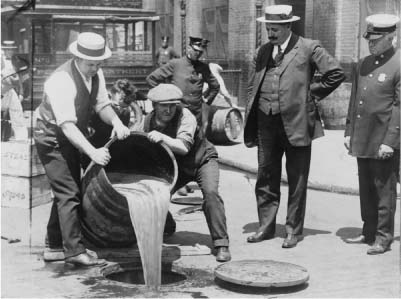
Workers following police orders pour a cask of wine into the New York City sewer during the Prohibition era.
Hester v. United States (1924) is among the Prohibition cases that developed new Fourth Amendment doctrine by the Court's recognition of the “open fields” exception to the exclusionary rule, a rule that the Court had only begun applying to the national government, but not yet to the states, in Weeks v. United States (1914). After the Weeks decision, courts acted under the “silver-platter doctrine” by which federal agents could use state evidence that it would have been illegal for federal agents to secure, but the Court limited this in Prohibition cases like Byars v. United States (1927), in which a federal agent had participated in such a raid, and in Gambino v. United States (1927), where the court thought that agents who had searched an automobile for alcohol were effectively acting on behalf of the federal government since there was no state law prohibiting alcohol.
The Prohibition era's most important contribution to Fourth Amendment jurisprudence may well be the decision in Carroll v. United States (1925), where the Court allowed for much freer searches and seizures of automobiles (which were mobile and in which individuals typically had lesser expectations of privacy) than for houses. The Court used this precedent for its decision in Husty v. United States (1931), another vehicle case involving prohibition for which police had considerable more evidence of possible wrongdoing. In Taylor v. United States (1932), however, the Court unanimously excluded as evidence 122 cases of whiskey that agents had seized in a warrantless search of a garage next to a residence. Similarly, in Amos v. United States (1921), the Court dismissed governmental claims that a wife had waived her husband's Fourth Amendment rights in a case that it believed was an example of implied coercion.
In Olmstead v. United States (1928), the Court ruled that reference within the Fourth Amendment to “persons, houses, papers, and effects” did not include intangible conversations and thus did not require police to obtain search warrants before engaging in electronic surveillance; the case also prompted a vigorous dissents by Justices Louis Brandeis and Oliver Wendell Holmes Jr. that are often cited in the development of a right to privacy. Although laws subsequently limited this practice, it was not until Katz v. United States (1967) that the Court overturned this precedent.
...
- Loading...
Get a 30 day FREE TRIAL
-
 Watch videos from a variety of sources bringing classroom topics to life
 -
Read modern, diverse business cases
-
Explore hundreds of books and reference titles

Read next

More like this
Sage Recommends
We found other relevant content for you on other Sage platforms.
Have you created a personal profile? Login or create a profile so that you can save clips, playlists and searches