
Entry
Entries A-Z
Subject index
Mapp v. Ohio (1961)
In Mapp v. Ohio (1961), the U.S. Supreme Court ruled that the exclusionary rule applied in state courts, preventing the use of materials obtained as a result of an unconstitutional search or seizure. The Court held that Cleveland police officers violated the Fourth Amendment rights of an African American woman named Dollree Mapp when they forcibly entered her home without a search warrant and engaged in a roving search.
Someone had bombed the home of Donald King (who later gained fame as a boxing promoter). Later, an anonymous caller phoned the police, saying that someone at Mapp's residence had bombed King's home. Several Cleveland police officers went to Mapp's home. She refused to allow them entry without a warrant. They came back later and forcibly entered her home. They did not have a search warrant, only an affidavit for one. They conducted a search and found no bombing paraphernalia. In the basement, they did find several books—London Stage Affairs, Affairs of a Troubadour, Memoirs of a Hotel Man, and Little Darlings—which were deemed obscene. They also found a nude pencil drawing. The police arrested Mapp for possession of obscene materials in violation of Ohio law.
Mapp's attorney, A. L. Kearns, filed a motion to suppress the evidence, which the trial court judge denied. A jury convicted Mapp of obscenity and sentenced her to one to seven years in prison and a $200 to $2,000 fine. Both an intermediate appeals court and the Ohio Supreme Court affirmed the conviction. Much of the opinions of the state appeals courts addressed First Amendment arguments against the obscenity law rather than Fourth Amendment search and seizure law.
Mug shot of Dollree Mapp, Cleveland, Ohio, March 17, 1965.
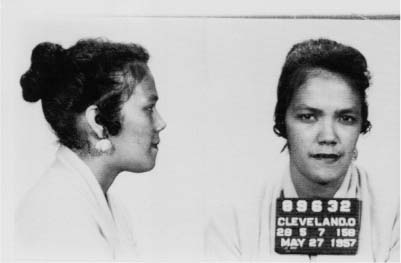
Mapp then appealed to the U.S. Supreme Court, which reversed. While the U.S. Supreme Court had ruled in Weeks v. United States (1914) that unconstitutionally seized evidence could be excluded in federal courts, the Court had failed to extend that ruling in state courts in Wolf v. Colorado (1949). The Court ruled in Mapp's favor and overruled its decision in Wolf. “We hold that all evidence obtained by searches and seizures in violation of the Constitution is, by that same authority, inadmissible in a state court,” Justice Tom C. Clark wrote for the majority. “Nothing can destroy a government more quickly than its failure to observe its own laws, or worse, its disregard of the charter of its own existence.”
Justice Hugo Black wrote a concurring opinion, saying that the exclusion of evidence was mandated by an analysis of the Fourth Amendment in conjunction with the Fifth Amendment and its ban on compelled self-incrimination. Justice William O. Douglas also wrote separately, emphasizing that the Court's decision in Wolf “was not the voice of reason or principle.” He said it made little sense to have the exclusionary rule applied in federal courts but not state courts.
Justice John Marshall Harlan—joined by Justices Felix Frankfurter and Charles Whittaker—wrote a dissenting opinion, saying that the majority should heed the doctrine of judicial restraint. He reasoned that the primary issue the Ohio state court examined was the First Amendment argument against the obscenity law, not the Fourth Amendment issues. “In this posture of things, I think it fair to say that five members of this Court have simply ‘reached out’ to overrule Wolf.”
...
- Loading...
Get a 30 day FREE TRIAL
-
 Watch videos from a variety of sources bringing classroom topics to life
 -
Read modern, diverse business cases
-
Explore hundreds of books and reference titles

Read next

More like this
Sage Recommends
We found other relevant content for you on other Sage platforms.
Have you created a personal profile? Login or create a profile so that you can save clips, playlists and searches