
Entry
Entries A-Z
Subject index
Exclusionary Rule
The Fourth Amendment to the U.S. Constitution prohibits the search of “persons, houses, papers, and effects” by government agents when conducted in an “unreasonable” manner. The amendment is silent, however, on the outcome should it be determined that a search yielding evidence failed to meet this vague standard.
In Weeks v. United States (1914), the Supreme Court introduced the exclusionary rule, a mandated antidote of excluding evidence unlawfully or improperly obtained. The decision involved the admissibility of physical evidence in cases where government action had been questioned on Fourth Amendment grounds of unreasonable search and seizure. “If letters and private documents can … be seized and held and used in evidence against a citizen accused of an offense,” Justice William R. Day wrote in the majority opinion, “the protection of the 4th Amendment … is of no value.”
The exclusionary rule, sometimes referred to as the fruit of the poisonous tree doctrine, was intended to curb law enforcement misconduct in the gathering of evidence. The rule initially applied only to federal officials presenting evidence in federal courts. Guidelines for state and local courts and officials in the aftermath of Weeks continued to be determined at the state and local levels.
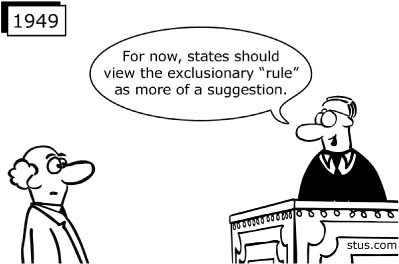
Wolf v. Colorado (1949) was the first significant Supreme Court case to address the application of the exclusionary rule created in Weeks to the states. Although ruling that the Fourth Amendment limited the states, a 6–3 majority decided that the “judicial implication” of excluding evidence was neither articulated in the text of the Fourth Amendment nor based on legislation passed by Congress. The rule, therefore, continued to have no bearing on state courts.
Just over a decade later, the Supreme Court overruled the Wolf decision in the 1961 case Mapp v. Ohio. By a 6–3 majority, the Court applied the exclusionary rule to the agents of state and local governments via the due process clause of the Fourteenth Amendment, arguing that the admission of unlawfully seized evidence encourages disobedience of the federal Constitution. Moreover, the Court noted that many states had already introduced this rule on their own.
The Supreme Court has revisited the exclusionary rule on countless occasions in the aftermath of the Weeks and Mapp cases. Application of the rule has been expanded in scope at some times, and at other times it has been narrowed. The Court ruled in Johnson v. United States (1948) that a reasonable search is one authorized by “a neutral and detached magistrate, instead of being judged by the officer engaged in the often competitive enterprise of ferreting out crime.” The Court also found in a series of rulings that when weighing the cost of an exclusionary omission of evidence, especially in cases where mistakes were made in “good faith,” judges are to consider the deterrent objective of exclusion against the “substantive social costs.”
The Supreme Court continues to articulate a series of situational searches and evidentiary seizures deemed reasonable absent judicial authorization. Permissible warrantless searches/seizures are generally broken down into various categories, which include the
...
- Loading...
Get a 30 day FREE TRIAL
-
 Watch videos from a variety of sources bringing classroom topics to life
 -
Read modern, diverse business cases
-
Explore hundreds of books and reference titles

Read next

More like this
Sage Recommends
We found other relevant content for you on other Sage platforms.
Have you created a personal profile? Login or create a profile so that you can save clips, playlists and searches