
Entry
Entries A-Z
Catholics, Roman
The Roman Catholic Church is a Christian denomination that accepts the supremacy of the pope as the successor to Jesus Christ. The Church itself considers the qualifier “Roman,” which derives from the geographical seat of the papacy, to be erroneous because it believes that it is the true “catholic,” or universal, Christian church.
Issues relating to the free exercise of religious liberties or the establishment of religion by the government are not unique to any particular religious affiliation. Indeed, it is the neutrality and inclusiveness of the First Amendment’s religion clauses—resulting in part from the framers’ knowledge of conflicts between Catholics and Protestants in Europe—that make the religious clauses a powerful force in support of the free exercise of religious liberties and the separation of church and state.
The United States was largely founded by Protestants, with Catholics playing a smaller role. Some early colonies discriminated against Catholics. The hegemony of Protestant thought and practice in public schools through much of the nineteenth century led many Catholics to form their own schools, which led to tensions concerning what, if any, type of government aid was appropriate. State Blaine amendments, which restricted all aid to parochial schools, were one mechanism of limiting such assistance. Although the Supreme Court used strong separationist language in its decision in Everson v. Board of Education (1947), it nonetheless permitted states to reimburse parents for bus service for their children to parochial school. City of Boerne v. Flores (1997), which arose from a denial of a permit request by a Texas-based Catholic church to enlarge its building, struck down a provision of the Religious Freedom Restoration Act of 1993 in a battle over the meaning of the free exercise clause and fundamental concerns over separation of powers. In Zelman v. Simmons-Harris (2002), the Court upheld a school voucher program in Cleveland, Ohio, against an establishment clause challenge based on the overwhelming use of the vouchers to send kids to private Catholic schools.
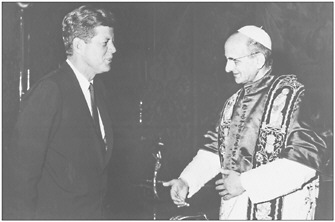
The Granger Collection, New York
For a time, many Protestants were wary of Catholic politicians, fearing that they would divide their loyalty between the nation and the papacy. It was not until 1960 that a Catholic, John F. Kennedy, was elected president. The current Supreme Court is composed of a majority of Catholics.
See alsoAid to Parochial Schools; Blaine Amendments; Everson v. Board of Education (1947); Murray, John Courtney; Vatican, U.S. Recognition of.
John H. Matheson
FURTHER READING
Miller, Adam S. The Roman Catholic Church: A Divine Institution or a Human Invention? 2d ed. Monrovia, Md.: Tower of David Publications, 2006.
Noll, Mark A., and Luke E. Harlow. Religion and American Politics. 2d ed. New York: Oxford University Press, 2007.
Witte, John, Jr. “Religious Liberty.” http://www.firstamendmentcenter.org/rel_liberty/overview.aspx.
- Catholicism
- parochial schools
- papacy
- Protestantism
- Catholic Church
- churches
- Christian Church
Get a 30 day FREE TRIAL
-
 Watch videos from a variety of sources bringing classroom topics to life
 -
Read modern, diverse business cases
-
Explore hundreds of books and reference titles

Read next

More like this
Sage Recommends
We found other relevant content for you on other Sage platforms.
Have you created a personal profile? Login or create a profile so that you can save clips, playlists and searches