
Entry
Reader's guide
Entries A-Z
Subject index
Space
Human beings have dreamed of exploring space for centuries, but the realization of that vision in the 20th century had its roots in military thinking. From the rocket technologies developed in Germany during World War II to the use of satellite imagery and communications during the Global War on Terrorism, space exploration and the military have repeatedly intertwined. This entry discusses the links between the U.S. military and technological innovations related to the space program.
These connections began early in the Cold War. After 1945, the Soviet Union and United States vied for the services of German scientists and engineers who had developed V-2 rockets for the Nazis during World War II. The Americans successfully lured Wernher von Braun and others to come to the United States to bolster the nation’s munitions program. He soon envisioned using rocket technologies to send human beings and spacecraft into the cosmos, but these dreams also had implications for the Cold War rivalry with the Russians. Satellites might perform military reconnaissance missions, and exploration of space could lead to celestial military bases or colonies. In the 1950s, both sides sought symbolic victories along the way to these goals, launching a “space race” that showcased Soviet and American technologies before the eyes of the world.
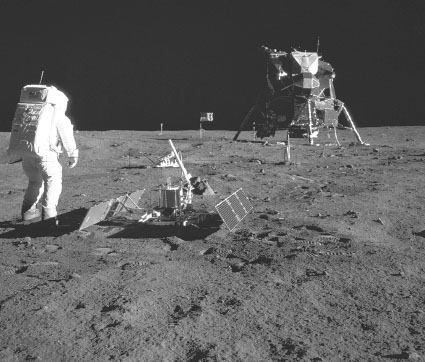
Astronaut Edwin E. “Buzz” Aldrin Jr., Lunar Module pilot, is photographed during the Apollo 11 extravehicular activity on the moon. He has just deployed the Early Apollo Scientific Experiments Package. In the foreground is the Passive Seismic Experiment Package; beyond it is the Laser Ranging Retro-Reflector; in the center background is the U.S. flag; in the left background is the black-and-white lunar surface television camera; and in the far right background is the Lunar Module “Eagle.” Astronaut Neil A. Armstrong, commander, took this photograph with a 70-millimeter lunar surface camera.
Source: National Aeronautics and Space Administration.
Many of these early triumphs went the Soviets’s way. They launched Sputnik, the first orbiting satellite, in 1957. President Dwight Eisenhower, though confident of American missile superiority and unimpressed by space gadgetry, faced pressure to support the creation of the National Aeronautics and Space Administration (NASA) the following year. Although NASA is a civilian agency, it maintained strong ties with the military; all the astronauts who journeyed into space until 1972 served with the U.S. armed forces. Eisenhower’s more aggressive successor, John F. Kennedy, declared in May 1961 that the United States would land a man on the moon before the end of the 1960s. The pledge materialized in the wake of the embarrassing debacle at the Bay of Pigs in Cuba and the first successful space flight of the Soviet cosmonaut Yuri Gagarin.
The United Launch Alliance Delta II rocket carrying the Space Tracking and Surveillance System–Demonstrator (STSS-Demo) spacecraft as it leaps into the sky from Launch Pad 17-B at Cape Canaveral Air Force Station. STSS-Demo was launched at 8:20:22 a.m. Eastern Daylight ime by National Aeronautics and Space Administration for the U.S. Missile Defense Agency. The STSS-Demo is a space-based sensor component of a layered ballistic missile defense system designed for the overall mission of detecting, tracking, and discriminating ballistic missiles. STSS-Demo is capable of tracking objects after the boost phase and provides trajectory information to other sensors.
Source: National Aeronautics and Space Administration/Sandra Joseph and Kevin O’Connell.
...
- Alliances and Allies, Potential Adversaries, and International Organizations
- Afghanistan
- Africa, Sub-Saharan
- Alliances
- ANZUS Security Treaty
- Asia
- Australia
- Bases, Foreign
- Brazil
- Canada
- Caribbean
- Central America
- Central Asia
- China, People’s Republic of
- Coalition, Warfare
- Colombia
- Cuba
- Egypt
- Europe
- France
- Germany
- Haiti
- Hamas
- India
- Iran
- Iraq
- Israel
- Japan
- Korea, North
- Liberia
- Libya
- Mexico
- North Atlantic Treaty Organization
- Organization of Americans States
- Pakistan
- Panama
- Philippines
- Red Cross, International Committee of
- Russia
- Saudi Arabia
- Somalia
- South America
- Syria
- Taiwan
- Turkey
- United Kingdom
- United Nations
- Venezuela
- Civil-Military Relations
- 9/11 Commission
- Air Force One
- Air Force, Department of
- American Legion
- Appropriations, Military
- Armed Forces Committee, House
- Armed Forces Committee, Senate
- Army, Department of
- Association of the United States Army
- Civil-Military Relations (Appendix 1)
- Congress, U.S.
- Congressional Relations, Military
- Constitution, U.S.
- Defense, Department of
- Defense, Secretary of
- Foreign Relations Committee, House
- Foreign Relations Committee, Senate
- Goldwater-Nichols Department of Defense Reorganization Act
- Homeland Security, Department of
- Intelligence Oversight, Congressional
- Iran-Contra Scandal
- Marine Corps League
- Marine Guards, Embassy
- Marine One
- Military Officers Association of America
- National Security Act
- National Security Council
- Navy League
- Navy, Department of
- Peace Movements
- Politics, Military Participation In
- Posse Comitatus Act
- President as Commander in Chief
- Public Affairs, Military
- Public Opinion on War and the Military
- U.S. Naval Institute
- U.S. State Department
- U.S. Supreme Court
- Veterans of Foreign Wars
- War Powers Act
- White House Military Office
- Diversity
- Educational Institutions
- Army War College
- Citadel, The
- Command and General Staff College
- Defense Language Institute
- Marine Corps University
- National Defense University
- Naval Postgraduate School
- Naval War College
- Noncommissioned Officer Academies
- Norwich University
- Recruiting on College Campuses
- ROTC
- ROTC, Jr.
- School of the Americas
- U.S. Air Force Academy
- U.S. Coast Guard Academy
- U.S. Military Academy
- U.S. Naval Academy
- Virginia Military Institute
- Intelligence
- Attachés, Military
- Central Intelligence Agency
- Classification Security
- Counterintelligence
- Defense Intelligence Agency
- Federal Bureau of Investigation
- Homeland Security, Department of
- Intelligence Cycle
- Intelligence Organizations, Military
- Intelligence, Geospatial
- Intelligence, Human
- Interrogation
- National Security Agency
- USA PATRIOT Act
- Law/Military Justice
- “Don’t Ask, Don’t Tell”
- Constitutional Rights, Personnel
- Court-Martial
- Crimes, Military
- Crimes, War
- Cultural Property and Heritage
- Desertion
- Geneva Conventions
- Genocide
- Hague Conventions
- Hazing
- Human Rights
- International Criminal Court
- Laws of War
- Laws of War: Major Treaties and Conventions (Appendix 3)
- My Lai Massacre
- Nuremberg War Crimes Trials
- Ottawa Land Mine Treaty
- Piracy, High Seas
- Police, Military
- Prisons, Military
- Rape
- Tokyo War Crimes Tribunal
- Torture
- Trauma, Military Sexual
- Treason
- U.S. Supreme Court Cases (Appendix 4)
- Uniform Code of Military Justice
- Whistle-Blowing
- Yamashita Precedent
- Leadership
- Logistics, Supply, Equipment, and Transportation
- Media, Military and Public
- Medical Care, Disability, Veterans, and the War Dead
- Agent Orange
- American Battle Monuments Commission
- Anthrax
- Arlington National Cemetery
- Army Nurse Corps
- Cemeteries, Military
- Combat, Physical and Psychological Impact
- Disability
- Environment
- Gulf War Syndrome
- HIV/AIDS
- Medical Disability, Veteran
- Medicine, Military
- Medicine, Veterans
- Military Casualties (Appendix 6)
- Navy Nurse Corps
- Posttraumatic Stress Disorder
- Psychiatry, Military
- Sexually Transmitted Diseases
- Suicide
- Traumatic Brain Injury
- TRICARE (Military Health Plan)
- Veterans Affairs, Department of
- War Dead, Disposition of
- Wounds and Injuries
- Military and Civil Society in the United States
- Military Life
- Abuse, Family and Child
- Army-Navy Game
- Bands and Music
- Benefits, Military
- Benefits, Veteran
- Customs and Traditions
- Discharge and Separation
- Drill and Ceremony
- Family Readiness
- Family, Military
- Finance, Personal
- Language, Military
- Leaves and Furloughs
- Military Courtesy
- National Military Family Association
- Physical Fitness
- Recreation
- Retirement
- Sports
- Support Groups for Military Spouses
- Time, Military
- Military Organizations and Commands
- Air Force Command
- Air Force, U.S.
- Air Mobility Command
- Air National Guard
- Airborne Units
- Army Corps of Engineers
- Army, U.S.
- Coast Guard, U.S.
- Engineers, Combat
- Infantry
- Interpreters and Translators
- Joint POW/MIA Accounting Command
- Marine Corps, U.S.
- Military Advisors, U.S.
- Military Organization (Appendix 5)
- Military Organization, Air Force
- Military Organization, Army
- Military Organization, Marine Corps
- Military Organization, Navy
- Modular Army
- National Guard, Army
- Navy, U.S.
- North American Aerospace Defense Command (NORAD)
- Organization, Coast Guard
- Rapid Deployment Force
- Reserve, Air Force
- Reserve, Army
- Reserve, Marine Corps
- Reserve, Navy
- SEALs, Navy
- Special Forces, Air Force
- Special Forces, Army
- Strategic Air Command
- Surgeon General, Air Force
- Surgeon General, Army
- Surgeon General, Navy
- U.S. Africa Command
- U.S. Central Command
- U.S. Northern Command
- U.S. Pacific Command
- U.S. Southern Command
- U.S. Special Operations Command
- U.S. Strategic Command
- U.S. Transportation Command
- Operations and Tactics
- Ambush
- Antisubmarine Warfare
- Asymmetric Warfare
- Attrition Warfare
- Aviation, Army
- Brigade
- Close Air Support
- Combat Power
- Combined Arms
- Command and Control
- Company
- Covert Actions, Military
- Cyberwar
- Direct Fire
- Division
- Effectiveness, Combat
- Force Reconnaissance, Marine
- Friendly Fire
- Indirect Fire
- Mobilization
- OODA (Observe, Orient, Decide, and Act)
- Operations, Air
- Operations, Cold-Weather
- Operations, Jungle
- Operations, Mountain
- Plans, Operational
- Psychological Warfare (PSYOP)
- Rangers
- Regiment
- Rules of Engagement
- Tactics, Air
- Tactics, Covert
- Tactics, Ground Forces
- Tactics, Naval
- Warfare, Amphibious
- Warfare, Biological
- Warfare, Electronic
- Warfare, Submarine
- Warfare, Surface
- Warfare, Unconventional
- Personnel: Recruitment and Training
- Advertising, Military-Sponsored
- All-Volunteer Force
- Conscientious Objection
- Conscription
- Drill and Ceremony
- Military Occupational Specialty
- Officer Candidate School
- Pay, Military
- Personnel Evaluation
- Rank
- Recruitment, Enlisted
- Recruitment, Officer
- Stop-Loss
- Training, Air Force Enlisted
- Training, Air Force Pilots
- Training, Army Enlisted
- Training, Army Officers
- Training, Coast Guard Enlisted
- Training, Coast Guard Officers
- Training, Marine Corps Enlisted
- Training, Marine Corps Officers
- Training, Multinational
- Training, Naval Aviators
- Training, Naval Enlisted
- Training, Naval Officers
- Strategy and Strategists, Military Intellectuals, and Military Concepts
- AirLand Battle Doctrine
- Anthropology and War
- Archives, Military
- Blitzkrieg Warfare
- Bush Doctrine
- Clausewitz, Carl von
- Counterinsurgency
- Culture, Military
- Deterrence
- Frederick II of Prussia
- Giap, Vo Nguyen
- Guerilla Warfare
- Hanson, Victor Davis
- History, Military: Approaches to
- History, Naval: Approaches to
- Huntington, Samuel
- Jomini, Antoine-Henri
- Keegan, John
- Levels of War
- Liddell Hart, Basil
- Luttwak, Edward N.
- Mahan, Alfred Thayer
- Mao Zedong
- Marshall, S. L. A.
- Military Science
- Nation-Building
- Neoconservatives
- Operations Research
- Pentomic Era
- Plans, War
- Political Science and International Relations
- Quadrennial Defense Review
- RAND Corporation
- Realism in International Relations
- Schelling, Thomas
- Single Integrated Operational Plan
- Society for Military History
- Sociology
- Soft Power
- Space
- Special Operations, Strategy
- Strategy, Air Power
- Strategy, Ground War
- Strategy, Naval
- Strategy, Nuclear
- Sun Tzu
- Terrorism
- Thucydides
- Total War
- Upton, Emory
- Urban Gueri1la Movements
- War, Principles of
- Weinberger-Powell Doctrine
- Values, Ethics, Culture, and Religion
- Wars/Military Involvement
- American Revolution
- Civil War, American
- Colonial Wars (1607–1774)
- Indian Wars
- Korean War (1950–1953)
- Lebanon, U.S. Intervention in (1982)
- Mexican-American War
- Nicaragua Intervention (1920s)
- Occupations
- Panama, U.S. Intervention in
- Philippines Insurrection
- Reconstruction
- Spanish-American War (1898)
- Vietnam War
- War of 1812
- World War I
- World War II
- Wars/Military Involvement: Contemporary
- 9/11 (2001)
- 9/11 Attack on Pentagon
- Abu Ghraib
- al Qaeda
- Bosnia Intervention
- Coalition Provisional Authority
- Gates, Robert
- Global War on Terrorism
- Guantanamo Bay Prison
- Haiti, U.S. Intervention in
- Humanitarian Intervention, Foreign
- Iraq Insurgency (2003–2011)
- Iraq War (2003)
- Iraq War, Planning for
- Kosovo Intervention
- Middle East Conflict
- Nuclear Proliferation
- Panama, U.S. Intervention in
- Peacekeeping
- Persian Gulf War
- Petraeus, David
- Powell, Colin
- Prisoners of War
- Rumsfeld, Donald
- Rwandan Genocide
- Shock and Awe Offensive
- Somalia Intervention
- Strategic Arms Limitation Treaties
- Surge, Iraq War
- War in Afghanistan
- Weapons Systems and Weapons Contractors
- Airborne Warning and Control System (AWACS) Aircraft
- Aircraft Carriers
- Aircraft, Antisubmarine
- Aircraft, Attack
- Aircraft, Bomber
- Aircraft, Fighter
- Aircraft, Patrol
- Aircraft, Reconnaissance
- Aircraft, Transport
- Ammunition
- Amphibious Vehicles
- Armored Vehicles
- Arms, Small
- Artillery
- Battleships
- Boeing
- Bombs, Cluster
- Bombs, Gravity
- Bombs, Nuclear
- Bombs, Smart
- Cruisers, Naval
- Destroyers
- Frigates
- General Dynamics
- Guns, Machine
- Helicopters
- Lockheed Martin
- Mines, Land
- Mines, Naval
- Missiles, Air-to-Air
- Missiles, Conventional
- Missiles, Cruise
- Missiles, Nuclear
- Northrop Grumman
- Raytheon
- Research and Development
- Science Applications International
- Stealth Technology
- Submarines
- Tanks
- Targeting Systems
- Technology
- Textron, Inc.
- Torpedoes
- United Technologies Corporation
- Unmanned Aerial Vehicles
- Warfare, Biological
- Weapons, Antiaircraft
- Weapons, Chemical
- Weapons, Nonlethal
- Weapons, Nuclear
- Weapons, Space
- Loading...
Get a 30 day FREE TRIAL
-
 Watch videos from a variety of sources bringing classroom topics to life
 -
Read modern, diverse business cases
-
Explore hundreds of books and reference titles

Read next

More like this
Sage Recommends
We found other relevant content for you on other Sage platforms.
Have you created a personal profile? Login or create a profile so that you can save clips, playlists and searches