
Entry
Reader's guide
Entries A-Z
Subject index
General Aggression Model
General aggression model (GAM; Anderson & Bushman 2002) is a comprehensive and integrative theoretical framework within which multiple social, cognitive, and developmental theories are incorporated to aid comprehension of and research on human aggressive behavior. Some of the more prominent (but not the only) theories that GAM incorporates include cognitive neoassociation theory, social learning theory, and behavioral script theory. Each theory offers crucial insight into understanding the reasons why people behave aggressively. This entry outlines the processes of GAM, especially with regard to media effects, and discusses the extensions of GAM to other research topics.
Processes
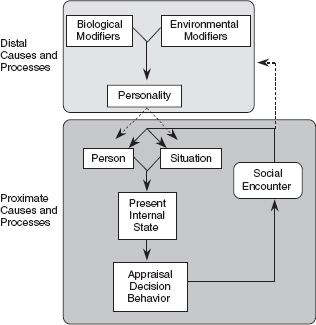
General aggression model can be broadly broken down into two sets of related processes. Proximate processes are those that are immediately related to aggressive behavior. Distal processes are those that influence short-term processes through long-term aggressive behavioral tendencies.
Proximal Processes
Proximal processes can best be understood by examining a single-cycle episode of GAM (see lower portion of Figure 1). A single episode begins with two forms of input. The first of these forms is the situation, factors within the present event that can influence social behavior. The second of these forms of input involves intrapersonal factors. These are individual differences—person factors—that may directly influence behavior, such as mood or trait aggressiveness, or may moderate the effects of situational factors.
In the next stage of GAM’s single-cycle episode, proximate processes influence internal states. The primary internal states of interest concern affect, cognitions, and physiological arousal, each of which interacts with the others (e.g., heart rate increases following frustration). General aggression model does not state which of these internal states are affected by which input variables; that is the task of more specific research. Instead, GAM specifies that factors that ultimately influence the likelihood of aggressive behavior do so through at least one of these three types of internal states. For example, research has demonstrated that the short-term effects of media violence on aggressive behavior are mediated primarily by aggressive cognitions. However, aggressive affect and physiological arousal also play a part in some cases.
Figure 1 The General Aggression Model: Single-Cycle and Distal Processes
Source: Anderson, C. A. & Carnagey, N. L. (2004) Violent evil and the general aggression model. Chapter in A. Miller (Ed.) The Social Psychology of Good and Evil (p. 183). New York, NY: Guilford Publications. Copyright Guilford Press. Reprinted with permission of The Guilford Press.
The single-cycle episode of GAM continues with decision and appraisal processes (Figure 2). It posits that the contents of an individual’s internal state both influence and are influenced by these decision and appraisal processes. Research regarding individuals’ attributions (e.g., Anderson, Krull, & Weiner, 1996) has shown that after a significant event occurs, an individual will immediately attempt to determine why it occurred. This initial appraisal can occur without conscious awareness. Furthermore, the appraisal may include behavioral response options. For example, if someone believes he or she has been provoked, a retaliatory response may occur as an immediate reaction. If an individual does not have the time, motivation, or cognitive resources to further evaluate his or her initial attribution, then an impulsive, reactionary decision will occur. However, if time, motivation, and cognitive resources are available, the individual must decide whether his or her initial attribution is both important and unsatisfying. If this is not the case, and the initial attribution is either unimportant or satisfying, then an impulsive behavior will likely occur. If this is the case, then one or several reappraisals of the event will occur. Reappraisals will continue to be made until the individual is satisfied with the attribution or until a response is required, in which case a thoughtful action will likely occur. Thoughtful or impulsive actions can be either aggressive or nonaggressive, and reappraisal of events does not necessarily guarantee that an initially hostile attribution will be altered by reappraisal.
...
- General Aggression
- Aggression and Affect
- Aggression and Anger
- Aggression and Attachment
- Aggression and Brain Functioning
- Aggression and Culture
- Aggression in Youth
- Aggression, Definition and Assessment of
- Aggression, Risk Factors for
- Aggressive Behavior
- Aggressive Personality
- Bullying, Definition and Laws of
- Cognition: Schemas and Scripts
- Cognitive Psychology of Violence
- Cognitive Script Theory and the Dynamics of Cognitive Scripting
- Cyberbullying, Definition and Effects of
- Gender and Aggression
- Genetics of Aggressive Behavior
- Group Aggression
- Memory and Violence
- Priming Theory
- Psychobiology of Violence
- Psychopathology and Susceptibility to Violence
- Reasons for Consuming Violent Entertainment
- Relational Aggression
- Trait Aggression
- Media Content
- Grand Theft Auto
- Advertising, Violent Content in
- Arousal and Aggressive Content, Theory and Psychology of
- Character Development Within Violent Content
- Competition, Sports, and Video Games
- Cultivating Content and Social Representation of Violence
- Cyberbullying, Violent Content in
- Drench Hypothesis
- Fantasy Genre, Violence and Aggression in
- Films, Representation of Violence and Its Effects in
- Media Violence, Definitions and Context of
- Music Videos and Lyrics, Violent Content in
- National Television Violence Study
- Pornography, Violent Content in
- Realism of Violence Content, Real-World Violence on Television, and Their Effects
- Sexualized Aggression
- Sports, Violence and Aggression in
- Stereotyping in Violent Media Content
- Television Violence
- Violence, Definition of
- Violent Artistic Expression
- Virtual Reality, Violent Content in
- Media Effects
- Attitude, Effects of Media Violence on
- Audience Interpretation of Media Violence, Effects of
- Bobo Doll Studies
- Comedic Violence, Effects of
- Demographic Effects
- Desensitization Effects on Society
- Developmental Effects
- Effect Size in Media Violence, Research and Effects of
- Effects From Violent Content, Short- and Long-Term
- Effects of Media Violence on Relational Aggression
- Emergent Public Health Issue: Effects of Violence
- Ethical Development, Effects on
- Ethical Issues in Researching Media Violence Effects
- Fear Reactions to Violent Content
- First-Person Perspective, Violent Content From
- Gender, Effects of Violent Content on
- General Aggression Model
- Identity, Media Violence and Its Effects on
- Interactive Media, Aggressive Outcomes of
- Internet Content, Effects of Violent
- Media Effects Perspectives of Violence
- Media Rating Systems
- Moral Development, Effects of Media Violence on
- Narrative, Effects of Violent
- News, the Presentation and Effects of Violent Content in
- Parasocial Relationships
- Pediatricians and Media Violence
- Peer Influence on Violent Content Effects
- Pornography, Violent Content in: Effects of
- Rap Lyrics, Effects of Violent Content in
- Rape Perceptions
- Screen Size and Violent Content, Effects of
- Sex in Media, Effects on Society
- Situational Influences on Aggressive Reactions to Media Violence
- Social Isolation
- Socialization of Violence in Media and Its Effects
- User Involvement in Violent Content, Effects of
- User Trends Toward Aggressive Games
- Uses and Gratifications Perspective of Media Effects
- Video Game Platforms, Effects of
- Video Games, User Motivation
- Violence in Media, Effects on Aggression and Violent Crime
- Virtual Reality, Effects of Violent Content in
- Weapons in Violent Media Content: Use, Policy, and Effects
- Media Policy
- Advertising Laws Regarding Violent and Aggressive Content
- Bullying, Definition and Laws of
- Censorship of Violent Content
- Cyberbullying Laws
- Federal Communications Commission
- First Amendment Protections and Freedom of Expression
- International Perspective on Media Violence
- Internet Blocking
- Internet Violence Laws
- Legislating Media Violence: Law and Policy
- Marketing of Violence
- Media Education and Media Literacy
- Rating Systems, Film
- Rating Systems, Television
- Rating Systems, Video Games
- Regulating Systems, Internet
- Video Game Industry, Regulation Within the
- Research Process
- Society and Media
- Grand Theft Auto, Social Representations in
- Advertising, Influence on Society
- African Americans in Media, Character Depictions and Social Representation of
- Asians in Media, Character Depictions and Social Representation of
- Cross-Cultural Perspectives
- Cultivating Content and Social Representation of Violence
- Cultural Voyeurism
- Culture of Violence
- Effect Size in Media Violence, Research and Effects of
- Exposure to Violent Content, Effects on Child Development
- Gender Stereotypes, Societal Influence on
- Internet Violence, Influence on Society
- Latinos in Media, Character Depictions and Social Representation of
- Media as a Reflection of Society
- Race-Based Attributes in Video Games, Influence on Hostility
- Social Learning From Media
- Theories of Media Influence
- Loading...
Get a 30 day FREE TRIAL
-
 Watch videos from a variety of sources bringing classroom topics to life
 -
Read modern, diverse business cases
-
Explore hundreds of books and reference titles

Read next

More like this
Sage Recommends
We found other relevant content for you on other Sage platforms.
Have you created a personal profile? Login or create a profile so that you can save clips, playlists and searches