
Entry
Reader's guide
Entries A-Z
Subject index
Competing Values Framework
The competing values framework (CVF) has been studied and tested in organizations for more than 30 years. It has been labeled as one of the most influential models ever developed in organizational studies. It emerged from studies of the factors that account for highly effective organizational performance. It was developed in response to the need for a broadly applicable method for fostering successful leadership, improving organizational effectiveness, and promoting value creation. The CVF serves primarily as a map, an organizing mechanism, a sense-making device, a source of new ideas, and a theory of management and organizational performance. From the CVF comes a theory regarding how various aspects of organizations function in simultaneous harmony as well as in tension with one another. The framework identifies a set of guidelines that can help leaders diagnose and manage the interrelationships, congruencies, and contradictions among these different aspects of organizations. In this entry, the history and development of the CVF are briefly discussed, the core dimensions of the framework are explained, and the applicability of the framework to organizational culture and performance is considered.
Fundamentals
The competing values framework was developed initially from empirical research on the major indicators of effective organizations, but it has been elaborated to include research on a whole host of other topics—shareholder value, mergers and acquisitions, approaches to learning, organizational culture, leadership competencies, organizational designs, communication styles, organizational virtues, creativity, human resource practices, employee-job matching, financial investments, and information processing. In each case, statistical analyses have confirmed the robustness and applicability of this framework to a broad array of human and organizational phenomena. That is, the same dimensions that emerged from research on organizational effectiveness also emerged when studying a wide variety of other aspects of human and organizational activities. These dimensions compose the CVF. Figure 1 illustrates this framework.
Figure 1 Core Dimensions of the Competing Values Framework
Source: Author.
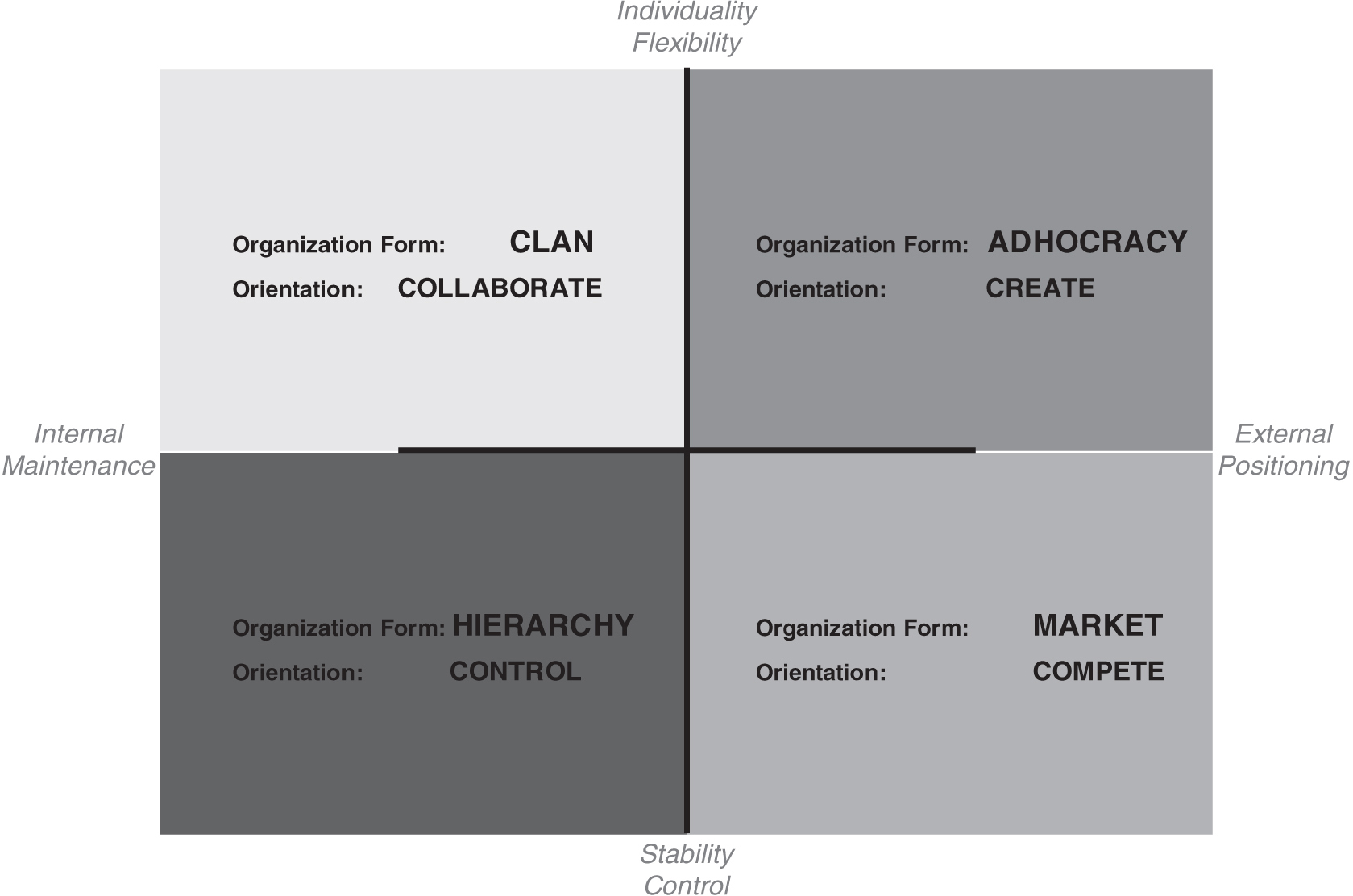
All organized human activity has an underlying structure. Completely haphazard action, or randomly dispersed elements, is said to be without organization. Organization, by definition, therefore, denotes patterns and predictability in relationships. Identifying the underlying dimensions of organization is one of the key functions of the CVF. It helps uncover the underlying relationships that exist in organizations, leadership, learning, culture, motivation, decision making, cognitive processing, creativity, and so on.
The basic framework comprises two dimensions— one drawn vertically and the other drawn horizontally—resulting in a two-by-two figure with four quadrants. The study of effectiveness in organizations three decades ago revealed that some organizations were effective if they demonstrated flexibility and adaptability, but other organizations were effective if they demonstrated stability and control. Similarly, some organizations were effective if they maintained efficient internal processes whereas others were effective if they maintained competitive external positioning relative to customers and clients. These differences represent the different ends of the two dimensions that makeup the CVF.
More specifically, one dimension of the framework differentiates an orientation toward flexibility, discretion, and dynamism from an orientation toward stability, order, and control. One dimension in the CVF, in other words, represents a continuum ranging from versatility and pliability on one end to consistency and durability on the other end. When referring to individuals, this dimension differentiates people who learn inductively, communicate with animated and speculative ideas, and process information by searching for innovative applications from people who learn deductively, communicate with rational and considered ideas, and process information methodically.
...
- Nature of Management
- Managing People, Personality, and Perception
- Affect Theory
- Affective Events Theory
- Big Five Personality Dimensions
- Causal Attribution Theory
- Cognitive Dissonance Theory
- Emotional and Social Intelligence
- Fairness Theory
- Image Theory
- Individual Values
- Job Demands–Resources Model
- Locus of Control
- Organizational Commitment Theory
- Organizational Identification
- Organizationally Based Self-Esteem
- Psychological Contract Theory
- Psychological Type and Problem-Solving Styles
- Schemas Theory
- Self-Concept and Theory of Self
- Self-Fulfilling Prophecy
- Sensemaking
- Social Cognitive Theory
- Social Construction Theory
- Social Identity Theory
- Social Information Processing Model
- Theory of Emotions
- Theory of Reasoned Action
- Theory of Self-Esteem
- Type A Personality Theory
- Managing Motivation
- Managing Interactions
- Circuits of Power and Control
- Conflict Handling Styles
- Critical Theory of Communication
- Dialectical Theory of Organizations
- Dual-Concern Theory
- Genderlect and Linguistic Styles
- Influence Tactics
- Informal Communication and the Grapevine
- Information Richness Theory
- Organizational Assimilation Theory
- Patterns of Political Behavior
- Principled Negotiation
- Social Exchange Theory
- Social Information Processing Model
- Social Movements
- Social Network Theory
- Social Power, Bases of
- Strategic Contingencies Theory
- Structuration Theory
- Theory of Cooperation and Competition
- Trust
- Managing Groups
- Asch Effect
- Group Development
- Group Polarization and the Risky Shift
- Group Punctuated Equilibrium Model
- Groupthink
- High-Performing Teams
- Multicultural Work Teams
- Norms Theory
- Role Theory
- Social Facilitation Management
- Social Identity Theory
- Social Impact Theory and Social Loafing
- Virtual Teams
- Work Team Effectiveness
- Managing Organizations
- Actor-Network Theory
- Agency Theory
- Behavioral Theory of the Firm
- Bureaucratic Theory
- Complexity Theory and Organizations
- Compliance Theory
- Cooptation
- Differentiation and the Division of Labor
- Dramaturgical Theory of Organizations
- High-Reliability Organizations
- Knowledge-Based View of the Firm
- Matrix Structure
- Meaning and Functions of Organizational Culture
- Multifirm Network Structure
- Organic and Mechanistic Forms
- Organizational Culture and Effectiveness
- Organizational Culture Model
- Organizational Culture Theory
- Organizational Identity
- Organizational Socialization
- Organizational Structure and Design
- Sociotechnical Theory
- Stewardship Theory
- Systems Theory of Organizations
- Technology and Complexity
- Technology and Interdependence/Uncertainty
- Technology and Programmability
- Typology of Organizational Culture
- Managing Environments
- Strategic Management
- Agency Theory
- Balanced Scorecard
- BCG Growth-Share Matrix
- Business Policy and Corporate Strategy
- Competitive Advantage
- Core Competence
- Diversification Strategy
- Dynamic Capabilities
- Excellence Characteristics
- Firm Growth
- First-Mover Advantages and Disadvantages
- Game Theory
- Hypercompetition
- Knowledge-Based View of the Firm
- Modes of Strategy / Planned-Emergent
- Organizational Effectiveness
- Product-Market Differentiation Model
- Resource Orchestration Management
- Resource-Based View of the Firm
- Seven-S Framework
- Six Sigma
- Stakeholder Theory
- Strategic Decision Making
- Strategic Flexibility
- Strategic Frames
- Strategic Groups
- Strategic Profiles
- Strategy and Structure
- Strategy-as-Practice
- SWOT Analysis Framework
- Tacit Knowledge
- Upper-Echelons Theory
- Value Chain
- Human Resources Management
- Attraction-Selection-Attrition Model
- Behavioral Perspective of Strategic Human Resource Management
- Career Stages and Anchors
- European Model of Human Resource Management
- High-Performance Work Systems
- Human Capital Theory
- Human Resource Management Strategies
- Human Resources Roles Model
- Knowledge Workers
- Model of Occupational Types
- Organizational Demography Model
- Personal Engagement (at Work) Model
- Protean and Boundaryless Careers
- Strategic International Human Resource Management
- Theory of Organizational Attractiveness
- Theory of Transfer of Training
- International Management and Diversity
- Acculturation Theory
- Cultural Attitudes in Multinational Corporations
- Cultural Intelligence
- Cultural Values
- Diamond Model of National Competitive Advantage
- GLOBE Model
- High- and Low-Context Cultures
- Institutional Theory of Multinational Corporations
- Interactional Model of Cultural Diversity
- Managing Diversity
- Multicultural Work Teams
- Organizational Demography
- Social Identity Theory
- Transnational Management
- Managerial Decision Making, Ethics, and Creativity
- “Unstructured” Decision Making
- Analytic Hierarchy Process Model
- Bounded Rationality and Satisficing (Behavioral Decision-Making Model)
- Brainstorming
- BVSR Theory of Human Creativity
- Componential Theory of Creativity
- Decision Support Systems
- Decision-Making Styles
- Escalation of Commitment
- Ethical Decision Making, Interactionist Model of
- Evidence-Based Management
- Experiential Learning Theory and Learning Styles
- Garbage Can Model of Decision Making
- Image Theory
- Interactionalist Model of Organizational Creativity
- Intuitive Decision Making
- Investment Theory of Creativity
- Managerial Decision Biases
- Moral Reasoning Maturity
- Participative Model of Decision Making
- Programmability of Decision Making
- Prospect Theory
- Stages of Creativity
- Strategic Decision Making
- Management Education, Research, and Consulting
- Academic-Practitioner Collaboration and Knowledge Sharing
- Action Research
- Analytical and Sociological Paradigms
- Appreciative Inquiry Model
- Bad Theories
- Critical Management Studies
- Engaged Scholarship Model
- Evidence-Based Management
- Large Group Interventions
- Management (Education) as Practice
- Multilevel Research
- Narrative (Story) Theory
- Organizational Development
- Positive Organizational Scholarship
- Process Consultation
- Psychological Type and Problem-Solving Styles
- Theory Development
- Theory of the Interesting
- Management of Operations, Quality, and Information Systems
- Kaizen and Continuous Improvement
- Adaptive Structuration Theory
- Decision Support Systems
- Gantt Chart and PERT
- Lean Enterprise
- Management Control Systems
- Quality Circles
- Quality Trilogy
- Strategic Information Systems
- Technology Acceptance Model
- Technology Affordances and Constraints Theory (of MIS)
- Theory of Constraints (TOC)
- Total Quality Management
- Management of Entrepreneurship
- Management of Learning and Change
- Action Learning
- Business Process Reengineering
- Continuous and Routinized Change
- Double Loop Learning
- Experiential Learning Theory and Learning Styles
- Force Field Analysis and Model of Planned Change
- Learning Organization
- Logical Incrementalism
- Organizational Development
- Organizational Learning
- Process Theories of Change
- Punctuated Equilibrium Model
- Quantum Change
- Strategies for Change
- Management of Technology and Innovation
- Architectural Innovation
- Dual-Core Model of Organizational Innovation
- Innovation Diffusion
- Innovation Speed
- Lead Users
- Open Innovation
- Patterns of Innovation
- Product Champions
- Profiting From Innovation
- Sociotechnical Theory
- Stages of Innovation
- Technological Discontinuities
- Technology Acceptance Model
- Technology and Complexity
- Technology and Interdependence/Uncertainty
- Technology and Programmability
- Technology S-Curve
- Transfer of Technology
- Management and Leadership
- Attribution Model of Leadership
- Authentic Leadership
- Charismatic Theory of Leadership
- Cognitive Resource Theory
- Competing Values Framework
- Contingency Theory of Leadership
- Leader–Member Exchange Theory
- Leadership Continuum Theory
- Leadership Practices
- Level 5 Leadership
- Managerial Grid
- Path-Goal Theory of Leadership
- Servant Leadership
- Situational Theory of Leadership
- Substitutes for Leadership
- Theory X and Theory Y
- Trait Theory of Leadership
- Transformational Theory of Leadership
- Management and Social / Environmental Issues
- Loading...
Get a 30 day FREE TRIAL
-
 Watch videos from a variety of sources bringing classroom topics to life
 -
Read modern, diverse business cases
-
Explore hundreds of books and reference titles

Read next

More like this
Sage Recommends
We found other relevant content for you on other Sage platforms.
Have you created a personal profile? Login or create a profile so that you can save clips, playlists and searches