
Entry
Reader's guide
Entries A-Z
Subject index
Trickster
The trickster is a type of character found in myths and folk tales around the world, who throws cultural boundaries into relief by crossing them in sly and audacious ways. Tricksters often display primal and unbridled desire as well as clever thinking, pursuing gratification in an almost infantile manner even as their cravings remain decidedly adult. Ever on the move, they illuminate the centers of culture by carrying out their exploits from the margins. This entry discusses different types of tricksters, issues surrounding tricksters, and the appearance of tricksters in literature.
Trickster incarnations around the world include Eshu (Nigerian), Hermes (Ancient Greek), Loki (Norse), Till Eulenspiegel (German), Susa-No-o (Japanese), Bricriu (Irish), Maui (Maori), and Agu Tompa (Tibetan). Tricksters sometimes take animal form, such as Monkey (Chinese), the spiders Anansi (West African) and Ture (Central African), Bre’r Rabbit (African American), and various Native American manifestations, including Coyote, Hare, Raven, and Mink. The medieval tale of Marcolf, which gained particular popularity in Germany, pits the physically deformed peasant in competitive dialogue with the biblical paragon of wisdom, King Solomon, during which the trickster trumps his opponent’s every pronouncement with a base and witty riposte. Lists of tricksters see a certain amount of overlap with those of fools and clowns.
The Norse trickster Loki, as portrayed in “The Punishment of Loki” by 19th-century French artist Louis Huard
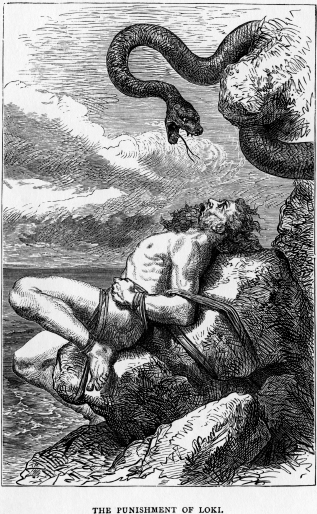
Source: Keary, A., & Keary, E. (1893). The heroes of Asgard: Tales from Scandinavian mythology. London, UK: Macmillan; Wikimedia Commons.
Paul Radin’s The Trickster: A Study in American Indian Mythology, published in 1956, is considered a breakthrough attempt to collect and theorize indigenous trickster cycles, although his critical stance is problematized by contributors to Troubling Tricksters: Revisioning Critical Conversations (2010). Radin’s study includes an essay by psychoanalyst Carl G. Jung, who theorizes a trickster archetype that embodies an undifferentiated consciousness with divine aspirations. In the social sciences, anthropologists like Claude Lévi-Strauss, Victor Turner, and Mary Douglas have in their own ways called attention to tricksters' engagements with categories of social thought and framing.
Statue of the German trickster Till Eulenspiegel in Mölln, Germany
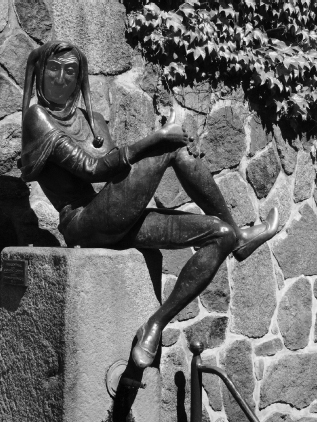
Source: Hans Weingartz/Wikimedia Commons.
Trickster Qualities
William J. Hynes (1997) notes six characteristic trickster-like traits, not all of which may appear in any given manifestation: (1) ambiguity, anomaly, or interplay of opposites; (2) deception and trickery; (3) disguise and shape-shifting; (4) inversion of situation or position; (5) uncertain or mixed birth, somewhere between the godly and earthly; and (6) a “sacred and lewd bricoleur” in Claude Lévi-Strauss’s sense of someone who resourcefully transforms whatever objects are at hand, including the body’s coarsest products. In many cases, trickster machinations connect to narratives about origins or transformations of the world and its inhabitants. This last feature leads sometimes to their characterizations as culture heroes and spiritual guides.
Trickster figures and their mischievous exploits are often humorous. They routinely engage in disapproved behaviors like lying and cheating, putting the spectator in the ambivalent position of joining in the ridicule while, perhaps, deriving vicarious pleasure from it. Their best laid plans often reverse laughably upon themselves to humiliating effect, which in common comic custom never prevents them from returning to scheme another day.
...
- Anthropology, Folklore, and Ethnicity
- Blason Populaire
- Philogelos
- Animal-Related Humor
- Anthropology
- Anti-Proverb
- Carnival and Festival
- College Humor
- Dialect Humor
- Ethnic Jokes
- Ethnicity and Humor
- Feast of Fools
- Folklore
- Fools
- Foolstowns
- Hoax and Prank
- Insult and Invective
- Jewish Humor
- Joke Cycles
- Joking Relationship
- National and Ethnic Differences
- Practical Jokes
- Race, Representations of
- Rituals of Laughter
- Social Network
- Stereotypes
- Targets of Humor
- Trickster
- Urban Legends
- Verbal Dueling
- Xeroxlore
- Antiquity
- Components of Humor
- Culture
- Xiangsheng, History of
- Xiangsheng
- Anthropology
- Carnival and Festival
- Cross-Cultural Humor
- Culture
- Education, Humor in
- Fools
- Foolstowns
- Gallows Humor
- High-Context Humor
- Humorous Names
- Intercultural Humor
- Jewish Humor
- Obscenity
- Puppets
- Race, Representations of
- Ritual Clowns
- Rituals of Inversion
- Scatology
- Sick Humor
- Sports
- Stereotypes
- Verbal Dueling
- Entertainment Industry
- History
- Forest of Laughter and Traditional Chinese Jestbooks
- Huaji-ists, The
- Philogelos
- Xiangsheng, History of
- Ancient Egypt, Humor in
- Arabic Culture, Humor in
- Assyrian and Babylonian Humor
- Biblical Humor
- Buddhism
- Christianity
- Confucianism
- Fabliau
- Feast of Fools
- Greek Visual Humor
- History of Humor: 19th-Century Europe
- History of Humor: Classical and Traditional China
- History of Humor: Early Modern Europe
- History of Humor: Medieval Europe
- History of Humor: Modern and Contemporary China
- History of Humor: Modern and Contemporary Europe
- History of Humor: Modern Japan
- History of Humor: Premodern Japan
- History of Humor: Renaissance Europe
- History of Humor: U.S. Frontier
- History of Humor: U.S. Modern and Contemporary
- Islam
- Jest, Jestbooks, and Jesters
- Magazines and Newspapers Outside the United States
- Magazines and Newspapers, U.S.
- Masks
- Medieval Visual Humor
- Menander
- Mock Epic
- Molière
- Plautus
- Rabelais, François
- Sanskrit Humor
- Satire
- Shakespearean Comedy
- Sitcoms
- Sketch Comedy Shows
- Slapstick
- Stand-Up Comedy
- Tall Tale
- Tragicomedy
- Travesty
- Humor Theory
- 3 WD Humor Test
- Aristotelian Theory of Humor
- Arousal Theory (Berlyne)
- Benign Violation Theory
- Bergson's Theory of the Comic
- Bisociation
- Evolutionary Explanations of Humor
- Framing Theory
- Freudian/Psychoanalytic Theory
- Hobbesian Theory
- Humor Theories
- Humor, Forms of
- Inversion, Topsy-Turvy
- Pattern Recognition
- Platonic Theory of Humor
- Release Theories of Humor
- Reversal Theory
- Simple Form
- Uses and Gratifications Theory
- Linguistics
- Pointe
- Witz
- Xiehouyu
- Ambiguity
- Anti-Proverb
- Aphorism
- Audiovisual Translation
- Computational Humor
- Conversation
- Cross-Cultural Humor
- Culture
- Dialect Humor
- Epigram
- Exaggeration
- Failed Humor
- Gender Roles in Humor
- Humor Markers
- Humor, Computer-Generated
- Humor, Etymology of
- Humor, Forms of
- Humorist
- Incongruity and Resolution
- Irony
- Jokes
- Joking Relationship
- Laugh, Laughter, Laughing
- Linguistic Theories of Humor
- Linguistics
- Maxim
- Mechanisms of Humor
- Metaphor
- Misdirection
- Phonological Jokes
- Politeness
- Punch Line
- Puns
- Reactions to Humor, Non-Laughter
- Rhetoric and Rhetorical Devices
- Riddle
- Second Language Acquisition
- Semantics
- Speech Play
- Teasing
- Tom Swifty
- Translation
- Verbal Humor
- Wellerism
- Literature and Major Literary Figures
- Commedia dell’Arte
- Forest of Laughter and Traditional Chinese Jestbooks
- Kyōgen
- Rakugo
- Senryū
- Share
- Witz
- Absurdist Humor
- Ancient Greek Comedy
- Ancient Roman Comedy
- Anecdote, Comic
- Aphorism
- Aristophanes
- Boccaccio, Giovanni
- Carnivalesque
- Cervantes, Miguel de
- Comedy
- Comic Relief
- Doggerel
- Epigram
- Exaggeration
- Fabliau
- Farce
- Genres and Styles of Comedy
- Goldoni, Carlo
- High Comedy
- Humorous Names
- Inversion, Topsy-Turvy
- Jest, Jestbooks, and Jesters
- Lampoon
- Limericks
- Literature
- Low Comedy
- Menander
- Mime
- Mock Epic
- Molière
- Nonsense
- Parody
- Pastiche
- Pirandello, Luigi
- Plautus
- Poetry
- Postmodern Irony
- Puns
- Rabelais, François
- Rhetoric and Rhetorical Devices
- Satire
- Satyr Play
- Schwank
- Science, Science Fiction, and Humor
- Shakespearean Comedy
- Simple Form
- South American Literature, Humor in
- Tall Tale
- Tragicomedy
- Travesty
- Trickster
- Mathematics, Computer Science, and the Internet
- Africa
- Americas
- Asia
- E’gao: Culture of Internet Spoofing in China
- Forest of Laughter and Traditional Chinese Jestbooks
- Huaji-ists, The
- Kyōgen
- Rakugo
- Senryū
- Share
- Xiangsheng, History of
- Xiangsheng
- Xiehouyu
- Buddhism
- Confucianism
- History of Humor: Classical and Traditional China
- History of Humor: Modern and Contemporary China
- History of Humor: Modern Japan
- History of Humor: Premodern Japan
- Islam
- Southeast Asia, Cartooning in
- Taoism
- Europe
- Commedia dell’Arte
- Lazzi
- Pointe
- Witz
- Ancient Greek Comedy
- Ancient Roman Comedy
- Byzantine Humor
- Fabliau
- Greek Visual Humor
- History of Humor: 19th-Century Europe
- History of Humor: Early Modern Europe
- History of Humor: Medieval Europe
- History of Humor: Modern and Contemporary Europe
- Medieval Visual Humor
- Satyr Play
- Schwank
- Middle East
- Performing Arts
- Commedia dell’Arte
- Lazzi
- Ancient Greek Comedy
- Ancient Roman Comedy
- Burlesque
- Carnivalesque
- Clowns
- Comedy
- Comedy Ensembles
- Comic Opera
- Farce
- Gag
- High Comedy
- Improv Comedy
- Low Comedy
- Masks
- Mime
- Music
- Music Hall
- Musical Comedy
- Parody
- Pastiche
- Puppets
- Satyr Play
- Shakespearean Comedy
- Sketch Comedy Shows
- Slapstick
- Stand-Up Comedy
- Tragicomedy
- Travesty
- Variety Shows
- Philosophy and Religion
- Aesthetics
- Aphorism
- Aristotelian Theory of Humor
- Bergson's Theory of the Comic
- Biblical Humor
- Buddhism
- Christianity
- Clergy
- Comic Frame
- Comic Versus Tragic Worldviews
- Comic World
- Confucianism
- Epigram
- Feast of Fools
- Hobbesian Theory
- Islam
- Jewish Humor
- Judaism
- Paradox
- Philosophy of Humor
- Platonic Theory of Humor
- Religion
- Rituals of Laughter
- Taoism
- Physiology and Biology
- Politics
- Business World
- Education
- Law
- Clinical and Counseling Psychology
- Cognition
- Developmental Psychology
- General Psychology
- Appreciation of Humor
- Failed Humor
- Humor Detection
- Humor Production
- Humor Styles
- Humorous Stimuli, Characteristics of
- Identity
- Laugh, Laughter, Laughing
- Pattern Recognition
- Psychological Distance
- Psychology
- Reactions to Humor, Non-Laughter
- Reception of Humor
- Release Theories of Humor
- Sense of Humor, Components of
- Smiling and Laughter: Expressive Patterns
- Health Psychology
- Interpersonal Relationships
- Motivation and Emotion
- Neuropsychology
- Personality and Social Psychology
- Tests and Measurement
- Sociology
- Aggressive and Harmless Humor
- Carnivalesque
- Conversation
- Cross-Cultural Humor
- Culture
- Dialect Humor
- Ethnic Jokes
- Ethnicity and Humor
- Failed Humor
- Gallows Humor
- Gender Roles in Humor
- High-Context Humor
- Homosexuality, Representation of
- Humor Group
- Identity
- Insult and Invective
- National and Ethnic Differences
- Obscenity
- Play and Humor
- Presidential Humor
- Race, Representations of
- Reactions to Humor, Non-Laughter
- Reception of Humor
- Roman Visual Humor
- Scatology
- Sick Humor
- Social Interaction
- Social Network
- Sociology
- Stereotypes
- Targets of Humor
- Teasing
- Visual Humor
- Loading...
Get a 30 day FREE TRIAL
-
 Watch videos from a variety of sources bringing classroom topics to life
 -
Read modern, diverse business cases
-
Explore hundreds of books and reference titles

Read next

More like this
Sage Recommends
We found other relevant content for you on other Sage platforms.
Have you created a personal profile? Login or create a profile so that you can save clips, playlists and searches