
Entry
Reader's guide
Entries A-Z
Subject index
Rakugo
Rakugo, which is written with characters meaning “falling words,” is the Japanese art of the professional teller of funny stories. It is a direct descendant of the ancient art of the village storyteller, the teller of tales, and the jester employed by large households in the Middle Ages. In Japan in the 1790s, it moved into the theaters and its material today is largely a modernized version of the funny stories of the Edo period (1603–1868 CE).
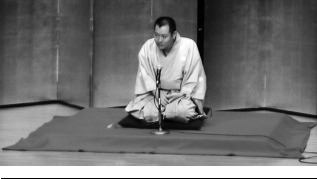
Rakugo performers wear kimono and sit, kneeling on a cushion. In this sense they might be called sit-down stand-up comedians. They use no props except those that a gentleman of the Edo period might have had about him—a fan, a pipe, a handkerchief, and a tobacco pouch—although these days, pipe and pouch are not so evident. The fan, however, is used with consummate skill as a pair of chopsticks, a sake cup, a rice bowl, a teacup, or as any other object that may appear in the story, including a fan.
The mime and characterization of the Rakugo performer rival and perhaps outclass those of the Kyōgen or Japanese farce actor in subtlety and delicacy. This skill is necessary, as the Rakugo performer appears alone on the stage and, while seated throughout, plays the parts of all the characters in the story. There may be as many as a half dozen roles in one story—men, women, old, young, children, of both high and low status. Each character is marvelously delineated by the performer in face, voice, gesture, and bodily poise. A Rakugo piece is thus a short play (normally a half hour long), consisting of at least one dialogue plus narration, all parts being performed by a single actor. As an example, in July 1988 at the Minami-za theater in Kyoto, Katsura Shijaku performed Jagansō (Snake-Grass). A man goes to visit a neighbor and finds him grilling rice cakes that have been left over from a wedding. The visitor helps himself to a cutting from a strange plant. It comes from the mountains where lives an enormous snake that eats monkeys and rabbits and sometimes also hunters and hikers. After eating a human being, the snake feels unwell, so it eats some of the snake grass, which dissolves the human being in its stomach, and then it feels better.
Rakugo performance at the Sanma Festival in Meguro, a ward in Tokyo, Japan, on September 14, 2008.
Source: vera46/Wikimedia Commons.
The performer tells how, uninvited, the visitor starts scoffing the rice cakes and how his host, annoyed at his bad manners, bets that he cannot eat them all. After tossing them on his nose and catching them in his mouth (all of course in mime), he manages to eat all but one and returns home, humiliated at having lost the bet and at being reproved for bad manners, but also in agony from the lump in his stomach. He collapses on the bed, moaning that he only wishes that there were some way of getting rid of it. An idea comes to him! He eats some of the snake grass. Then the neighbor comes round to find out if the man is all right, and he and the man’s wife come into the bedroom to check.
...
- Anthropology, Folklore, and Ethnicity
- Blason Populaire
- Philogelos
- Animal-Related Humor
- Anthropology
- Anti-Proverb
- Carnival and Festival
- College Humor
- Dialect Humor
- Ethnic Jokes
- Ethnicity and Humor
- Feast of Fools
- Folklore
- Fools
- Foolstowns
- Hoax and Prank
- Insult and Invective
- Jewish Humor
- Joke Cycles
- Joking Relationship
- National and Ethnic Differences
- Practical Jokes
- Race, Representations of
- Rituals of Laughter
- Social Network
- Stereotypes
- Targets of Humor
- Trickster
- Urban Legends
- Verbal Dueling
- Xeroxlore
- Antiquity
- Components of Humor
- Culture
- Xiangsheng, History of
- Xiangsheng
- Anthropology
- Carnival and Festival
- Cross-Cultural Humor
- Culture
- Education, Humor in
- Fools
- Foolstowns
- Gallows Humor
- High-Context Humor
- Humorous Names
- Intercultural Humor
- Jewish Humor
- Obscenity
- Puppets
- Race, Representations of
- Ritual Clowns
- Rituals of Inversion
- Scatology
- Sick Humor
- Sports
- Stereotypes
- Verbal Dueling
- Entertainment Industry
- History
- Forest of Laughter and Traditional Chinese Jestbooks
- Huaji-ists, The
- Philogelos
- Xiangsheng, History of
- Ancient Egypt, Humor in
- Arabic Culture, Humor in
- Assyrian and Babylonian Humor
- Biblical Humor
- Buddhism
- Christianity
- Confucianism
- Fabliau
- Feast of Fools
- Greek Visual Humor
- History of Humor: 19th-Century Europe
- History of Humor: Classical and Traditional China
- History of Humor: Early Modern Europe
- History of Humor: Medieval Europe
- History of Humor: Modern and Contemporary China
- History of Humor: Modern and Contemporary Europe
- History of Humor: Modern Japan
- History of Humor: Premodern Japan
- History of Humor: Renaissance Europe
- History of Humor: U.S. Frontier
- History of Humor: U.S. Modern and Contemporary
- Islam
- Jest, Jestbooks, and Jesters
- Magazines and Newspapers Outside the United States
- Magazines and Newspapers, U.S.
- Masks
- Medieval Visual Humor
- Menander
- Mock Epic
- Molière
- Plautus
- Rabelais, François
- Sanskrit Humor
- Satire
- Shakespearean Comedy
- Sitcoms
- Sketch Comedy Shows
- Slapstick
- Stand-Up Comedy
- Tall Tale
- Tragicomedy
- Travesty
- Humor Theory
- 3 WD Humor Test
- Aristotelian Theory of Humor
- Arousal Theory (Berlyne)
- Benign Violation Theory
- Bergson's Theory of the Comic
- Bisociation
- Evolutionary Explanations of Humor
- Framing Theory
- Freudian/Psychoanalytic Theory
- Hobbesian Theory
- Humor Theories
- Humor, Forms of
- Inversion, Topsy-Turvy
- Pattern Recognition
- Platonic Theory of Humor
- Release Theories of Humor
- Reversal Theory
- Simple Form
- Uses and Gratifications Theory
- Linguistics
- Pointe
- Witz
- Xiehouyu
- Ambiguity
- Anti-Proverb
- Aphorism
- Audiovisual Translation
- Computational Humor
- Conversation
- Cross-Cultural Humor
- Culture
- Dialect Humor
- Epigram
- Exaggeration
- Failed Humor
- Gender Roles in Humor
- Humor Markers
- Humor, Computer-Generated
- Humor, Etymology of
- Humor, Forms of
- Humorist
- Incongruity and Resolution
- Irony
- Jokes
- Joking Relationship
- Laugh, Laughter, Laughing
- Linguistic Theories of Humor
- Linguistics
- Maxim
- Mechanisms of Humor
- Metaphor
- Misdirection
- Phonological Jokes
- Politeness
- Punch Line
- Puns
- Reactions to Humor, Non-Laughter
- Rhetoric and Rhetorical Devices
- Riddle
- Second Language Acquisition
- Semantics
- Speech Play
- Teasing
- Tom Swifty
- Translation
- Verbal Humor
- Wellerism
- Literature and Major Literary Figures
- Commedia dell’Arte
- Forest of Laughter and Traditional Chinese Jestbooks
- Kyōgen
- Rakugo
- Senryū
- Share
- Witz
- Absurdist Humor
- Ancient Greek Comedy
- Ancient Roman Comedy
- Anecdote, Comic
- Aphorism
- Aristophanes
- Boccaccio, Giovanni
- Carnivalesque
- Cervantes, Miguel de
- Comedy
- Comic Relief
- Doggerel
- Epigram
- Exaggeration
- Fabliau
- Farce
- Genres and Styles of Comedy
- Goldoni, Carlo
- High Comedy
- Humorous Names
- Inversion, Topsy-Turvy
- Jest, Jestbooks, and Jesters
- Lampoon
- Limericks
- Literature
- Low Comedy
- Menander
- Mime
- Mock Epic
- Molière
- Nonsense
- Parody
- Pastiche
- Pirandello, Luigi
- Plautus
- Poetry
- Postmodern Irony
- Puns
- Rabelais, François
- Rhetoric and Rhetorical Devices
- Satire
- Satyr Play
- Schwank
- Science, Science Fiction, and Humor
- Shakespearean Comedy
- Simple Form
- South American Literature, Humor in
- Tall Tale
- Tragicomedy
- Travesty
- Trickster
- Mathematics, Computer Science, and the Internet
- Africa
- Americas
- Asia
- E’gao: Culture of Internet Spoofing in China
- Forest of Laughter and Traditional Chinese Jestbooks
- Huaji-ists, The
- Kyōgen
- Rakugo
- Senryū
- Share
- Xiangsheng, History of
- Xiangsheng
- Xiehouyu
- Buddhism
- Confucianism
- History of Humor: Classical and Traditional China
- History of Humor: Modern and Contemporary China
- History of Humor: Modern Japan
- History of Humor: Premodern Japan
- Islam
- Southeast Asia, Cartooning in
- Taoism
- Europe
- Commedia dell’Arte
- Lazzi
- Pointe
- Witz
- Ancient Greek Comedy
- Ancient Roman Comedy
- Byzantine Humor
- Fabliau
- Greek Visual Humor
- History of Humor: 19th-Century Europe
- History of Humor: Early Modern Europe
- History of Humor: Medieval Europe
- History of Humor: Modern and Contemporary Europe
- Medieval Visual Humor
- Satyr Play
- Schwank
- Middle East
- Performing Arts
- Commedia dell’Arte
- Lazzi
- Ancient Greek Comedy
- Ancient Roman Comedy
- Burlesque
- Carnivalesque
- Clowns
- Comedy
- Comedy Ensembles
- Comic Opera
- Farce
- Gag
- High Comedy
- Improv Comedy
- Low Comedy
- Masks
- Mime
- Music
- Music Hall
- Musical Comedy
- Parody
- Pastiche
- Puppets
- Satyr Play
- Shakespearean Comedy
- Sketch Comedy Shows
- Slapstick
- Stand-Up Comedy
- Tragicomedy
- Travesty
- Variety Shows
- Philosophy and Religion
- Aesthetics
- Aphorism
- Aristotelian Theory of Humor
- Bergson's Theory of the Comic
- Biblical Humor
- Buddhism
- Christianity
- Clergy
- Comic Frame
- Comic Versus Tragic Worldviews
- Comic World
- Confucianism
- Epigram
- Feast of Fools
- Hobbesian Theory
- Islam
- Jewish Humor
- Judaism
- Paradox
- Philosophy of Humor
- Platonic Theory of Humor
- Religion
- Rituals of Laughter
- Taoism
- Physiology and Biology
- Politics
- Business World
- Education
- Law
- Clinical and Counseling Psychology
- Cognition
- Developmental Psychology
- General Psychology
- Appreciation of Humor
- Failed Humor
- Humor Detection
- Humor Production
- Humor Styles
- Humorous Stimuli, Characteristics of
- Identity
- Laugh, Laughter, Laughing
- Pattern Recognition
- Psychological Distance
- Psychology
- Reactions to Humor, Non-Laughter
- Reception of Humor
- Release Theories of Humor
- Sense of Humor, Components of
- Smiling and Laughter: Expressive Patterns
- Health Psychology
- Interpersonal Relationships
- Motivation and Emotion
- Neuropsychology
- Personality and Social Psychology
- Tests and Measurement
- Sociology
- Aggressive and Harmless Humor
- Carnivalesque
- Conversation
- Cross-Cultural Humor
- Culture
- Dialect Humor
- Ethnic Jokes
- Ethnicity and Humor
- Failed Humor
- Gallows Humor
- Gender Roles in Humor
- High-Context Humor
- Homosexuality, Representation of
- Humor Group
- Identity
- Insult and Invective
- National and Ethnic Differences
- Obscenity
- Play and Humor
- Presidential Humor
- Race, Representations of
- Reactions to Humor, Non-Laughter
- Reception of Humor
- Roman Visual Humor
- Scatology
- Sick Humor
- Social Interaction
- Social Network
- Sociology
- Stereotypes
- Targets of Humor
- Teasing
- Visual Humor
- Loading...
Get a 30 day FREE TRIAL
-
 Watch videos from a variety of sources bringing classroom topics to life
 -
Read modern, diverse business cases
-
Explore hundreds of books and reference titles

Read next

More like this
Sage Recommends
We found other relevant content for you on other Sage platforms.
Have you created a personal profile? Login or create a profile so that you can save clips, playlists and searches