
Entry
Reader's guide
Entries A-Z
Subject index
Puppets
As inanimate objects, puppets resemble, move like, and talk like the humans they imitate, parody, or mock. This interplay of similarity and difference, along with conventional and not so conventional aspects of puppets, causes audiences to laugh at them. Puppetry involves people looking at and reframing themselves and their social lives in a comical mode. This entry describes traditional and contemporary puppets and discusses the role of puppetry in culture.
Traditional and Contemporary Puppets
Shadow puppets are cut-out figures that are held between a source of light and a translucent screen or scrim. The cut-out shapes of the puppets sometimes include translucent color or other types of detailing. Shown here are Javanese shadow puppets (wayang kulit). In 2003, UNESCO recognized wayang kulit as a Masterpiece of Oral and Intangible Heritage of Humanity.
Source: Sentausa/Wikimedia Commons.
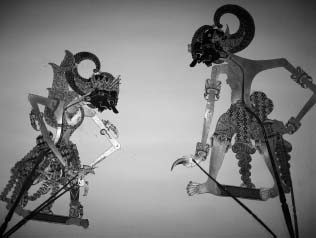
Puppets are classified as either traditional or contemporary (modern), a distinction that is only partially useful. Traditional puppets are puppets that have been in communities for many generations, sometimes for hundreds of years, whereas modern puppets are recent creations. Several types of puppets are widespread around the world. These include glove puppets (England, France), shadow puppets (China, Greece, India, Indonesia, Malaysia, Turkey), rod or string puppets (Belgium, Italian mainland, Japan, Sicily), story scrolls (India), masks (Bali), water puppets (Vietnam), and even humans themselves imitating puppets (Indonesia). The word marionette is used to refer to both string puppets and puppets in general. A well-defined line between traditional puppets and contemporary puppets does not exist. Both are found in the same forms and express the same kinds of humor. And all forms of puppetry, even if invented yesterday, draw on many features and techniques that have always been characteristic of puppets.
One of 35 marionettes from the Tiller-Clowes Family Marionette Company, one of the last Victorian marionette troupes in England. Shown here is Clown, the character who developed from the Italian commedia dell’arte. In Great Britain, traveling marionette shows were a popular form of entertainment for adults in the 19th century.
Source: Theatre and Performance Collection, Victoria and Albert Museum; © Victoria and Albert Museum, London.
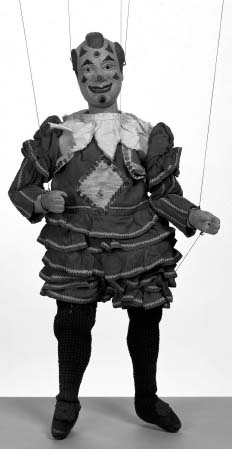
Traditional puppetry still exists in many places, and contemporary puppetry is present in all major population centers. Puppetry is practiced in Palermo in Sicily, as well as other places in Italy; Brussels and Liege in Belgium; Amiens, Charleville-Mézières, and Lyon in France; in Central and Eastern Europe, especially in Prague in the Czech Republic and Moscow in Russia; in Egypt and Greece; in many Asian countries, including Cambodia, China, India, Japan, China, Vietnam, and Taiwan; in Africa; in New York City and other cities in the United States; and in northeastern Brazil and other places in Latin America. In these places, puppets are performed both in public places, often as part of festivals and rituals, and in museums, schools, and libraries.
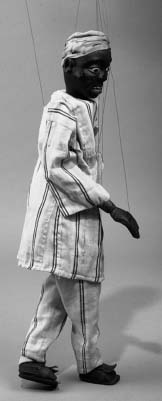
String puppet from the Tropenmuseum in Amsterdam, the Netherlands.
Source: Tropenmuseum of the Royal Tropical Institute (KIT)/Wikimedia Commons.
Puppetry as Popular Culture
Puppetry is an expression of popular and folk culture. It is intended for audiences of adults as well as children and is a form of communication and entertainment and an aesthetic creation. The dominant feature of puppetry is humor. Puppets become animate through the (usually hidden) activities of the puppeteers, who make them perform—walk, talk, sing, dance, burp, fart, and laugh. This disparity and intersection between the animate and the inanimate, the human and the nonhuman, is at the heart of the humor of puppets. Ironically because they are not human, puppets usually can do more and get away with more than can humans.
...
- Anthropology, Folklore, and Ethnicity
- Blason Populaire
- Philogelos
- Animal-Related Humor
- Anthropology
- Anti-Proverb
- Carnival and Festival
- College Humor
- Dialect Humor
- Ethnic Jokes
- Ethnicity and Humor
- Feast of Fools
- Folklore
- Fools
- Foolstowns
- Hoax and Prank
- Insult and Invective
- Jewish Humor
- Joke Cycles
- Joking Relationship
- National and Ethnic Differences
- Practical Jokes
- Race, Representations of
- Rituals of Laughter
- Social Network
- Stereotypes
- Targets of Humor
- Trickster
- Urban Legends
- Verbal Dueling
- Xeroxlore
- Antiquity
- Components of Humor
- Culture
- Xiangsheng, History of
- Xiangsheng
- Anthropology
- Carnival and Festival
- Cross-Cultural Humor
- Culture
- Education, Humor in
- Fools
- Foolstowns
- Gallows Humor
- High-Context Humor
- Humorous Names
- Intercultural Humor
- Jewish Humor
- Obscenity
- Puppets
- Race, Representations of
- Ritual Clowns
- Rituals of Inversion
- Scatology
- Sick Humor
- Sports
- Stereotypes
- Verbal Dueling
- Entertainment Industry
- History
- Forest of Laughter and Traditional Chinese Jestbooks
- Huaji-ists, The
- Philogelos
- Xiangsheng, History of
- Ancient Egypt, Humor in
- Arabic Culture, Humor in
- Assyrian and Babylonian Humor
- Biblical Humor
- Buddhism
- Christianity
- Confucianism
- Fabliau
- Feast of Fools
- Greek Visual Humor
- History of Humor: 19th-Century Europe
- History of Humor: Classical and Traditional China
- History of Humor: Early Modern Europe
- History of Humor: Medieval Europe
- History of Humor: Modern and Contemporary China
- History of Humor: Modern and Contemporary Europe
- History of Humor: Modern Japan
- History of Humor: Premodern Japan
- History of Humor: Renaissance Europe
- History of Humor: U.S. Frontier
- History of Humor: U.S. Modern and Contemporary
- Islam
- Jest, Jestbooks, and Jesters
- Magazines and Newspapers Outside the United States
- Magazines and Newspapers, U.S.
- Masks
- Medieval Visual Humor
- Menander
- Mock Epic
- Molière
- Plautus
- Rabelais, François
- Sanskrit Humor
- Satire
- Shakespearean Comedy
- Sitcoms
- Sketch Comedy Shows
- Slapstick
- Stand-Up Comedy
- Tall Tale
- Tragicomedy
- Travesty
- Humor Theory
- 3 WD Humor Test
- Aristotelian Theory of Humor
- Arousal Theory (Berlyne)
- Benign Violation Theory
- Bergson's Theory of the Comic
- Bisociation
- Evolutionary Explanations of Humor
- Framing Theory
- Freudian/Psychoanalytic Theory
- Hobbesian Theory
- Humor Theories
- Humor, Forms of
- Inversion, Topsy-Turvy
- Pattern Recognition
- Platonic Theory of Humor
- Release Theories of Humor
- Reversal Theory
- Simple Form
- Uses and Gratifications Theory
- Linguistics
- Pointe
- Witz
- Xiehouyu
- Ambiguity
- Anti-Proverb
- Aphorism
- Audiovisual Translation
- Computational Humor
- Conversation
- Cross-Cultural Humor
- Culture
- Dialect Humor
- Epigram
- Exaggeration
- Failed Humor
- Gender Roles in Humor
- Humor Markers
- Humor, Computer-Generated
- Humor, Etymology of
- Humor, Forms of
- Humorist
- Incongruity and Resolution
- Irony
- Jokes
- Joking Relationship
- Laugh, Laughter, Laughing
- Linguistic Theories of Humor
- Linguistics
- Maxim
- Mechanisms of Humor
- Metaphor
- Misdirection
- Phonological Jokes
- Politeness
- Punch Line
- Puns
- Reactions to Humor, Non-Laughter
- Rhetoric and Rhetorical Devices
- Riddle
- Second Language Acquisition
- Semantics
- Speech Play
- Teasing
- Tom Swifty
- Translation
- Verbal Humor
- Wellerism
- Literature and Major Literary Figures
- Commedia dell’Arte
- Forest of Laughter and Traditional Chinese Jestbooks
- Kyōgen
- Rakugo
- Senryū
- Share
- Witz
- Absurdist Humor
- Ancient Greek Comedy
- Ancient Roman Comedy
- Anecdote, Comic
- Aphorism
- Aristophanes
- Boccaccio, Giovanni
- Carnivalesque
- Cervantes, Miguel de
- Comedy
- Comic Relief
- Doggerel
- Epigram
- Exaggeration
- Fabliau
- Farce
- Genres and Styles of Comedy
- Goldoni, Carlo
- High Comedy
- Humorous Names
- Inversion, Topsy-Turvy
- Jest, Jestbooks, and Jesters
- Lampoon
- Limericks
- Literature
- Low Comedy
- Menander
- Mime
- Mock Epic
- Molière
- Nonsense
- Parody
- Pastiche
- Pirandello, Luigi
- Plautus
- Poetry
- Postmodern Irony
- Puns
- Rabelais, François
- Rhetoric and Rhetorical Devices
- Satire
- Satyr Play
- Schwank
- Science, Science Fiction, and Humor
- Shakespearean Comedy
- Simple Form
- South American Literature, Humor in
- Tall Tale
- Tragicomedy
- Travesty
- Trickster
- Mathematics, Computer Science, and the Internet
- Africa
- Americas
- Asia
- E’gao: Culture of Internet Spoofing in China
- Forest of Laughter and Traditional Chinese Jestbooks
- Huaji-ists, The
- Kyōgen
- Rakugo
- Senryū
- Share
- Xiangsheng, History of
- Xiangsheng
- Xiehouyu
- Buddhism
- Confucianism
- History of Humor: Classical and Traditional China
- History of Humor: Modern and Contemporary China
- History of Humor: Modern Japan
- History of Humor: Premodern Japan
- Islam
- Southeast Asia, Cartooning in
- Taoism
- Europe
- Commedia dell’Arte
- Lazzi
- Pointe
- Witz
- Ancient Greek Comedy
- Ancient Roman Comedy
- Byzantine Humor
- Fabliau
- Greek Visual Humor
- History of Humor: 19th-Century Europe
- History of Humor: Early Modern Europe
- History of Humor: Medieval Europe
- History of Humor: Modern and Contemporary Europe
- Medieval Visual Humor
- Satyr Play
- Schwank
- Middle East
- Performing Arts
- Commedia dell’Arte
- Lazzi
- Ancient Greek Comedy
- Ancient Roman Comedy
- Burlesque
- Carnivalesque
- Clowns
- Comedy
- Comedy Ensembles
- Comic Opera
- Farce
- Gag
- High Comedy
- Improv Comedy
- Low Comedy
- Masks
- Mime
- Music
- Music Hall
- Musical Comedy
- Parody
- Pastiche
- Puppets
- Satyr Play
- Shakespearean Comedy
- Sketch Comedy Shows
- Slapstick
- Stand-Up Comedy
- Tragicomedy
- Travesty
- Variety Shows
- Philosophy and Religion
- Aesthetics
- Aphorism
- Aristotelian Theory of Humor
- Bergson's Theory of the Comic
- Biblical Humor
- Buddhism
- Christianity
- Clergy
- Comic Frame
- Comic Versus Tragic Worldviews
- Comic World
- Confucianism
- Epigram
- Feast of Fools
- Hobbesian Theory
- Islam
- Jewish Humor
- Judaism
- Paradox
- Philosophy of Humor
- Platonic Theory of Humor
- Religion
- Rituals of Laughter
- Taoism
- Physiology and Biology
- Politics
- Business World
- Education
- Law
- Clinical and Counseling Psychology
- Cognition
- Developmental Psychology
- General Psychology
- Appreciation of Humor
- Failed Humor
- Humor Detection
- Humor Production
- Humor Styles
- Humorous Stimuli, Characteristics of
- Identity
- Laugh, Laughter, Laughing
- Pattern Recognition
- Psychological Distance
- Psychology
- Reactions to Humor, Non-Laughter
- Reception of Humor
- Release Theories of Humor
- Sense of Humor, Components of
- Smiling and Laughter: Expressive Patterns
- Health Psychology
- Interpersonal Relationships
- Motivation and Emotion
- Neuropsychology
- Personality and Social Psychology
- Tests and Measurement
- Sociology
- Aggressive and Harmless Humor
- Carnivalesque
- Conversation
- Cross-Cultural Humor
- Culture
- Dialect Humor
- Ethnic Jokes
- Ethnicity and Humor
- Failed Humor
- Gallows Humor
- Gender Roles in Humor
- High-Context Humor
- Homosexuality, Representation of
- Humor Group
- Identity
- Insult and Invective
- National and Ethnic Differences
- Obscenity
- Play and Humor
- Presidential Humor
- Race, Representations of
- Reactions to Humor, Non-Laughter
- Reception of Humor
- Roman Visual Humor
- Scatology
- Sick Humor
- Social Interaction
- Social Network
- Sociology
- Stereotypes
- Targets of Humor
- Teasing
- Visual Humor
- Loading...
Get a 30 day FREE TRIAL
-
 Watch videos from a variety of sources bringing classroom topics to life
 -
Read modern, diverse business cases
-
Explore hundreds of books and reference titles

Read next

More like this
Sage Recommends
We found other relevant content for you on other Sage platforms.
Have you created a personal profile? Login or create a profile so that you can save clips, playlists and searches