
Entry
Reader's guide
Entries A-Z
Subject index
Comic Strips
The modern incarnation of comic strips can trace its origins to illustrated novels of the early-19th century, when graphic art in the form of cartoons and caricatures was widely appreciated as post hoc narrative support. At that time, however, original illustrated stories were also finding an audience. In Europe, creations such as Rudolphe Töpffer's Histoire de M. Vieux Bois (1827) and Wilhelm Busch's Max und Moritz (1865) would prove to have a definitive influence on the production of American comic art, which in turn would affect the global development of the comic strip as a forum for gag humor, social commentary, political satire, or science-fiction adventure. This entry gives a brief history of the popularization of comic strips and presents the key features of comic strips before concluding with a discussion of comic strip humor.
The Popularization of Comic Strips
In an effort to boost sales and circulation, 19th-century American newspapers and magazines began including weekly supplementary material, such as the American Humorist supplement published in W. R. Hearst's New York Journal in the 1890s. The popularization of comic strips began with The Yellow Kid, by Richard Felton Outcault, widely credited as the first serial newspaper comic strip and acknowledged for initiating the crucial development away from text as merely an embellishment to art and toward a cultivation of comic dialogue reflecting textual and graphical harmony.
By the early 1900s, comic strips were featured in daily newspapers, creating a forum for continuous narrative. By the 1930s, weekday black-and-white comic strips were complemented with Sunday edition full color comic strip pages, introducing a format that is maintained today around the world.
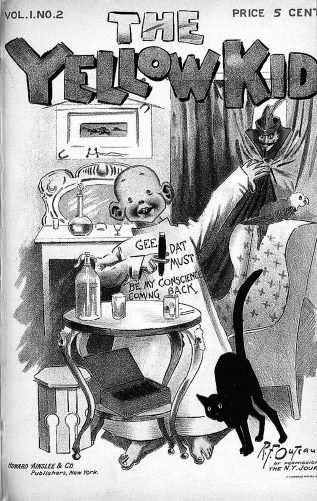
The Yellow Kid (Micky Dugan), a small, toothless orphan, was the lead character in the comic strip Hogan's Alley that was introduced in 1895. The Kid, wearing an oversized yellow nightshirt with the words “Gee dat must be my conscience coming back” is standing in a parlor, smoking a cigar and drinking absinthe or some other alcoholic beverage. A black cat rubs against his legs and, in the background, the devil pokes his head between the curtains. The strip, drawn by Richard Felton Outcault, is widely considered the beginning of the U.S. comic strip tradition. First appearing in Joseph Pulitzer's New York World, it was later published in William Randolph Hearst's NewYork Journal. The strip became a national sensation through heavy licensing activity (including appearances in advertising and on Broadway) and through the national distribution of Hearst's Sunday humor section.
Source: Library of Congress Prints and Photographs Division, Washington, DC.
The combination of serial and syndicated publication, the development of episodic narrative, and the proliferation of comic strips proved conducive to dedicated following and collecting, which ultimately led to the comic book as the premier form of comic strip consumption and established the comic strip as a literary genre.
Key Features of Comic Strips
Comic strips can generally be defined as illustrations arranged sequentially, each typically contained within a square or rectangular frame known as a panel, and accompanied by text in the form of captions, dialogue, or a combination of the two to create a humorous narrative. However, not all comic strips are multipaneled, serial, or episodic in nature, nor can they all be rightly understood as comical. Nevertheless, comic strip serves as the most common generic term to refer to a genre characterized by panel gag comics (see below), but it also includes superhero comics such as Superman, adventure comics such as Popeye, dramatic comics such as Mary Worth, or political or editorial comics such as Doonesbury. Closely related to comic strips are graphic novels, while cultural variations include Japanese manga and Franco-Belgian bandes-dessinées, the best known of which include The Adventures of Tintin and Astérix.
...
- Anthropology, Folklore, and Ethnicity
- Blason Populaire
- Philogelos
- Animal-Related Humor
- Anthropology
- Anti-Proverb
- Carnival and Festival
- College Humor
- Dialect Humor
- Ethnic Jokes
- Ethnicity and Humor
- Feast of Fools
- Folklore
- Fools
- Foolstowns
- Hoax and Prank
- Insult and Invective
- Jewish Humor
- Joke Cycles
- Joking Relationship
- National and Ethnic Differences
- Practical Jokes
- Race, Representations of
- Rituals of Laughter
- Social Network
- Stereotypes
- Targets of Humor
- Trickster
- Urban Legends
- Verbal Dueling
- Xeroxlore
- Antiquity
- Components of Humor
- Culture
- Xiangsheng, History of
- Xiangsheng
- Anthropology
- Carnival and Festival
- Cross-Cultural Humor
- Culture
- Education, Humor in
- Fools
- Foolstowns
- Gallows Humor
- High-Context Humor
- Humorous Names
- Intercultural Humor
- Jewish Humor
- Obscenity
- Puppets
- Race, Representations of
- Ritual Clowns
- Rituals of Inversion
- Scatology
- Sick Humor
- Sports
- Stereotypes
- Verbal Dueling
- Entertainment Industry
- History
- Forest of Laughter and Traditional Chinese Jestbooks
- Huaji-ists, The
- Philogelos
- Xiangsheng, History of
- Ancient Egypt, Humor in
- Arabic Culture, Humor in
- Assyrian and Babylonian Humor
- Biblical Humor
- Buddhism
- Christianity
- Confucianism
- Fabliau
- Feast of Fools
- Greek Visual Humor
- History of Humor: 19th-Century Europe
- History of Humor: Classical and Traditional China
- History of Humor: Early Modern Europe
- History of Humor: Medieval Europe
- History of Humor: Modern and Contemporary China
- History of Humor: Modern and Contemporary Europe
- History of Humor: Modern Japan
- History of Humor: Premodern Japan
- History of Humor: Renaissance Europe
- History of Humor: U.S. Frontier
- History of Humor: U.S. Modern and Contemporary
- Islam
- Jest, Jestbooks, and Jesters
- Magazines and Newspapers Outside the United States
- Magazines and Newspapers, U.S.
- Masks
- Medieval Visual Humor
- Menander
- Mock Epic
- Molière
- Plautus
- Rabelais, François
- Sanskrit Humor
- Satire
- Shakespearean Comedy
- Sitcoms
- Sketch Comedy Shows
- Slapstick
- Stand-Up Comedy
- Tall Tale
- Tragicomedy
- Travesty
- Humor Theory
- 3 WD Humor Test
- Aristotelian Theory of Humor
- Arousal Theory (Berlyne)
- Benign Violation Theory
- Bergson's Theory of the Comic
- Bisociation
- Evolutionary Explanations of Humor
- Framing Theory
- Freudian/Psychoanalytic Theory
- Hobbesian Theory
- Humor Theories
- Humor, Forms of
- Inversion, Topsy-Turvy
- Pattern Recognition
- Platonic Theory of Humor
- Release Theories of Humor
- Reversal Theory
- Simple Form
- Uses and Gratifications Theory
- Linguistics
- Pointe
- Witz
- Xiehouyu
- Ambiguity
- Anti-Proverb
- Aphorism
- Audiovisual Translation
- Computational Humor
- Conversation
- Cross-Cultural Humor
- Culture
- Dialect Humor
- Epigram
- Exaggeration
- Failed Humor
- Gender Roles in Humor
- Humor Markers
- Humor, Computer-Generated
- Humor, Etymology of
- Humor, Forms of
- Humorist
- Incongruity and Resolution
- Irony
- Jokes
- Joking Relationship
- Laugh, Laughter, Laughing
- Linguistic Theories of Humor
- Linguistics
- Maxim
- Mechanisms of Humor
- Metaphor
- Misdirection
- Phonological Jokes
- Politeness
- Punch Line
- Puns
- Reactions to Humor, Non-Laughter
- Rhetoric and Rhetorical Devices
- Riddle
- Second Language Acquisition
- Semantics
- Speech Play
- Teasing
- Tom Swifty
- Translation
- Verbal Humor
- Wellerism
- Literature and Major Literary Figures
- Commedia dell’Arte
- Forest of Laughter and Traditional Chinese Jestbooks
- Kyōgen
- Rakugo
- Senryū
- Share
- Witz
- Absurdist Humor
- Ancient Greek Comedy
- Ancient Roman Comedy
- Anecdote, Comic
- Aphorism
- Aristophanes
- Boccaccio, Giovanni
- Carnivalesque
- Cervantes, Miguel de
- Comedy
- Comic Relief
- Doggerel
- Epigram
- Exaggeration
- Fabliau
- Farce
- Genres and Styles of Comedy
- Goldoni, Carlo
- High Comedy
- Humorous Names
- Inversion, Topsy-Turvy
- Jest, Jestbooks, and Jesters
- Lampoon
- Limericks
- Literature
- Low Comedy
- Menander
- Mime
- Mock Epic
- Molière
- Nonsense
- Parody
- Pastiche
- Pirandello, Luigi
- Plautus
- Poetry
- Postmodern Irony
- Puns
- Rabelais, François
- Rhetoric and Rhetorical Devices
- Satire
- Satyr Play
- Schwank
- Science, Science Fiction, and Humor
- Shakespearean Comedy
- Simple Form
- South American Literature, Humor in
- Tall Tale
- Tragicomedy
- Travesty
- Trickster
- Mathematics, Computer Science, and the Internet
- Africa
- Americas
- Asia
- E’gao: Culture of Internet Spoofing in China
- Forest of Laughter and Traditional Chinese Jestbooks
- Huaji-ists, The
- Kyōgen
- Rakugo
- Senryū
- Share
- Xiangsheng, History of
- Xiangsheng
- Xiehouyu
- Buddhism
- Confucianism
- History of Humor: Classical and Traditional China
- History of Humor: Modern and Contemporary China
- History of Humor: Modern Japan
- History of Humor: Premodern Japan
- Islam
- Southeast Asia, Cartooning in
- Taoism
- Europe
- Commedia dell’Arte
- Lazzi
- Pointe
- Witz
- Ancient Greek Comedy
- Ancient Roman Comedy
- Byzantine Humor
- Fabliau
- Greek Visual Humor
- History of Humor: 19th-Century Europe
- History of Humor: Early Modern Europe
- History of Humor: Medieval Europe
- History of Humor: Modern and Contemporary Europe
- Medieval Visual Humor
- Satyr Play
- Schwank
- Middle East
- Performing Arts
- Commedia dell’Arte
- Lazzi
- Ancient Greek Comedy
- Ancient Roman Comedy
- Burlesque
- Carnivalesque
- Clowns
- Comedy
- Comedy Ensembles
- Comic Opera
- Farce
- Gag
- High Comedy
- Improv Comedy
- Low Comedy
- Masks
- Mime
- Music
- Music Hall
- Musical Comedy
- Parody
- Pastiche
- Puppets
- Satyr Play
- Shakespearean Comedy
- Sketch Comedy Shows
- Slapstick
- Stand-Up Comedy
- Tragicomedy
- Travesty
- Variety Shows
- Philosophy and Religion
- Aesthetics
- Aphorism
- Aristotelian Theory of Humor
- Bergson's Theory of the Comic
- Biblical Humor
- Buddhism
- Christianity
- Clergy
- Comic Frame
- Comic Versus Tragic Worldviews
- Comic World
- Confucianism
- Epigram
- Feast of Fools
- Hobbesian Theory
- Islam
- Jewish Humor
- Judaism
- Paradox
- Philosophy of Humor
- Platonic Theory of Humor
- Religion
- Rituals of Laughter
- Taoism
- Physiology and Biology
- Politics
- Business World
- Education
- Law
- Clinical and Counseling Psychology
- Cognition
- Developmental Psychology
- General Psychology
- Appreciation of Humor
- Failed Humor
- Humor Detection
- Humor Production
- Humor Styles
- Humorous Stimuli, Characteristics of
- Identity
- Laugh, Laughter, Laughing
- Pattern Recognition
- Psychological Distance
- Psychology
- Reactions to Humor, Non-Laughter
- Reception of Humor
- Release Theories of Humor
- Sense of Humor, Components of
- Smiling and Laughter: Expressive Patterns
- Health Psychology
- Interpersonal Relationships
- Motivation and Emotion
- Neuropsychology
- Personality and Social Psychology
- Tests and Measurement
- Sociology
- Aggressive and Harmless Humor
- Carnivalesque
- Conversation
- Cross-Cultural Humor
- Culture
- Dialect Humor
- Ethnic Jokes
- Ethnicity and Humor
- Failed Humor
- Gallows Humor
- Gender Roles in Humor
- High-Context Humor
- Homosexuality, Representation of
- Humor Group
- Identity
- Insult and Invective
- National and Ethnic Differences
- Obscenity
- Play and Humor
- Presidential Humor
- Race, Representations of
- Reactions to Humor, Non-Laughter
- Reception of Humor
- Roman Visual Humor
- Scatology
- Sick Humor
- Social Interaction
- Social Network
- Sociology
- Stereotypes
- Targets of Humor
- Teasing
- Visual Humor
- Loading...
Get a 30 day FREE TRIAL
-
 Watch videos from a variety of sources bringing classroom topics to life
 -
Read modern, diverse business cases
-
Explore hundreds of books and reference titles

Read next

More like this
Sage Recommends
We found other relevant content for you on other Sage platforms.
Have you created a personal profile? Login or create a profile so that you can save clips, playlists and searches