
Entry
Reader's guide
Entries A-Z
Subject index
Risk Information Seeking and Processing Model
The risk information seeking and processing (RISP) model, proposed by Robert Griffin and colleagues, seeks to explain how and when people are likely to seek information about various risks. The model is based on the idea that people's engagement with risk information is determined by many factors, including characteristics of the hazard, beliefs about the channel where the information is available, their own skills in gathering the information, their past experience, and the extent to which they feel knowledgeable about the risk. RISP was originally developed to examine environmental risk information seeking, but has since been expanded to other topics, including clinical trial enrollment, influenza vaccine uptake, and engagement in health-protective behaviors by low-income populations.
Figure 1 depicts the main elements of the RISP model. The outcome of the RISP model is a combination of an individual's seeking and processing of information. Information seeking is defined as the use of multiple channels to gather information to achieve a personal goal such as to problem solve or reduce anxiety. In the model, information seeking is thought of in two ways: routine (i.e., using habitual information sources) and nonroutine (i.e., actively seeking information from new channels). For example, people may gather new risk information from a television news program that they watch habitually (which would be called routine), or they may purposefully search the Internet for more information about a risk (called nonroutine).
Figure 1 Risk information seeking and processing model
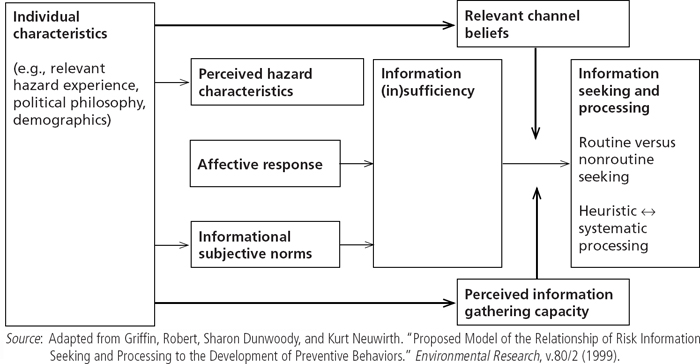
Based on the heuristic-systematic model, information processing is conceptualized in terms of how extensively people engage with the risk information; this is bounded at one end by “heuristic” processing (referring to a superficial, limited engagement) and, at the other end, by “systematic” processing (a more thoughtful and effortful engagement). For example, an individual may read a newspaper article about the risk of death from cancer due to alcohol, but spend little time actually thinking about the risk; this illustrates heuristic processing. Another person may read the same article but think more deeply about the risk, and even compare it to other viewpoints; this illustrates systematic processing. Risk information seeking and processing are combined into one outcome with four categories: routine heuristic, nonroutine heuristic, routine systematic, and nonroutine systematic behavior.
Information seeking and processing is the product of an individual's: (1) perceived discrepancy between current knowledge and needed information about a risk (information sufficiency); (2) beliefs about the channels of risk information (relevant channel beliefs); and (3) perceived ability to seek and process information to achieve the desired goal (perceived information gathering capacity). When people perceive that their knowledge does not meet the “sufficiency threshold” (the amount of information that individuals think is necessary to know), they engage in more effortful information seeking and processing behaviors. However, the relationship between information sufficiency and information seeking and processing behaviors is affected by the relevant channel beliefs and perceived information gathering capacity.
Relevant channel beliefs are perceptions about various channels of risk communication, such as the channel's trustworthiness or usefulness. For example, the same information about the benefits of a drug tends to be thought about differently if it is coming from a physician, as compared to from a pharmaceutical representative.
...
- Community Health Issues
- Change Agency
- Collective Efficacy
- Community Initiatives, Comprehensive
- Community Mobilization
- Community Organizing as a Research Approach
- Community Participation
- Community-Based Participatory Research
- Conflict Management: Health Professionals
- Cultural Differences
- Health Activism and Public Health
- Immigrant Families
- Media Literacy
- Nature, Environment, and Sustainability
- Organizational and Public Policy Barriers
- Readiness Assessments
- Rural Health Communication
- Sex Workers
- Social Action, Types of
- Social Aggregates
- Social Capital
- Social Determinants of Health
- University–Community Relationships
- End-of-Life Issues
- Evaluation of Health Intervention, Health Education, Health Communication
- Content Analysis
- Data Mining
- Evaluation, Statistical Challenges in
- Evaluation: Mixed Methods
- Evaluation: Qualitative Methods
- Evaluation: Quantitative Methods
- Focus Groups
- Intervention Evaluation Methodology Technologies, New
- Logic Models and Program Evaluation
- Measurement Problems
- Measurement: Message Quality
- Modeling Development and Testing
- Risk Communication
- Risk Society
- Sampling
- Setting Objectives: Health Communication and Intervention
- Everyday and Family Health Communication Issues
- Adolescent Substance Abuse Prevention
- Aging
- Alcohol and Health Decision Making
- Childhood Injury Prevention
- Children, Health Communication With
- Cross-Generational Health Communication
- Decision Making
- Disabilities and Family Relationships
- Everyday Health Communication
- Everyday Health Communication, Social Influence of
- Familial Roles in Health Communication
- Families, Communication With
- Family Caregiving
- Family Meeting
- Family Planning
- Family: Relationship to Health
- Grief and Loss
- Health Communication, Unintended Effects of
- Health Education
- Health Literacy and Numeracy
- Health Literacy, Consequences of
- Health Literacy, Improving
- Health Literacy, Measurement of
- Health Literacy, Model of
- Health Literacy, Online
- Health Literacy: Integrating Into Health Care Systems
- Health Transition and Family Communication
- Illness Identity
- Mother–Daughter Dyad Communication
- Religion and Spirituality
- Social Construction: Disability
- Social Identity
- Social Norms
- Social Support and Cardiovascular Health
- Social Support and Support Groups
- Social Support Interventions
- Social Support, Types of
- Social Support: Relationship to Health
- Stigma Reduction
- Stigmatization
- Stigmatization, Consequences of
- Stigmatization, Coping With
- Stigmatization: Courtesy Stigma
- Stigmatization: Labels, Marks, and Peril
- Surrogate Decision Makers
- Teen Pregnancy
- Health Campaigns
- Advertising, Governmental Regulation of
- Advertising: Dietary Supplements
- Advertising: Food
- Advertising: Over-the-Counter Drugs
- Advertising: Prescription Drugs
- Affordable Care Act
- Assessment of Health Campaigns
- Awareness and Instruction Strategies
- Campaign Effects Versus Effectiveness
- Channels and Formats
- Communication Complex
- Communication for Behavioral Impact
- Crisis Communication
- Developing Countries, Campaigns in
- Disease Prevention
- Dissemination
- Emotion Appraisals Regarding Risk
- Evidence: Role in Campaigns
- Formative Evaluation
- Health Campaigns
- Health Campaigns, Assessment of
- Incentive Appeals
- Influential Source Messengers
- Integrated Marketing Mix
- Interpersonal Communication and Mass Media Health Campaigns
- Message Design
- Message Sidedness
- Message Tailoring
- Optimistic Bias
- Perceived Threat
- Program Strategies: Campaigns
- Public Service Announcements
- Risk Communication
- Risk Communication: Food Safety
- Risk Perceptions
- Risk-Taking Behavior
- Segmentation: Health Campaigns
- Sensation-Seeking Targeting
- Social Marketing
- Health Communication, International and Diversity Issues
- Bangladesh
- Bolivia
- Brazil
- China
- Conflict and Negative Health Effects
- Cultural Sensitivity
- Disenfranchised Populations
- Egypt
- Ethnic Diversity in Health Care Settings
- Europe
- Ghana
- Health Care: Discrimination or Bias in
- Health Disparities, Personal Influences on
- Health Disparities, Relational Influences on
- Health Disparities, Solutions for
- Health Disparities: Clinical Interactions
- Health Disparities: Communal Level
- Health Disparities: Overall
- Human Rights
- Immigrant Populations
- India
- Indonesia
- Intercultural Health Communication
- Iran
- Islamic Healing
- Japan
- LGBT Issues
- Malawi
- Marginalized Populations
- Mexico
- Middle East
- Nepal
- Nigeria
- Philippines
- Public Health Intervention: Multicultural Communities
- Russia
- Senegal
- South Africa
- South Korea
- Structure-Centered Approach
- Sub-Saharan Africa
- Thailand
- Turkey
- Uganda
- United Kingdom
- United States
- Zimbabwe
- Health Information
- Defensive Reactions: Health Messages
- Digital Divide
- Disclosure: Family Health History
- Disclosure: Medical Errors
- Disclosure: Providers and Patients
- Emotion and Information Seeking
- Explaining Illness
- Explaining Illness, Need for
- Expressive Writing and Health
- Health Citizenship
- Health Communication Curricula
- Health Information-Seeking Behavior, Psychosocial Determinants of
- Health Information-Seeking Behavior, Social Determinants of
- Information Nonseeking
- Information Seeking
- Information Sharing
- Numeracy
- Online Health Information Seeking
- Online Health Information Sharing
- Opinion Leaders
- History of Health Communication
- Communication Networks
- Communication, Basic Concepts of
- E-Health: Defined
- Health Communication, History of
- Health Information Channels
- Lifespan, Communication Across the
- Medicine as Business, Evolution of
- Patient and Relationship-Centered Communication and Medicine
- Personalized Medicine
- Postcolonial Studies and Health
- Premises of Health Communication
- Science Communication
- Translational Research
- Media Content
- Advertising Unhealthy Foods to Children
- Audiences, Reaching
- Body Images and Portrayals
- Celebrity Cancer Announcements
- Celebrity Endorsements
- Digital Media
- Disclaimers, Interpretation and Effects of
- Entertainment–Education
- Entertainment–Education: European Approach
- Entertainment–Education: Hollywood and Public Relations Approach
- Entertainment–Education: Role of Involvement
- Genetically Modified Organisms, Media Coverage of
- Health Blogging
- Health Disparities: Media
- Health Journalism
- Health Promotion
- Ideological Hegemony
- Institutional Processes and Competing Agendas
- Mass Media
- Media and Health, Critical Analysis of
- Media Content, Impact of
- Media Content: Magazines
- Media Content: Newspapers
- Media Content: Other Print
- Media Content: Televised Entertainment
- Media Content: Televised News
- Media Depictions: Disability
- Media Depictions: Medical Workers
- Media Depictions: Mental Illnesses
- Media: Quality of Health Information
- Moderating Variables and Audience Effects: Violence
- Music in Health Behavior: Change Campaigns and Interventions
- Obesity and Mass Media
- Pathways to Change Tool
- Pornography, Health Consequences of
- Public Relations and Health Journalism
- Public Relations and Health Promotion
- Public Relations and Social Media
- Social Marketing: Community Change Perspective
- Television
- Twitter and Public Health
- Organizational Issues and Health Policy
- Adult Children of Alcoholics
- Advocacy
- American Medical Association
- Centers for Disease Control and Prevention, U.S.
- Conflict Management: Health Professionals
- Department of Health and Human Services
- Health Care Teams
- Health Policy
- Healthy People Initiative
- Hospital Governance Culture
- Informed Consent
- Interdisciplinary Health Services Research
- Mediated Health Campaigns
- Multicultural Campaigns
- National Action Plan to Improve Health Literacy
- National Cancer Institute
- National Institutes of Health
- National Library of Medicine
- National Medical Association
- Organizations and Health
- Patient Privacy
- Politics and Political Complexities
- Public Relations and Health Care Organizations
- Role Stress: Overall
- Segmentation: Public Relations
- Stress and Burnout: Emotional Labor
- Stress and Burnout: Home–Work Conflict
- Stress and Burnout: Overall
- Three Community and Five Cities Projects
- UNICEF
- Working Well
- World Health Organization
- Provider–Patient Interaction
- Amputation
- Anger Appeals
- Anxiety
- Clinical Trial Participation
- Coding Health Interaction
- Collaborative Decision Making
- Collaborative Decision Making, Uncertainty in
- Collaborative Decision Making: Shared Mind
- Communication Skills Training and Assessment: Providers
- Communication Skills Training: Patients
- Compassion
- Contested Illnesses
- Conversation Analysis
- Coping
- Dependent Variables Derived From Critical Health Outcomes
- Difficult Patients
- Discourse and Health
- Doctor–Patient Communication
- Emergency Rooms
- Emotions and the Medical Care Process
- Face and Politeness
- Health Care Environment
- HIV Test Counseling
- Humor
- Identification
- Interactional Context and Intervention
- Interpersonal Communication Skills
- Interpreters and Language
- Interviewing in the Health Care Context
- Language and Negation Bias: Doctor–Patient Interaction
- Language Brokering
- Listening in Health Care Interactions
- Malpractice Litigation
- Medical Outcomes
- Medical Regimens, Adherence to
- Nonverbal Communication in Health Care Settings
- Open Dialogue Approach
- Overtreatment and Overreliance on Diagnostic Testing
- Pathways to Health Outcomes
- Patient Activation
- Patient Education: Hospital Discharge and Readmission
- Patient Empowerment
- Patient Navigators and Family Advisors
- Patient Safety
- Prescribing Medications
- Quality of Life as a Health Outcome
- Satisfaction
- Support Providers and Persons With Disabilities, Decision Making Between
- Supportive Listening
- Public Health Communication
- Biopreparedness and Biosecurity
- Climate Change
- Communication Networks
- Developmental Health
- Disaster Relief
- Emergency Preparedness and Response
- Environmental Health
- Environmental Health, Research in
- HIV/AIDS Prevention
- HIV/AIDS: Mother-to-Child Transmission
- Immunizations
- Memorable Messages
- Newborn Care
- Online Health Information Credibility
- Priming in Health Campaign Messages
- Public Engagement: Science Policy
- Public Health and Academic Partnerships
- Public Health Communication
- Public Health Communication, Evolution of
- Public Understanding: Research
- Public Understanding: Science
- Rhetoric: Flu Vaccine
- School Health
- Science Literacy
- Scientific Complexity, Communication of
- Sexual Health
- Tobacco
- Warning Labels: Alcohol
- Warning Labels: Cigarettes
- Warning Labels: Overview
- Warning Labels: Prescription Drugs
- Women's Health
- Work Site Safety
- Specific Health Issues/Providers
- Abuse: Child and Spousal
- Acupuncture
- Age-Related Hearing Loss
- Alternative and Complementary Medicine
- Alzheimer's Disease
- Antisocial Behaviors: Bullying and Cyberbullying
- Ayurveda, Yoga, and Meditation
- Bioterrorism
- Birth Control and Contraception
- Breast Cancer
- Breastfeeding
- Cancer Survivorship
- Cancer: Risk Communication
- Childbirth
- Childhood Injury Prevention
- Chronic Diseases
- Circumcision, Male
- Communication Interventions
- Contraception
- Depression
- Diabetes
- Dialectical Behavioral Therapy
- Disability
- Disaster Relief
- Distance Caregiving
- Drug and Alcohol Abuse Minimization
- Eating Disorders
- Emergency Health Communication
- Enhancement
- Environmental Health
- Exercise
- Fertility
- Gambling Addiction
- Gender
- Genetics
- Heart Health
- HIV/AIDS Test, Meanings of
- HIV/AIDS Treatment
- HIV/AIDS: Condom Use and Meanings
- HIV/AIDS: Disclosure Dilemmas
- HIV/AIDS: Language, Metaphors, and Social Construction
- HIV/AIDS: Overview
- HIV/AIDS: Social Determinants of Disparities
- Holistic Medicine
- Human Papillomavirus
- Influenza A Virus Subtype H1N1
- Integrative Medicine
- Internet Addiction
- Malaria and Mosquito Nets
- Mammography
- Mental Health
- Military Health
- Military Sexual Assault
- Multilevel Interventions
- Neurorhetoric
- Nursing
- Nutrition and Diet
- Obesity: Overview
- Oral Health and Dentistry
- Organ Donation
- Osteopathy
- Pandemics
- Pharmacists
- Physical Activity and Weight
- Post-Traumatic Stress Disorder
- Pregnancy
- Prenatal Health Promotion
- Prostate Cancer
- Safer Sex
- Severe Acute Respiratory Syndrome
- Sex Education
- Sexual Assault
- Sexually Transmitted Disease Prevention
- Skin Cancer and Sun Safety
- Skin Cancer and Tanning
- Slow-Motion Technological Disaster, Responses to
- Smoking
- Suicide
- Transitions, Health Effects, and Support
- Traumatic Brain Injury
- Tuberculosis
- Vaccinations
- Technology
- Big Data
- Biomedical and Health Informatics
- Body Implants, Medical
- Bundled Interventions
- Computer Kiosks, Free-Standing
- Computer-Tailored Interventions
- Customization as Tailoring 2.0
- Digital Divide
- Digital Personal Health Records
- Gaming
- Geographic Information Systems Technology
- Internet: Information Acquisition
- Medical Records, Electronic
- Message Tailoring
- Mobile Health
- Online Focus Groups
- Online Health Information Exchange and Privacy
- Online Support Groups
- Online Support Groups, Advantages and Disadvantages of
- Persuasive Technologies for Health
- PubMed
- Reproductive Technologies, New
- Secondary Data Analysis
- Social Media
- Technology and Health Outcomes
- Technology: Impact on Physician–Patient Dialogue
- Telemedicine
- Theoretical Frameworks, Communication Technology
- Virtual Reality Environments
- Weak Tie/Strong Tie Network Support
- Web-Based Delivery
- Theories, Ethics, Philosophy, and Overriding Methodological Issues
- Acculturation
- Action Tendency Emotions
- Acute Versus Preventive Care
- Affection Exchange Theory
- Ageism
- Agenda Setting
- Amputee Wannabes
- Attribution Theory and Attribution Error
- Biological Citizenship
- Biopower and Biopolitics
- Care Model and Productive Interaction
- Change Approaches, Transtheoretical and Stages of
- Communication Accommodation Theory
- Communication Privacy Management Theory
- Communication Theory of Identity
- Community Resilience
- Control Theory
- Critical Approaches
- Cultivation Theory
- Cultural Variance Model
- Culture-Centered Approaches
- Cyberchondria
- Diffusion of Innovations Model
- Double ABC-X Model of Family Stress and Coping
- Dual-Processing Models
- Ecological Perspectives
- Encoded Exposure and Aided Versus Unaided Awareness
- Ethic of Care
- Ethics: Campaigns
- Ethics: Health Communication Strategies
- Ethics: New Technologies
- Ethics: Overall
- Ethics: Provider–Patient Interaction
- Ethnography
- Ethnomethodology
- Fatalism
- Fear Appeals and the Extended Parallel Process Model
- Framing
- Generative Tensions in Health Communication Theory
- Globalization Theory
- Grounded Theory
- Harm Reduction Theory
- Health Belief Model
- Health Locus of Control
- Hofstede's Dimensions of Culture
- Inconsistent Nurturing as Control Theory
- Inoculation Effects
- Invisible Disabilities
- Loose Versus Tight Coupling
- Media Complementarity Theory
- Medicalization
- Message Sensation Value
- Meta-Analysis
- Metaphor
- Metatheory
- Motivational Interviewing
- Multilevel Modeling
- Narrative Engagement Theory
- Narrative Medicine
- Narratives and Barrier Reduction
- Narratives: Health Campaigns
- Narratives: Overall
- Narratives: Social Marketing
- Negotiated Morality Theory
- O-S-O-R Model
- Olson's Circumplex Model of Marital and Family Systems
- Organization–Public Relations Theory
- Perceived Effectiveness
- Phenomenology
- Photovoice
- Placebo Effects
- Problem-Based Learning
- Problematic Integration Theory
- Psychological Reactance
- Psychometric Theory and Reliability/Validity of Measures
- Realism
- Reconceptualized Health Belief Model
- Relational Dialectics Theory
- Relational Health Communication Competence Model
- Resilience
- Rhetoric: Health and Medicine
- Risk Communication: Instructional Principles
- Risk Communication: Social Construction Perspective
- Risk Information Seeking and Processing Model
- Risk Perception Attitude Framework
- Self-Determination Theory
- Self-Efficacy
- Situational Theory and Communication Behaviors
- Social Cognitive Theory
- Social Comparison Theory
- Social Construction: Reality
- Social Judgment Theory
- Social Networks and Message Delivery
- Social Networks, Measurement of
- Social Networks: Overall
- Societal Risk Reduction Motivation Model
- Sociometric Social Networks
- Structural Violence and Health
- Systems Theory
- Theory of Motivated Information Management
- Theory of Normative Social Behavior
- Theory of Planned Behavior
- Theory of Reasoned Action
- Traditions of Health Communication Theory
- Trait Approaches
- Uncertainty Management Theory
- Uses and Gratifications Theory
- Weick's Model of Organizing
- Loading...
Get a 30 day FREE TRIAL
-
 Watch videos from a variety of sources bringing classroom topics to life
 -
Read modern, diverse business cases
-
Explore hundreds of books and reference titles

Read next

More like this
Sage Recommends
We found other relevant content for you on other Sage platforms.
Have you created a personal profile? Login or create a profile so that you can save clips, playlists and searches