
Entry
Reader's guide
Entries A-Z
Subject index
Watergate
Few political scandals of the modern age have rivaled the complexity and, to some extent, the theatricality of those events that have collectively become known as simply “Watergate.” In fact, so far-reaching were the consequences of both the initial events and their protracted cover-up that the scandal effectively became the model by which future political and public relations catastrophes were to be defined—not only in America, but also globally. The now common trend of branding a well-publicized cover-up with the seemingly requisite “gate” suffix speaks to the apparent timelessness of the Watergate scandal and how it remains seared into the collective memory, retaining the ability even decades later to connect all acts of political or public disgrace with Watergate as their common progenitor.
While history has largely focused on the political circumstances of Watergate and its legal and legislative aftermaths, the events that led to the historically unprecedented resignation of President Richard Nixon in August 1974 remain a matter of interdisciplinary interest with respect to the group dynamics of deception and collusion among both elected and appointed officials. In most cases involving criminal acts of deception, the office held by a perpetrator is often considered an aggravating factor at sentencing, especially with respect to breaches of the public trust. Watergate is a remarkable exception, however, in terms of public trust apparently being a mitigating rather than aggravating circumstance, in turn raising questions about the psychopathology of group lying and condoning of antisocial behavior by senior elected officials.
Another reason for the ongoing intrigue surrounding the Watergate scandal is the apparent lack of a concrete motive for the crimes that set the president's downfall in motion and ruined countless careers. The scandal also lacked what might be described as a central or prevailing incentive when considering how quickly it seems to have lured in so many conspirators of such differing backgrounds, many of whom had little to gain during the plotting, commission, and eventual unraveling of the convoluted affair.
Burglarizing Democratic Headquarters
Having punctuated an era that remains defined by allegations of clandestine political pacts and far-reaching deceptions and conspiracies, Watergate essentially began as an unexceptional commercial burglary at the Democratic National Committee (DNC) headquarters located in the Watergate office complex in Washington, D.C., on the Memorial Day weekend in 1972. The initial burglary, as with the second attempt in June 1972, was unquestionably an intelligence-gathering mission either ordered or condoned by senior Republican Party principals, including President Nixon, yet the precise nature of the information being sought remains unclear. Some involved in the burglary's planning and commission have cited the official objective as having been the identification and collection of evidence confirming that the Cuban government was providing the DNC with covert funding; others have speculated that it might have been as simple as an overzealous attempt to gather dirt on senior DNC officials through the installation of illegal wiretaps and pilferage of sensitive documents, but with no specific endgame.
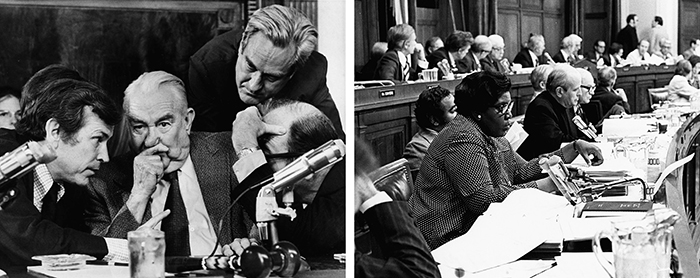
Members of the Senate Select Committee on Presidential Campaign Activities consult during a hearing on Watergate In 1973. From left: Tennessee Senator Howard Baker, North Carolina Senator Sam Ervin (chair), chief counsel Sam Dash, and minority counsel Arthur Miller (rear). The 435 members of the 93rd Congress (right) were charged with considering the impeachment of President Richard Nixon in 1974, including Texas Congresswoman Barbara C. Jordan (center), who delivered an impassioned rationale for impeachment.
...
- Advertising, Marketing, and Public Relations
- Animals and Nature
- Communication
- “Boy Who Cried Wolf”
- Aroused Suspicion
- Bluffing
- Bragging and Grandiosity
- Burgoon, Judee
- Coherence and Correspondence
- Communication
- Content in Context
- Deception Detection Accuracy
- Discovered Deception, Reactions to
- Equivocation
- Exaggeration
- Frank, Mark
- Frankfurt, Harry G.
- Generalized Communicative Suspicion
- Goffman, Erving
- Half-Truths
- Honesty
- Infidelity
- Information Manipulation Theory 1
- Information Manipulation Theory 2
- Interpersonal Deception Theory
- Knapp, Mark
- Language
- Lie Acceptability
- Lie Bias
- Lies, Types of
- Lying, Prevalence of
- McCornack-Parks Model
- McCornack, Steven
- Miller, Gerald
- Paltering
- Park-Levine Probability Model
- Park, Hee Sun
- Plausibility
- Probing Effect
- Relationships: Family
- Relationships: Friends
- Relationships: Romantic
- Relationships: Sexual
- Reputation
- Sender Demeanor
- Sock Puppetry
- Source Credibility
- Tall Tales
- Transparent Liars
- Truth
- Truth Bias
- Veracity Effect
- White Lies
- Deception in Different Cultures
- Entertainment, Media, and Sports
- Invention of Lying, The
- Lie to Me
- To Tell the Truth
- War of the Worlds
- Audience
- Baseball
- Basketball
- Beatles Hoax
- Blair, Jayson
- Brer Rabbit
- Children's Sports Teams
- College Sports
- Computer-Generated Images
- Fairy Tales
- Fantasy and Imagination
- Fiction
- Football
- Frey, James
- Games, Children's
- Glass, Stephen
- Gossip
- High School Sports
- Hockey
- Humor
- Iago (Shakespeare's Othello)
- Internet: Chat Rooms
- Internet: E-Mail
- Internet: Facebook and Social Media Sites
- Internet: Online Dating
- Magic Tricks
- Memoirs
- Movies, Lying in
- News Media: Internet
- News Media: Print
- News Media: Television and Radio
- Photographs, Altered
- Pinocchio
- Poker
- Rose, Pete
- Rumor
- Sawyer, Tom
- Soccer (Football)
- Ethics, Morality, and Religion
- Law, Business, and Academia
- Academia
- Accounting
- Alibi
- Attorneys
- Bankruptcy
- Business
- Caveat Emptor
- Cold Fusion
- Collusion
- Context
- Corporate Fraud
- Corporations
- Credibility
- Dot-Com Bubble
- Financial Markets
- Forgery, Art
- Greenspan, Alan
- Identity Theft
- Insider Trading
- Investment Fraud
- Justice
- Law and Law Enforcement
- Letters of Recommendation
- Libel and Slander
- Manipulation
- Marketing, Deceptive
- Medical and Pharmaceutical Industry
- Perjury
- Plagiarism
- Résumés
- Stylometry
- Witness, False Testimony of
- Military
- Battle of Fishguard
- Battle of the Bulge
- Bush, George W.
- Camouflage
- Churchill, Winston
- Civil War, U.S.
- Clausewitz, Carl von
- Defense Academy for Credibility Assessment
- Department of Defense, U.S.
- Disinformation
- Feigned Retreat
- Iran-Contra Affair
- Iraq War
- Korean War
- Military Deception
- Napoleon Bonaparte
- Nazi Propaganda
- Normandy, Allied Invasion of
- Operation Bodyguard
- Operation Mincemeat
- Operation Neptune
- Operation Quicksilver
- Siege of Mafeking
- Smoke Screen
- Sun Tzu
- Terrorism
- Torture
- Vietnam War
- World War I
- World War II
- Politics and Government
- Authoritarian States
- Big Lie Technique
- Bush, George W.
- Central Intelligence Agency, U.S.
- Clinton, Bill
- Contagious Disease Outbreaks
- Disasters
- Edwards, John
- Espionage and Counterespionage
- Government Propaganda
- Government, Decline of Public Trust in
- Iran-Contra Affair
- Kennedy, John F.
- Nazi Propaganda
- Nixon, Richard
- Secrecy
- Spin, Political
- Stalin, Josef
- Watergate
- White House Press Secretaries
- Psychology: Clinical and Developmental
- Adolescence, Lying in
- Brain
- Childhood, Lying in
- Children, Development of Deception in
- Consciousness
- Consensual Reality
- Cooperation
- Crying
- Disbelief, Suspension of
- Drugs
- Emotions
- False Memories
- Freud, Sigmund
- Guilt
- Impression
- Intelligence
- Lying as Exercise of Power
- Lying as Norm in Social Interactions
- Lying, Accusations of
- Lying, Costs of
- Lying, Difficulty of
- Lying, Intentionality of
- Malingering
- Memory
- Mental Effort in Lying
- Narcissism
- Neurophysiology
- Pathological Lying
- Projection
- Psychoanalysis
- Rationality
- Repressed Memories
- Self-Deception
- Self-Esteem
- Self-Justification
- Theory of Mind
- Ward, Lester F.
- Psychology: Social, Legal, and Forensic
- Behavioral Analysis Interview
- Betrayal
- Bond, Charles
- Cheating
- Cognitive Dissonance
- Cognitive Heuristics
- Cognitive Load
- Concealed Information Test
- Courtship, Deception in
- Daily Life, Lying in
- Deception and Technology
- Deception and Trust
- Deception in Different Contexts
- Deception in Research Design
- Deception Motives
- Deception, Attitudes Toward
- Deception, Characteristics of
- Deception, Definitions of
- Deception, Research on
- Deniability
- Denial
- DePaulo, Bella
- Dishonesty
- Distrust
- Duchenne Smile
- Duping Delight
- Ekman, Paul
- Electroencephalography
- Evidence, Strategic Use of
- Eye Contact
- False Confessions
- Functional Magnetic Resonance Imaging
- Guilt
- Gullibility
- Honest Baseline Behaviors
- Investigator Bias
- Leakage
- Linguistic Cues
- Lying as Ability or Skill
- Machiavellianism
- Meta-Analysis
- Microfacial Expressions
- Motivational Impairment Effect
- Nonverbal Cues
- Othello Effect
- Overconfidence
- Polygraph
- Reaction Time
- Reality Monitoring
- Scientific Content Analysis
- Situational Familiarity
- Sock Puppetry
- Statement Validity Assessment
- Thermal Imaging
- Vocal Stress Analysis
- Vrij, Aldert
- Wizards of Lie Detection
- Social History: Lies in History, Famous Liars, and Hoaxes
- Great Gatsby, The
- New York Sun's Moon Series
- War of the Worlds
- Anderson, Anna (Anastasia)
- Anthropology, Cultural
- April Fool's Day
- Aristotle
- Bailey, Frederick George
- Barnum, P. T.
- Cardiff Giant
- Charles II Plot
- Churchill, Winston
- Civil War, U.S.
- Clausewitz, Carl von
- Clever Hans
- Colonialism
- Columbus, Christopher
- Con Man
- Conspiracies
- Cottingley Fairies
- Cromwell, Oliver
- Darwin, Charles
- Disasters
- Dreyfus Affair
- Eisenhower, Dwight
- Freud, Sigmund
- Hartzell, Oscar
- Hearst, William Randolph
- Historical Narratives, False
- History of Deception: 1600 to 1700
- History of Deception: 1700 to 1800
- History of Deception: 1800 to 1900
- History of Deception: 1900 to 1950
- History of Deception: 1950 to the Present
- History of Deception: Ancient Civilizations
- History of Deception: Medieval Period
- History of Deception: Renaissance
- Hitler, Adolf
- Inca Empire
- Iran-Contra Affair
- Irving, Clifford
- Jackalope
- Jackson, Andrew
- Jefferson, Thomas
- Kennedy, John F.
- Korean War
- Machiavelli, Niccolò
- Madoff, Bernard
- Memoirs
- Myth
- Napoleon Bonaparte
- Native Americans
- Nazi Propaganda
- Newman, Cardinal
- Nietzsche, Friedrich
- Nixon, Richard
- Normandy, Allied Invasion of
- Nostradamus
- Operation Bodyguard
- Operation Mincemeat
- Operation Neptune
- Operation Quicksilver
- Piltdown Man
- Plato
- Rose, Pete
- Santa Claus
- Siege of Mafeking
- Spanish-American Conquests
- Stalin, Josef
- Stewart, Martha
- Sun Tzu
- Trojan Horse
- UFOs
- Urban Legends
- Vietnam War
- Washington, George
- White House Press Secretaries
- World War I
- World War II
- Loading...
Get a 30 day FREE TRIAL
-
 Watch videos from a variety of sources bringing classroom topics to life
 -
Read modern, diverse business cases
-
Explore hundreds of books and reference titles

Read next

More like this
Sage Recommends
We found other relevant content for you on other Sage platforms.
Have you created a personal profile? Login or create a profile so that you can save clips, playlists and searches